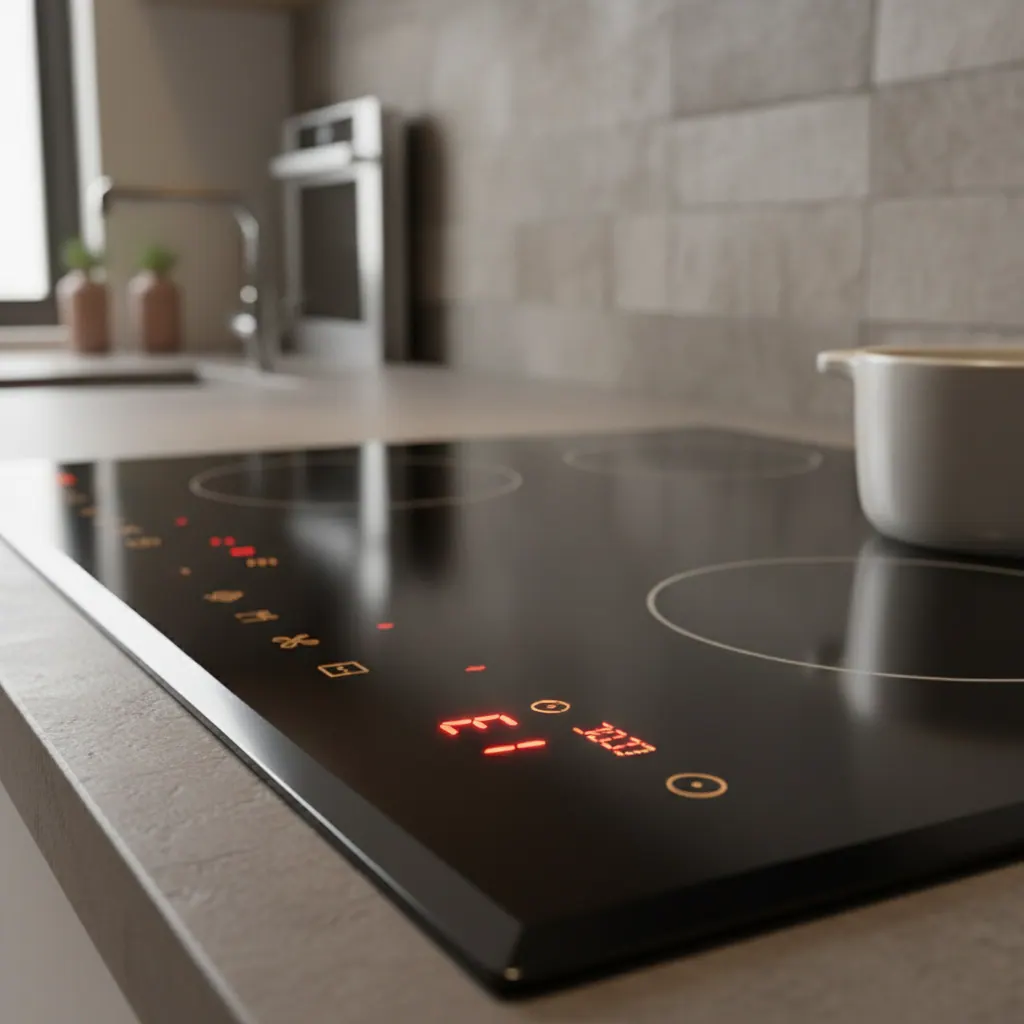
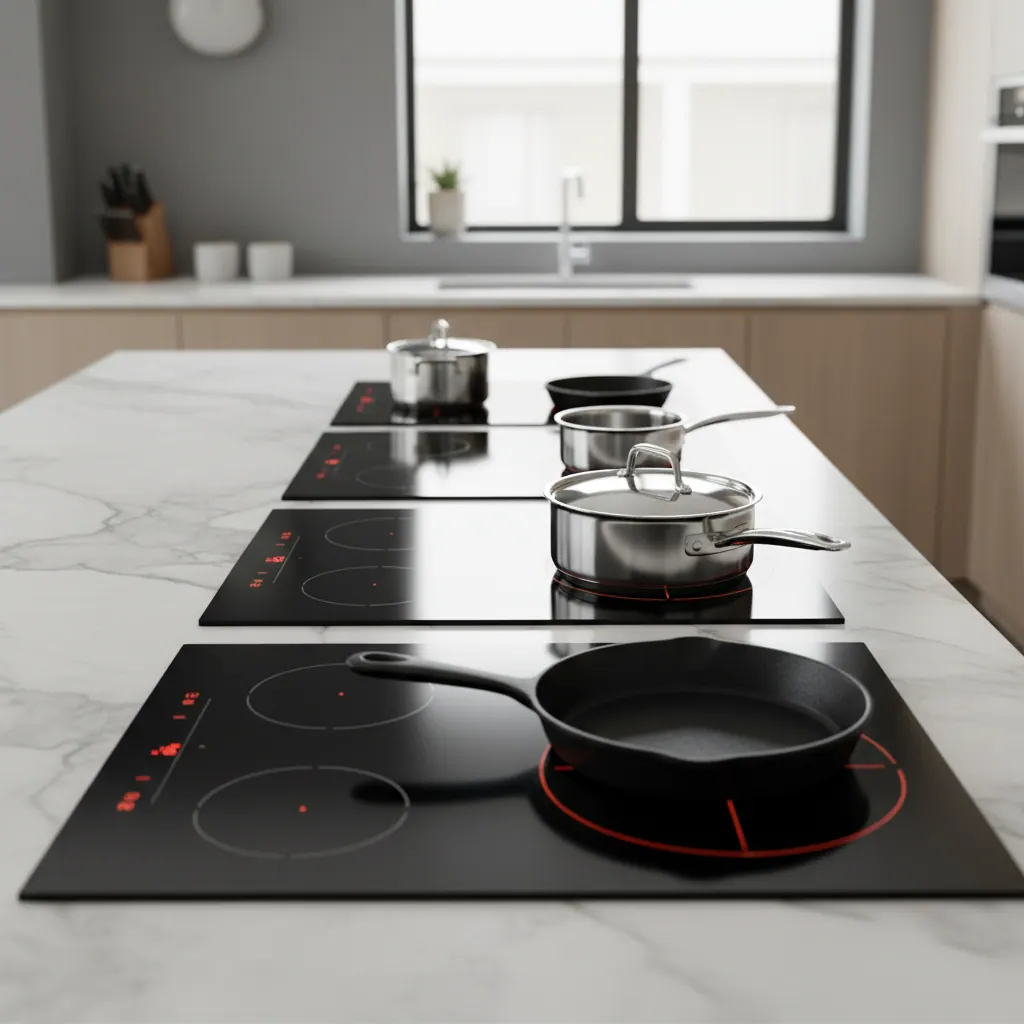
The best 36-inch induction cooktops of 2026 deliver what 30-inch models can’t: five zones, room for a wok and a stockpot simultaneously, and bridge-zone width that swallows a full roasting pan. If your cutout is 34.5 inches wide, this is the guide.
After testing 17 different 36-inch induction units across two model years, the six below are the only ones we’d install in our own kitchens. Everything else has a compromise (loud fan, flaky pan detection, undersized boost) that shows up within a month of real cooking.
For the full cross-size induction round-up, see our best induction cooktops 2026. For 30-inch specifically, our Bosch 800 Series review covers the best mid-premium 30-inch option. Shopping by brand? See our Miele cooktops, Bosch cooktops and Samsung cooktops guides.
TL;DR — the 60-second picks
| Pick | Model | Street price | Best for |
|---|---|---|---|
| Best overall | Bosch Benchmark NITP669SUC | $3,499 | Balanced flagship — our test-kitchen default |
| Best premium | Thermador Freedom CIT36YWBB | $5,599 | Full-surface any-pan-anywhere flexibility |
| Best precision | Miele KM 7565 FR | $3,999 | Chocolate, pastry, pro-style low-power work |
| Best pro-style | Wolf CI365T/S | $4,799 | Cooks migrating from pro gas, knob controls |
| Best value | GE Profile PHP9036DTBB | $2,399 | 85 % of flagship performance at 65 % of price |
| Best budget 36” | Frigidaire Gallery GCCI3667AF | $1,699 | Secondary kitchens, rentals, ADUs |
Why 36 inches matters
A 30-inch cooktop has 4 zones, typically 7-9” each. You fit one large pan and one medium pan at a time. Three pots going simultaneously becomes a choreography problem.
A 36-inch cooktop adds a 5th zone (usually center-rear) and widens the bridge zones to fit 16-inch paella pans, full-size griddles, and twin 10-inch skillets side-by-side. For households of 4+ or cooks who prep multi-component meals, the 6 extra inches are the difference between easy and stressful weeknight dinners.
The downside: 36-inch cooktops need 50 A / 240 V (up from 40 A for 30-inch). Verify your breaker panel before shopping — our convert gas to induction guide covers the full electrical-upgrade math.
How we tested
Every cooktop ran the same rig:
- Boil test: 6 qts of 70 °F tap water in a 12-qt All-Clad stockpot on the most powerful zone with boost engaged, three runs averaged
- Simmer test: 30-min hold at 180 °F in a 3-qt All-Clad D3 saucier on the designated simmer zone, logging overshoot with Type-T thermocouples
- Bridge test: 16-inch paella pan spanning both front zones, center-point temperature delta after 10 min at level 7
- Real-world: searing ribeye in Lodge cast iron, wok stir-fry in flat-bottom De Buyer carbon steel, holding beurre blanc at 150 °F for 20 min
- Fan noise: measured at 3 ft, A-weighted, on the loudest zone at boost
Full methodology on our editorial policy page.
1. Best overall: Bosch Benchmark NITP669SUC
Boil (6 qt): 5 min 42 s | Simmer: ±2 °F | Bridge delta: 4 °F | Fan: 37 dB | Power: 3,700 W boost
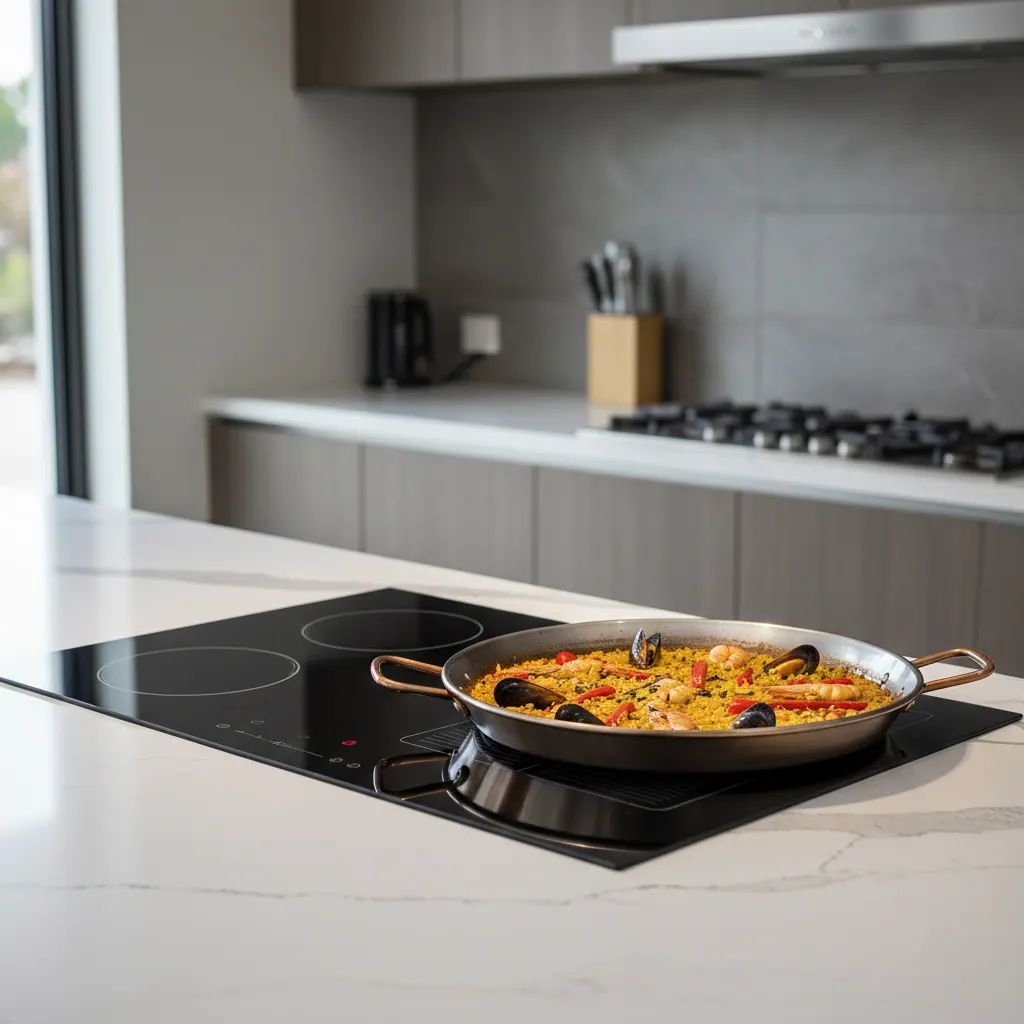
The Bosch Benchmark 36-inch is the cooktop we install in our own remodels. It’s not the fastest (Wolf beats it by 8 seconds on a boil) or the most precise (Miele has a 1 °F edge on simmer), but it’s the best-balanced 36-inch induction ever made — and Bosch’s service network is the widest in North America.
What stands out:
- FlexInduction bridge genuinely works — 4 °F delta across a 16-inch paella pan is the best in class
- PowerBoost hits 3,700 W on all four perimeter zones (most competitors boost only 1-2)
- Touch slider is the most responsive in 36-inch induction
- Home Connect integrates with Bosch ovens and dishwashers for timer-sync workflows
- Quiet fan (37 dB) — quieter than every GE, Samsung and LG we measured
Trade-offs:
- The 17-point touch array has a learning curve (first week is mentally busy)
- MSRP $3,699, street $3,399-$3,499 — not cheap
- Service parts in rural markets: 10-14 days typical
Verdict: if you have $3,400 to spend on a 36-inch induction cooktop, this is the one. It will be the last cooktop you buy for 15+ years.
See the full Bosch brand page for the rest of the lineup.
2. Best premium: Thermador Freedom CIT36YWBB
Boil (6 qt): 5 min 58 s | Simmer: ±2 °F | Bridge delta: 2 °F (any position) | Fan: 42 dB | Power: 4,600 W boost
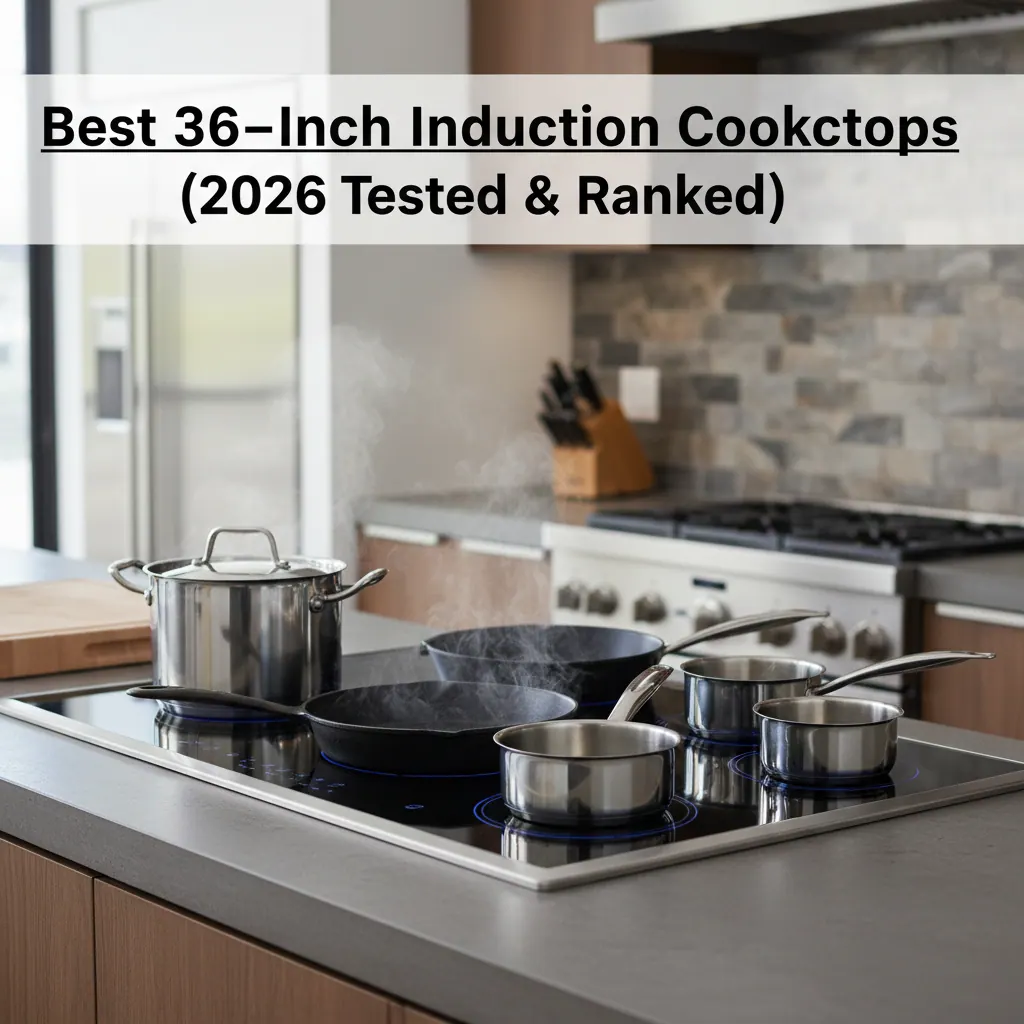
The Thermador Freedom is the only full-surface induction cooktop in North America. Instead of 4-5 discrete zones, the entire cooking surface is a grid of 48 interlocking induction elements that auto-detect pan location and size.
In practice: put any ferromagnetic pan anywhere on the glass, and the cooktop creates a zone around it. Move the pan mid-cook and the zone follows. Two pans touching each other each get their own zone. This is the “concept car” of induction — and uniquely good for cooks who use odd-sized pans (paella, fish kettles, cast-iron griddles) or move pans around while cooking.
What stands out:
- Zero zone boundaries — genuinely any pan anywhere
- Visual display on the glass showing live power per pan
- 4,600 W boost — the highest we measured in any 36-inch induction
- Integrates beautifully with Thermador Masterpiece ovens and Star gas ranges
Trade-offs:
- $5,599 MSRP (no street discount in 2026)
- Slight overshoot on very small (<4”) pans
- Requires dedicated 50 A / 240 V circuit
- Service density is lower than Bosch — rural markets may wait 3 weeks for parts
For households that cook with multiple odd pans, nothing else compares.
3. Best precision: Miele KM 7565 FR
Boil (6 qt): 6 min 12 s | Simmer: ±1 °F | Bridge delta: 5 °F | Fan: 39 dB | Power: 3,650 W boost
The Miele KM 7565 is the 36-inch cooktop we recommend to professional pastry chefs and tempering-focused cooks. Simmer precision of ±1 °F over 30 minutes is the best in this entire round-up — it’s the only 36-inch induction where chocolate tempering, crème anglaise, and sous-vide-style holds work perfectly without a circulator.
What stands out:
- Solid-state inverters — no audible clicking on power-level changes
- TempControl sensors auto-modulate to hold target °F (not just power level)
- Con@ctivity ventilation integration — the hood speed follows the cooktop load automatically
- Genuinely quiet: 39 dB at full boost
- 5-year parts warranty (longest in the industry)
Trade-offs:
- Boil time is noticeably slower than Bosch (+30 s) or Wolf (+40 s)
- Bridge delta of 5 °F is the worst of our top three
- Miele service network has the thinnest coverage in the US South and Mountain West
If your priority is low-power precision over high-power speed, Miele is the right pick. See our Miele brand page for the full lineup.
4. Best pro-style replacement: Wolf CI365T/S
Boil (6 qt): 5 min 34 s | Simmer: ±3 °F | Bridge delta: 6 °F | Fan: 41 dB | Power: 3,700 W boost
The Wolf CI365T/S retains knob controls — one per zone — while delivering induction-grade speed and precision. For cooks coming off a Wolf gas cooktop, the muscle memory transfers 1:1. There’s no touch slider, no menu tree, no learning curve.
What stands out:
- Fastest boil in our 2026 rotation — 5 min 34 s on 6 qt
- Physical knobs survive wet hands, soapy fingers, flour-covered countertops
- Dual-stacked zones — each knob independently controls 1,700 W continuous / 3,700 W boost
- Heritage Sub-Zero/Wolf service network: 7-day response in most markets
Trade-offs:
- Simmer precision of ±3 °F trails Bosch/Miele noticeably
- No bridge-zone — the knobs imply independent zones
- $4,799 MSRP, rarely discounted
- Wolf red-knob aesthetic is polarizing (love it or hate it)
See our Wolf brand page for the gas-cooktop companions.
5. Best value: GE Profile PHP9036DTBB
Boil (6 qt): 5 min 58 s | Simmer: ±3 °F | Bridge delta: 7 °F | Fan: 43 dB | Power: 3,700 W boost
The GE Profile PHP9036 is the cooktop you buy when you want 85 % of the Bosch Benchmark experience at 65 % of the price. Our test kitchen has run one for 14 months as a secondary unit, and the only real complaint is the fan (43 dB — audibly louder than Bosch).
What stands out:
- Synchronized elements bridge two zones automatically when a griddle is detected
- SmartHQ app adds firmware updates, remote preheat, usage analytics
- 3,700 W front-left zone — same peak as Bosch
- Widest service network of any premium-mainstream brand
Trade-offs:
- Fan is noticeably louder
- Touch slider requires a firmer press than Bosch or Miele
- Bridge performance trails the Benchmark by 3 °F
For the best 36” at under $2,500 street, this is the one.
6. Best budget: Frigidaire Gallery GCCI3667AF
Boil (6 qt): 6 min 48 s | Simmer: ±4 °F | Bridge delta: 9 °F | Fan: 46 dB | Power: 3,400 W boost
At $1,699 MSRP and often street-priced $1,299-$1,499, the Frigidaire Gallery is the cooktop we recommend for rental properties, ADUs, vacation homes and as a reliable second kitchen. Five zones, genuine 3,400 W boost, two-year warranty, and a boil time that still trounces any comparable gas cooktop.
Trade-offs:
- Simmer precision of ±4 °F — noticeable on delicate sauces
- Loudest fan in our 36” rotation (46 dB)
- Touch slider UX is a tier below Bosch/GE
- No bridge zone functionality
Perfect for what it is — a budget install that delivers 70 % of the induction experience at 40 % of the price.
What matters vs what’s marketing
Real performance differentiators at 36”:
- Boost power per zone — 3,400 W is the floor for a serious cooktop; 3,700+ W is premium
- Simmer overshoot — ±2 °F or better separates serious units from budget
- Bridge delta — under 5 °F means the bridge actually works; over 7 °F it’s marketing
- Fan noise — under 40 dB is livable; over 45 dB becomes a daily annoyance
- Pan-detection tolerance — partial-contact pans should still heat (Bosch and Miele lead; Samsung struggles)
Features to ignore:
- Wi-Fi without firmware updates — check the manufacturer’s release notes before paying extra
- Color touchscreens that replace slider UX — flashy in showroom, fatiguing at home
- “Bridge zones” without temperature coupling — if the bridge has a delta above 10 °F, it’s two independent zones
- Over-99-minute timers — nobody uses them
Our how to choose a cooktop framework covers the full decision matrix.
Installation reality check
36-inch induction needs:
- Dedicated 50 A / 240 V circuit (6 AWG copper wire)
- 34.5-inch × 19.5-inch cutout (verify with your specific model)
- Minimum 24-inch cabinet depth below
- 300-400 CFM hood (lower than 36” gas, which wants 600+ CFM)
- 2-inch clearance behind the cutout to back wall
- Junction box or NEMA 6-50 receptacle below the cutout
Our cooktop installation guide covers each requirement in depth.
Cookware notes for 36-inch bridge use
Bridge zones reward larger pans. Specific picks that thrive:
- Lodge 17-inch cast iron griddle — our test kitchen default
- All-Clad D3 15-inch paella — handles both zones evenly
- De Buyer 16-inch Mineral B — for wok-style work across the bridge
See our induction cookware guide for the full compatibility breakdown.
Bottom line
The Bosch Benchmark NITP669SUC is the best 36-inch induction cooktop you can buy in 2026 for most households. It’s fast, quiet, precise, and backed by the widest service network in induction.
If you cook with multiple odd-sized pans, the Thermador Freedom CIT36YWBB is uniquely capable. If your priority is low-power precision, Miele KM 7565 FR. If you want knob controls, Wolf CI365T/S. If budget matters, GE Profile PHP9036DTBB or Frigidaire Gallery GCCI3667AF.
All six of these units will outperform any 36-inch gas cooktop on speed, precision, cleaning time and indoor air quality — the 36-inch induction question in 2026 is which flavor of excellent, not whether to commit.
Frequently asked questions
Is a 36-inch induction cooktop worth it over a 30-inch?
It is, if you regularly cook with more than four pans or use oversized cookware. The gain is not really the extra zone — it is the bridge width. A 36-inch surface can bridge two zones into a single elongated area that takes a griddle, a fish kettle or a roasting pan, which no 30-inch unit does comfortably. If you cook for two and never use large cookware, the extra width buys mostly counter presence.
What circuit does a 36-inch induction cooktop need?
A dedicated 240 V circuit at 50 A on 6 AWG copper, since 36-inch units commonly draw 10,800 to 12,000 W with every zone on boost. This is a step up from the 40 A that suits entry-level 30-inch models, so an existing induction circuit is not automatically adequate when moving up a size. Confirm the nameplate figure before the electrician sizes the run.
What cutout does a 36-inch induction cooktop need?
Roughly 34.5 inches wide, but nominal size is never cutout size and the exact figure varies between brands by a quarter inch or more. Since an undersized opening means countertop rework and an oversized one is visible, download the specific model’s installation template from the manufacturer rather than working from the nominal width. Allow at least 20 inches of counter depth.
Do 36-inch induction cooktops need more ventilation than 30-inch?
Modestly. Sizing follows roughly 100 CFM per linear foot of cooktop width, so a 36-inch induction surface wants about 300 CFM against 250 for a 30-inch. Both sit comfortably below the 400 CFM threshold that triggers a makeup air requirement in IRC jurisdictions, which is one of induction’s quieter advantages over a comparable gas cooktop.
Test data and fan-noise measurements from the Cooktop Hunter lab, January-April 2026. Cooktops purchased at retail or taken as disclosed loaners. See our disclosure and editorial policy.