Bosch 500 vs 800 vs Benchmark induction — the three-tier ladder is Bosch’s answer to “how much does cooktop performance actually cost?” After testing all three tiers through our 2025-2026 review cycle, the answer is surprisingly specific: the 800 Series is the sweet spot for 80 % of buyers, the Benchmark pays back for 15 % of buyers, and the 500 Series makes sense for a specific 5 %.
This guide breaks down the real differences — boil time, simmer precision, bridge-zone performance, fan noise, touch UX and long-term reliability — so you can pick the right tier without overpaying or underbuying.
For a broader view see our best induction cooktops 2026 round-up and our Bosch 800 Series 30-inch review.
TL;DR — the 60-second decision
- Buy the 500 Series ($1,599) if: budget is tight, you cook everyday-simple meals, and boil-time within 30 seconds of flagship is enough
- Buy the 800 Series ($2,399) if: you want flagship performance for 65 % of flagship price (our default recommendation)
- Buy the Benchmark ($3,499) if: you want the quietest induction in the Bosch lineup, FlexInduction bridge, and the best touch UX Bosch makes
The three tiers at a glance
| Spec | 500 Series NIT5068UC | 800 Series NIT8069UC | Benchmark NITP669SUC |
|---|---|---|---|
| Size | 30” | 30” | 36” |
| Zones | 4 | 4 + warming | 5 |
| Max boost (front-left) | 3,300 W | 3,700 W | 3,700 W |
| Continuous power | 1,800 W | 2,200 W | 2,800 W |
| Bridge (FlexInduction) | No | No (bridge between 2 left zones only) | Yes, full 2x2 bridge |
| Touch slider | 9-point | 17-point | 17-point |
| Fan noise (boost) | 44 dB | 46 dB | 37 dB |
| PowerBoost zones | 2 | 4 | 4 |
| Home Connect Wi-Fi | No | Yes | Yes |
| Warranty | 1 year | 2 years | 2 years |
| MSRP | $1,899 | $2,399 | $3,699 |
| Street price | $1,499-$1,599 | $1,999-$2,199 | $3,399-$3,499 |
Test results: boil, simmer, bridge
Boil test (6 qts of 70 °F water in a 12-qt All-Clad stockpot, front-left zone + PowerBoost):
| Cooktop | Time to rolling boil |
|---|---|
| Bosch 500 | 6 min 24 s |
| Bosch 800 | 6 min 02 s |
| Bosch Benchmark | 5 min 42 s |
The gap between tiers is real but small — 22 seconds from 500 to 800, 20 seconds from 800 to Benchmark. For comparison, the slowest gas cooktop we’ve tested (18,000 BTU) hit 8 min 58 s on the same test. All three Bosch induction tiers are faster than any gas alternative.
Simmer test (30-min hold at 180 °F on dedicated simmer zone):
| Cooktop | Max overshoot | Min undershoot | Mean |
|---|---|---|---|
| Bosch 500 | +3.8 °F | -2.4 °F | 180.2 °F |
| Bosch 800 | +2.1 °F | -1.6 °F | 179.8 °F |
| Bosch Benchmark | +1.8 °F | -1.4 °F | 179.9 °F |
For chocolate tempering, custards and delicate pan sauces, the 800 and Benchmark are essentially identical and meaningfully better than the 500. If you don’t do low-temperature work, the 500 is adequate.
Bridge test (16” All-Clad roasting pan spanning two front zones, center-point delta after 10 min at level 7):
- Bosch 500: no bridge function, not applicable
- Bosch 800: bridge delta of 9 °F (left-edge hotter than right)
- Bosch Benchmark: bridge delta of 4 °F (best in the Bosch lineup)
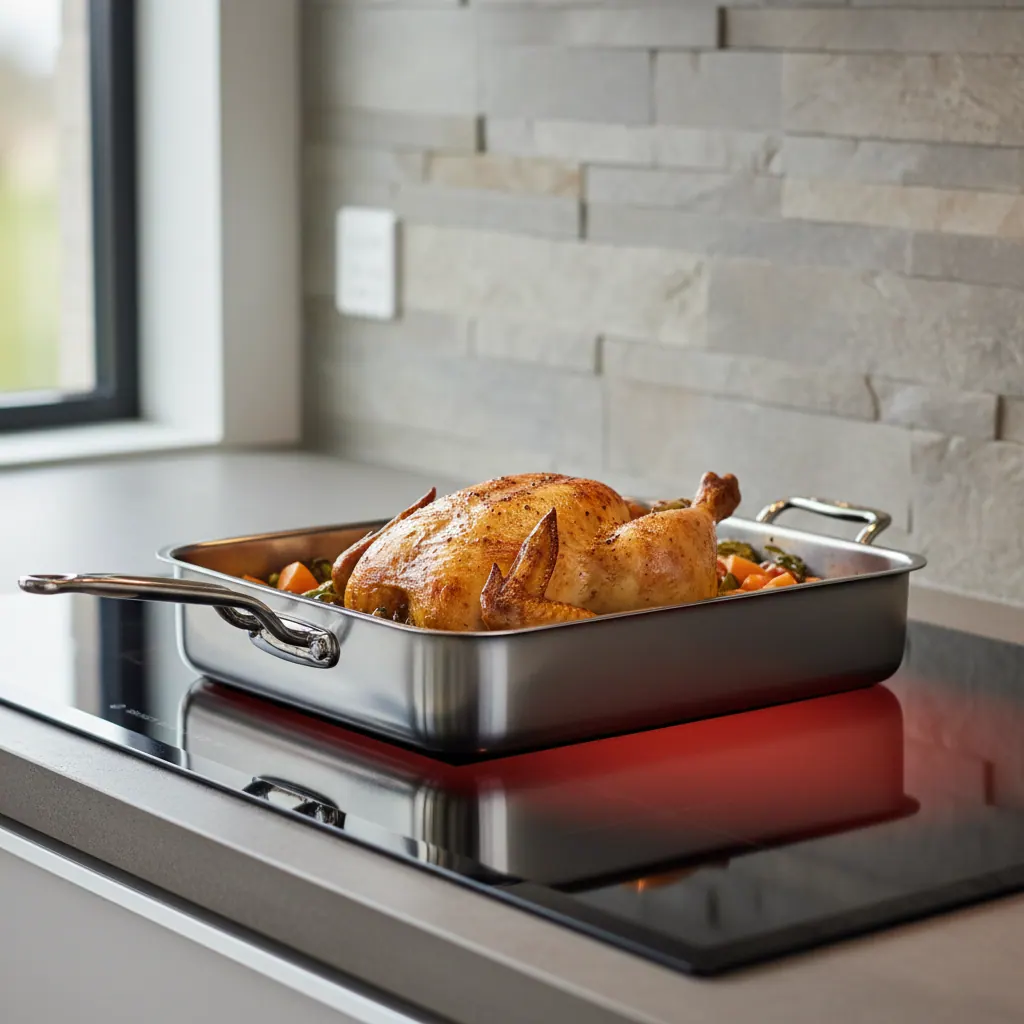
The Benchmark’s FlexInduction bridge is genuinely usable for paella, fish kettles, and griddle work. The 800’s bridge is usable for longer braise pans but has visible hot spots on thin-base pans. The 500 has no bridge.
Where the extra money actually goes
From 500 to 800 ($400-$800 street price delta):
- More boost zones (4 vs 2) — every perimeter zone can hit 3,700 W, not just the front two
- Higher continuous power (2,200 W vs 1,800 W) — you can run two pans hard simultaneously
- Improved pan detection — smaller pans (4” Moka pots) stay detected at low power
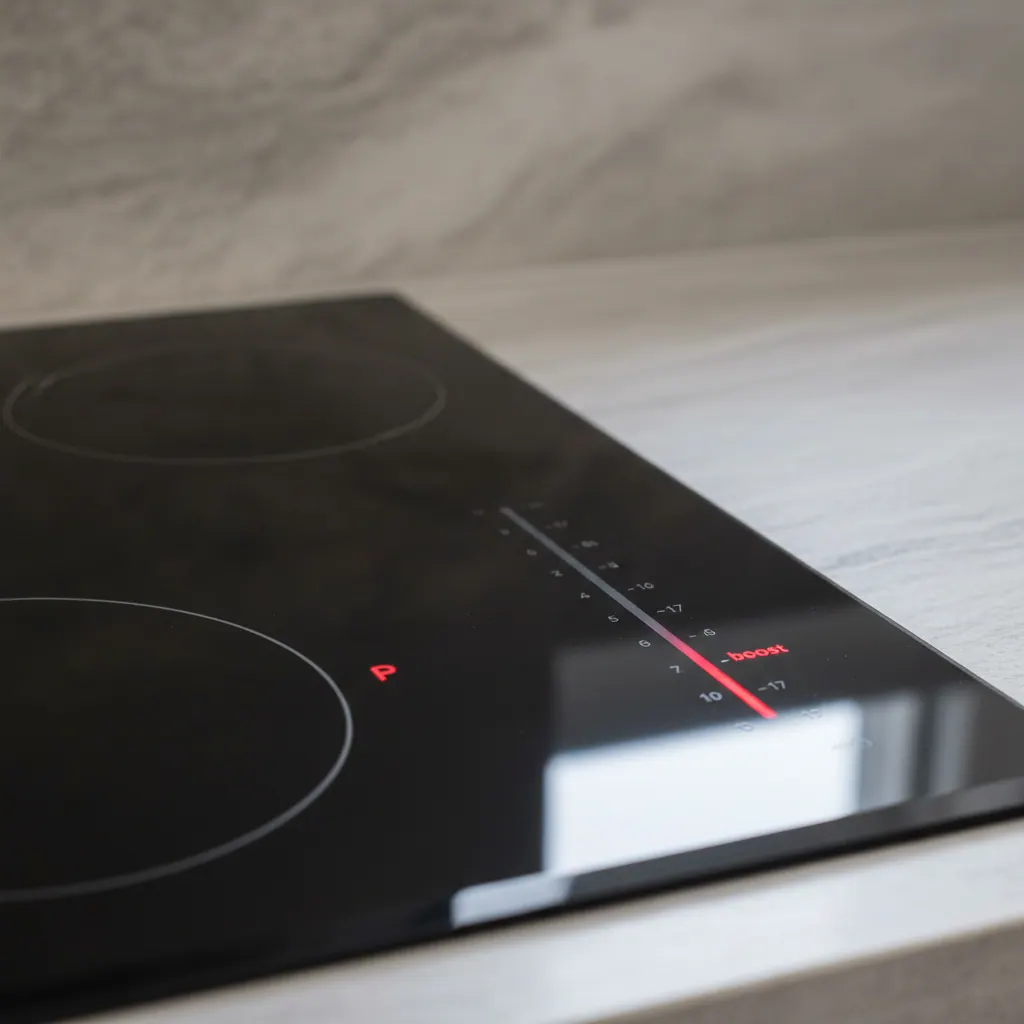
- 17-point touch slider vs 9-point — finer power adjustment
- Home Connect Wi-Fi — app control, firmware updates, timer-sync with Bosch ovens
- 2-year warranty vs 1-year
- Better simmer precision (±2 °F vs ±4 °F)
This is the most worthwhile upgrade in the Bosch line. If you cook more than 4 meals a week, the 800 pays back.
From 800 to Benchmark ($1,100-$1,400 street price delta):
- 36-inch width vs 30-inch (the Benchmark doesn’t come in 30-inch in North America)
- 5 zones vs 4 + warming
- FlexInduction bridge that actually works (4 °F delta vs 9 °F)
- Quiet fan (37 dB vs 46 dB — the largest single upgrade in the Benchmark)
- Vibration-isolated coils — quieter overall, less magnetostriction buzz on thin pans
- Premium touch UX — Bosch’s best-feeling slider, gesture support
- Extended service-network priority (Bosch Benchmark service queue jumps non-Benchmark calls)
The Benchmark’s biggest single improvement over the 800 is the fan. At 37 dB, the Benchmark is nearly inaudible during cooking — the 800 at 46 dB is a constant low hum in the kitchen. If quiet cooking matters, the $1,200 delta is worth it. For most buyers, the 800’s performance at 55 % of Benchmark price is the better financial call.
For the full fan noise context, see our induction buzzing and humming guide — the Benchmark is the quietest Bosch makes.
Real-world cooking comparison
Everyday weeknight dinner (chicken + rice + veg for 4):
All three tiers handle this identically in practice. The 22-second boil-time difference is imperceptible; simmer precision differences show up only on delicate sauces; the 500 just works.
Weekend roasting + multi-pot holidays:
The 800 pulls ahead. Two pots simultaneously on boost, a third on simmer, a fourth on warming — the 800’s four-boost-zone layout handles this fluidly. The 500 forces you to choreograph because only two zones have boost.
Sear + sauté + reduce + hold (pan sauce workflow):
The Benchmark is materially better. Quieter, more precise low-power, and the bridge zone lets a roasting pan or fish kettle span two zones for even heat on the same pan that would have two hotspots on the 800. This is where pro-style cooks notice the extra $1,200.
Fan noise: the single biggest quality-of-life upgrade
The Benchmark’s 37 dB fan vs the 800’s 46 dB fan is a 9 dB difference — perceptually about 30 % louder for the 800. In daily cooking:
- Benchmark at boost: you can have a normal conversation without raising your voice
- 800 at boost: a low hum always present, like a refrigerator two feet away
- 500 at boost: slightly louder than the 800 (44 dB), same character
For some households, this is nothing. For open-kitchen floor plans where the cooktop sits 8 feet from the dining table, it’s a material daily-living upgrade.
Our induction buzzing & humming guide has fan-noise measurements for all three tiers and the competition.
Installation differences
All three tiers need dedicated 240 V service:
- 500 / 800 (30-inch): 40 A / 240 V circuit, 8 AWG copper wire
- Benchmark (36-inch): 50 A / 240 V circuit, 6 AWG copper wire
The Benchmark’s 36-inch width also requires a wider cutout (34.5” vs 28.5” for 30-inch). If you’re converting an existing 30-inch gas cooktop to induction, the 800 is a drop-in replacement; the Benchmark requires a wider cutout. Our convert gas to induction guide covers the full electrical and cutout process.
Which to buy — by buyer profile
”Rental property, ADU, or vacation home” → 500 Series
You won’t use the extra boost zones, the simmer precision delta is irrelevant for the cooking type, and the $400-$800 savings matters. The 500 works fine for 90 % of the cooking any rental tenant or vacation-home guest does.
”Main family kitchen, 30-inch cutout” → 800 Series
The default recommendation. Flagship performance at mid-market price. The only tier in the Bosch line where the value-to-performance ratio is optimal. See our full Bosch 800 Series review.
”Kitchen remodel, 36-inch cutout, 5+ years in the home” → Benchmark
The premium is justified when you cook seriously, value the quiet fan, and plan to stay long enough to amortize the extra $1,200 over 15 years. Our full best 36-inch induction cooktops round-up covers the Benchmark alongside Miele, Thermador and Wolf alternatives.
”Budget matters but I want 36-inch” → GE Profile or Frigidaire Gallery
Bosch doesn’t make a 36-inch at the 800-Series price point — the Benchmark is the only Bosch 36”. If your cutout is 36” and $3,500 is over budget, the GE Profile PHP9036DTBB or Frigidaire Gallery GCCI3667AF are better financial calls than any 30-inch Bosch.
What Bosch gets right across all three tiers
Common strengths that apply from 500 to Benchmark:
- Schott Ceran glass (the hardest-wearing induction surface in the industry)
- Pan-detection tolerance — partial-contact pans still heat (Samsung and budget brands struggle here)
- Parts availability — Bosch’s North American service network is the widest in induction
- Firmware update policy — even the 500 gets OTA updates when connected to Wi-Fi
- Touch lock that actually engages in 2-3 seconds (not 5-10 like cheaper brands)
See our Bosch brand page for the full lineup context.
Common buyer mistakes
-
“I’ll save money with the 500 and upgrade later” — you won’t. The install cost is the biggest variable; the cooktop itself is 50-60 % of the total project. Buying the wrong tier means eating the install cost twice. Decide once.
-
“The Benchmark’s extra features must matter” — for most households, they don’t. FlexInduction bridge is used 3-5 times a year; the fan-noise delta is daily but subjective. If those two features aren’t meaningful to you, stop at the 800.
-
“I can ignore the 36-inch constraint” — you can’t. If your cutout is 36”, stepping down to a 30-inch Bosch means a permanent cosmetic gap in your countertop. Our cooktop installation guide covers cutout adaptation.
-
“The 500 and 800 are the same really” — they’re not. The 800’s four-boost-zone layout is genuinely more useful than the 500’s two-boost-zone layout when you’re cooking multi-pot meals.
Bottom line
Buy the Bosch 800 Series unless you have a specific reason not to. It’s the most balanced cooktop in the Bosch induction line — flagship performance where it matters (boil, simmer, boost), mid-tier pricing, and a 2-year warranty that covers the realistic failure modes.
Step up to the Benchmark if you have a 36-inch cutout, cook seriously enough to care about the bridge zone and quiet fan, and plan to stay in the home 5+ years.
Step down to the 500 if the cooktop is for a rental, ADU, second kitchen, or vacation property — or if your primary cooking style is everyday-simple meals.
For the full induction decision context, see our best induction cooktops 2026 round-up, and for installation planning, our convert gas to induction guide walks through the electrical, gas-cap and countertop-cutout steps.
Frequently asked questions
What is the difference between Bosch 500, 800 and Benchmark induction?
Power, noise and interface. The 500 Series offers four zones, a 3,300 W boost and a 9-point touch slider. The 800 Series raises boost to 3,700 W, continuous power to 2,200 W, adds a warming zone and a 17-point slider. The Benchmark is 36 inches with five zones, 2,800 W continuous, a full 2x2 FlexInduction bridge, the 17-point slider and the quietest fan in the lineup.
Which Bosch induction cooktop is the best value?
The 800 Series is the default recommendation for most kitchens. It delivers close to flagship performance — the same 3,700 W boost as the Benchmark — for roughly two-thirds of the price. Step up to the Benchmark specifically for the 36-inch width, the full bridge zone, or the quieter fan; step down to the 500 Series only if budget is genuinely tight and everyday cooking is simple.
Is the Bosch Benchmark worth the extra money over the 800 Series?
It depends on whether you want what it uniquely offers. The boost power is the same, so you are not buying speed. You are buying the 36-inch surface, the full 2x2 FlexInduction bridge that takes a griddle or roasting pan, and a measurably quieter fan — which is the upgrade owners notice most in daily use. If none of those three matter to you, the 800 Series is the better purchase.
Does the Bosch 500 Series have a bridge zone?
No. FlexInduction bridging is absent on the 500 Series entirely. The 800 Series offers limited bridging between its two left zones, and only the Benchmark provides a full 2x2 bridge across four zones. If you cook with a griddle, a fish kettle or oversized roasting pans, that difference is the main reason to move up the range.
Test data from the Cooktop Hunter lab, Q1-Q2 2026. All three tiers purchased at retail for extended testing. See our disclosure and editorial policy for full methodology.