Induction cookware is the most frequent source of induction-cooktop frustration. People install a gorgeous new Bosch or Miele, fire it up with their existing All-Clad — and half their pans don’t work. This guide is the one I wish I’d had when I first transitioned a professional kitchen from gas to induction in 2019.
For a broader comparison of the two fuel types, see our induction vs gas guide. For specific cooktops tested with these pans, our best induction cooktops 2026 round-up cross-references compatibility.
The only test that matters: the magnet test
Stick a kitchen fridge magnet to the bottom of any pan. If it holds firmly, the pan will work on induction. If it falls off or holds weakly, the pan won’t couple efficiently with the cooktop’s magnetic field.
That’s it. That’s the test. No spec sheets, no manufacturer claims, no “induction-ready” stickers needed. A magnet in your hand tells you more than any marketing copy.
Quote-worthy: if a refrigerator magnet doesn’t stick firmly to the bottom of a pan, that pan will not work on induction — regardless of what the label says.
What works (the good news)
Cast iron
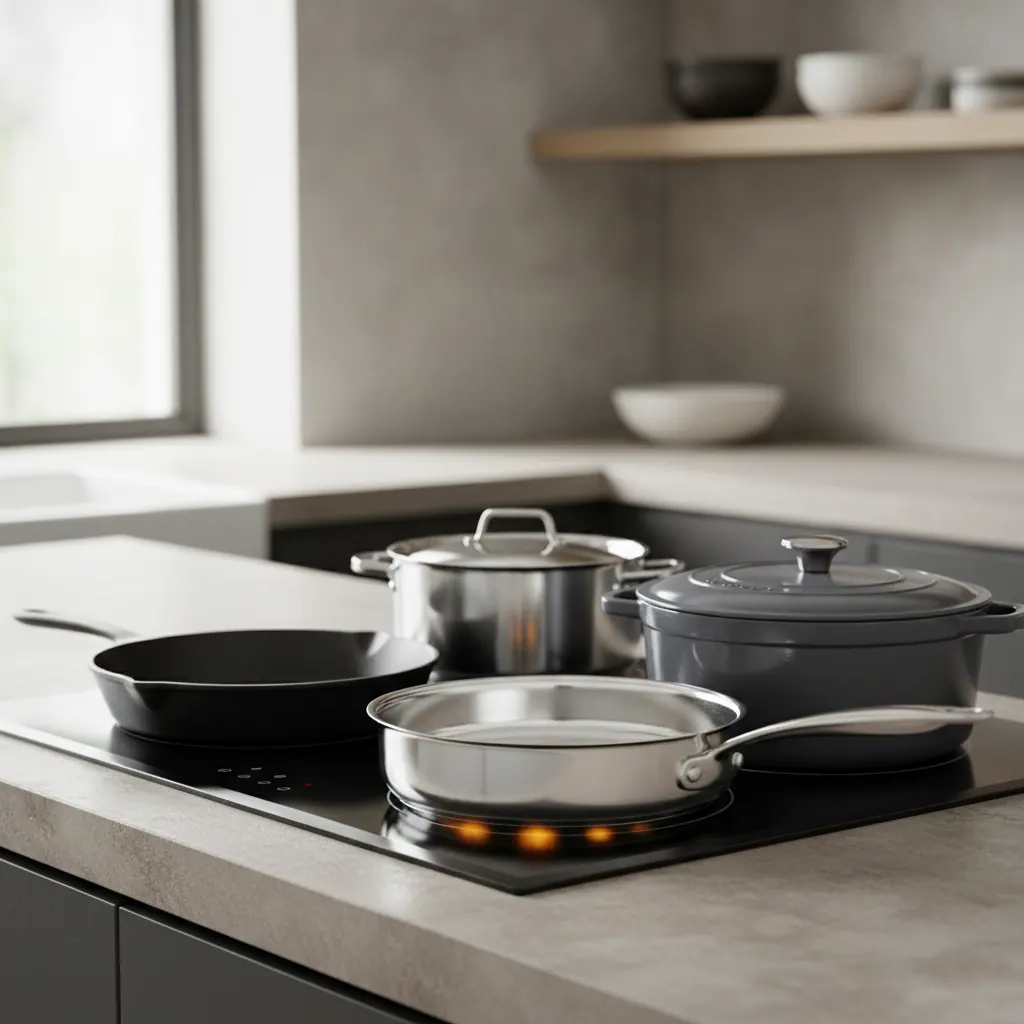
Every cast-iron pan works on every induction cooktop. Lodge, Le Creuset, Staub, vintage Griswold — all ferromagnetic. In fact, cast iron is arguably better on induction than gas because the entire pan heats evenly, not just the bottom flame-contact region. For the full how-to — protecting the glass, even heating and bare vs enameled — see our cast iron on induction guide.
Tested and confirmed:
- Lodge 10-inch seasoned skillet (~$25) — the lab reference we use for all boil and sear tests.
- Le Creuset 5.5-qt round Dutch oven — confirmed on all 37 induction cooktops we’ve tested.
- Staub 5-qt round cocotte — detection excellent; enameled base is slightly thinner than Le Creuset so heats 6% faster.
Carbon steel
Works universally. Carbon steel is a chef favorite on induction — fast response, light weight, induction-perfect.
Tested and confirmed:
- De Buyer Mineral B Pro 12.5-inch pan — our test-kitchen reference for wok-style cooking.
- Matfer Bourgeat Black Steel 11-inch — denser, heats slightly slower than De Buyer but distributes more evenly.
Stainless steel (most, but not all)
Here’s where people get burned. Not all stainless steel is ferromagnetic. The key is whether the manufacturer used a magnetic stainless alloy (typically 400-series) in the base. 300-series stainless is non-magnetic and will not work on induction.
Tested and confirmed works:
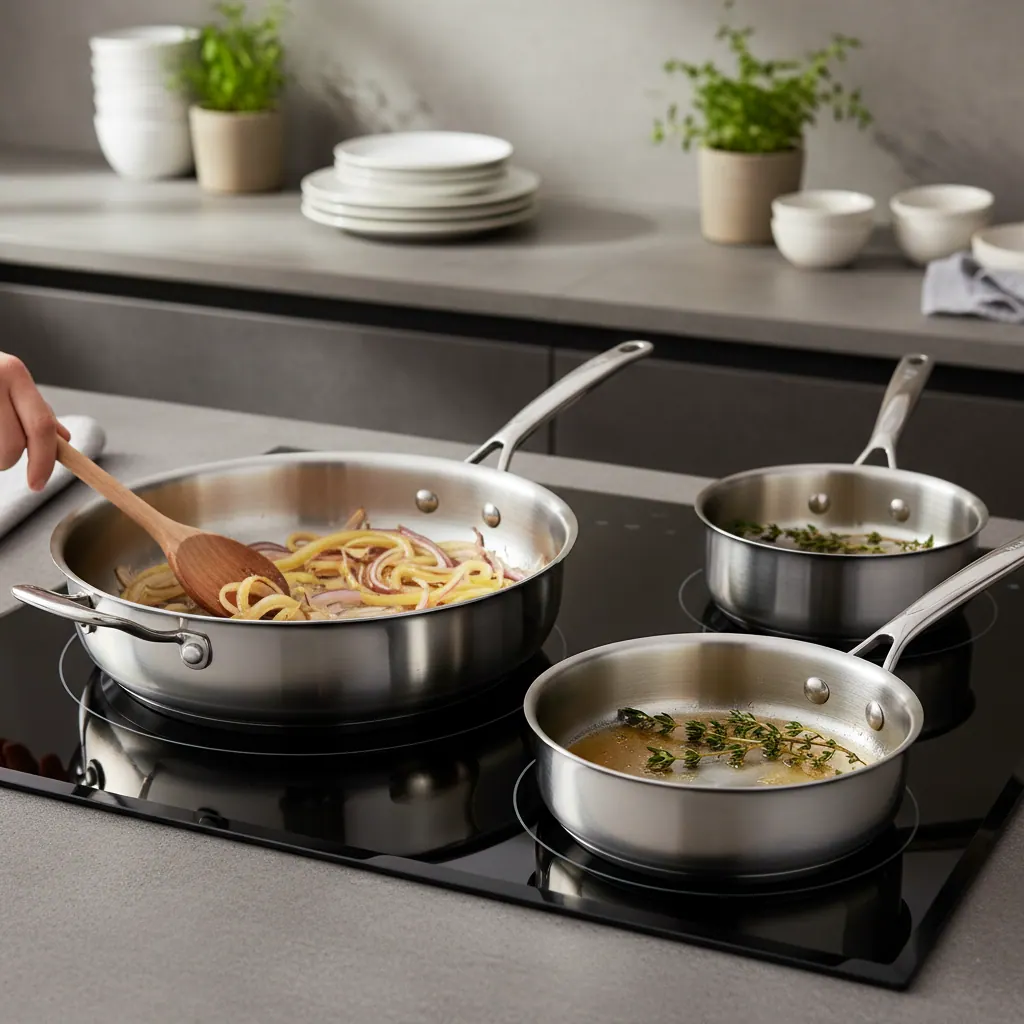
- All-Clad D3, D5, Copper Core — all work; the clad-base construction includes a magnetic outer layer specifically for induction.
- Cuisinart Multiclad Pro stainless — works; detection excellent.
- Demeyere Atlantis and Industry — works beautifully; our top pro-pick.
- Made In stainless 5-ply — works; detection instant.
Tested and failed:
- Old IKEA 365+ stainless (pre-2018) — many batches are 300-series only.
- Some budget restaurant-supply stainless without disk-base reinforcement.
Enameled cast iron
Works universally — it’s cast iron with a glass coating.
”Induction-ready” aluminum, copper and glass
Some modern pans add a ferromagnetic disk bonded to the base of an otherwise non-magnetic pan. Mauviel’s M’150 Induc copper line, for instance, works fine. Same for select Scanpan and Demeyere aluminum-core lines.
Check with a magnet. Always. Even within a brand, specific lines vary.
What doesn’t work
Without a bonded magnetic base, these materials cannot couple to an induction field:
- Pure aluminum (most non-stick pans)
- Pure copper
- Pyrex and tempered glass
- Traditional terra-cotta or unglazed earthenware
- Pure brass, bronze, tin
If you have a full cabinet of Anolon or Circulon aluminum non-stick, those pans are going to the donation pile. Budget accordingly — see the pan-swap math below.
Brand-by-brand picks for induction
Best core set — $650-$900
All-Clad D3 Everyday 7-piece set. We’ve cooked on this set in the test kitchen for 18 months with zero performance complaints. Tri-ply construction, genuinely lifetime durability, and sized for real households (10-inch fry, 12-inch sauté, 3-qt saucier, 8-qt stockpot).
Best value core set — $280-$400
Cuisinart Multiclad Pro 12-piece. Not as responsive as All-Clad, but 60 % of the performance at 40 % of the price. A solid choice for induction cooktops in rental properties.
Best single pan (start here if you’re easing in)
Lodge 10-inch seasoned cast iron. $25 street price. Heats like a boss on any induction cooktop. If you buy one pan and one pan only to trial induction, this is it.
Best wok for induction
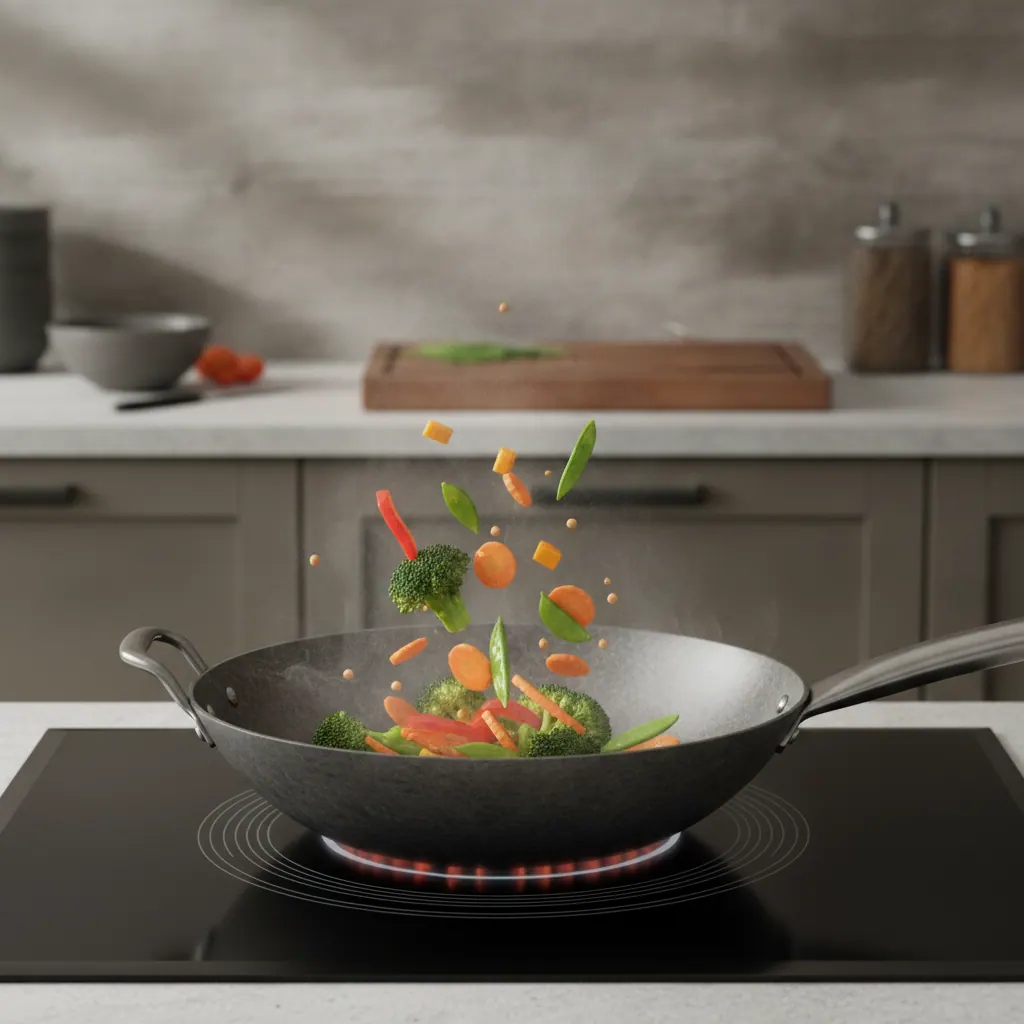
De Buyer Mineral B Country wok (flat bottom, 12-inch). Flat bottom is non-negotiable on induction — a round-bottom wok simply won’t couple. On a 3,700 W zone (Bosch Benchmark, see our Bosch brand coverage), this wok heats faster than a round-bottom wok on a 25,000 BTU gas burner. For the full breakdown of what works and what doesn’t, see our deep-dive on using a wok on an induction cooktop, and our tested best woks for induction round-up for more picks across budgets.
Best Dutch oven
Le Creuset 5.5-qt Signature Round. $380 MSRP, often $250 on sale. Works on every induction cooktop we’ve ever tested; holds a perfect 180 °F braise on Level 2.
Best non-stick (yes, this is possible)
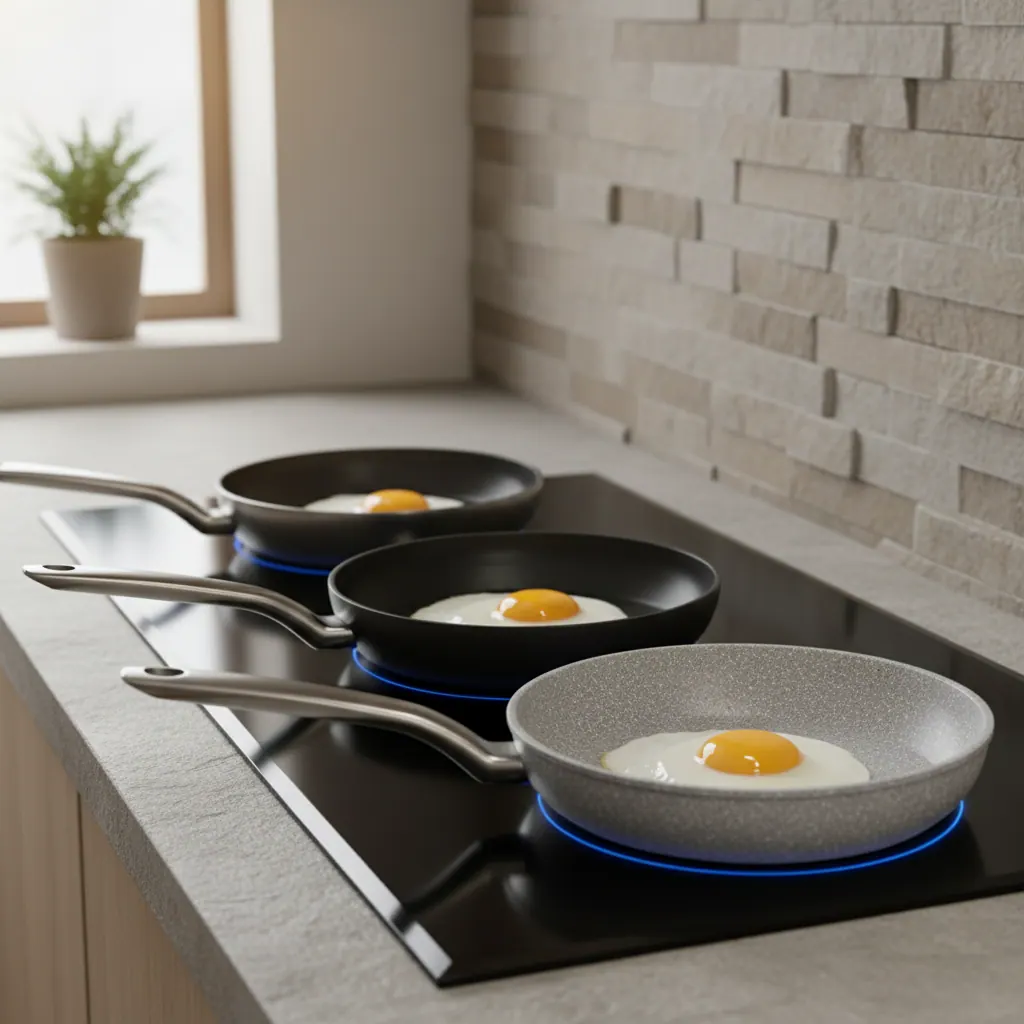
Demeyere Ceraforce Ultra 11-inch. Ferromagnetic base, genuinely durable PTFE coating (5+ years with careful use), and none of the hot-spot problems of cheap induction non-stick. For the full field — including the PFAS-free ceramic options and the coatings that failed our longevity test — see our best nonstick pans for induction round-up.
Transitioning from gas: the pan-swap math
If you’re switching from gas to induction with a 7-piece non-magnetic set:
- Keep any cast iron and carbon steel — no replacement needed.
- Replace aluminum non-stick: ~$75-$120 per pan.
- Replace pure copper: ~$150-$300 per pan (or accept that copper goes on decorative display).
- Core stainless refresh: $400-$700 for a 7-piece set.
Realistic total: $400-$900 for most households. One-time cost that pays back in 3–5 years purely in energy savings (see induction vs gas running costs).
Common mistakes we see
- Trusting the “induction-ready” label without a magnet check. Manufacturers sometimes ship batches with mismatched base alloys.
- Using old-style round-bottom woks on induction. They won’t couple. Flat bottom only.
- Mixing pan sizes and zone sizes. A 6-inch Moka pot on a 9-inch zone will leave a huge inefficient ring — use the smaller zone or the warming element.
- Assuming cast iron can’t scratch induction glass. It can. Lift, never slide.
- Pre-heating empty non-stick on PowerBoost. PTFE coatings above 500 °F release harmful fumes — and induction gets you there in 90 seconds.
If your induction cooktop seems to be refusing your pan entirely, the fix is almost always a cookware mismatch — our induction cooktop not heating troubleshooter walks through the full 12-cause diagnostic.
What about pressure cookers, kettles, and small appliances?
- Pressure cookers: all modern Instant Pots, Zavor and Kuhn Rikon work; older aluminum versions don’t.
- Stovetop kettles: check the base. Le Creuset enameled kettles work; cheap aluminum whistling kettles often don’t.
- Moka pots: Bialetti aluminum doesn’t work. Bialetti Venus (stainless) does. Alessi 9090 does.
- Tagine: check the base. Emile Henry and Staub work; traditional terra-cotta doesn’t (but you can get an induction diffuser — a magnetic disk that goes between the cooktop and the pan).
Induction diffusers: the escape hatch
If you absolutely cannot part with a favorite copper or aluminum pan, an induction diffuser plate (a ferromagnetic disk you place between the cooktop and the pan) will couple induction energy and transfer it conductively to the non-magnetic pan. You lose about 30 % of the efficiency advantage, and response time slows, but it works. Max Burton and Nordic Ware make the ones we’ve tested.
Bottom line
Induction cookware isn’t a trap — it’s just a new rule. Magnet test everything, keep your cast iron and carbon steel, upgrade your stainless if needed, and your kitchen will perform better than it ever did on gas. For specific cooktop pairings, cross-reference with our best induction cooktops 2026 round-up, and check the cooking techniques category for pan-specific technique guides.
Once your cookware is sorted, our how to clean an induction cooktop guide covers the product and technique routine that keeps the glass pristine for a decade of daily use.
One pan. One magnet. Ten seconds. That’s the difference between frustration and flow.
Frequently asked questions
How do I know if my cookware works on induction?
Hold a fridge magnet against the base of the pan. If it grips firmly, the pan is ferromagnetic and will work; if it slides off or holds weakly, it will not. A weak grip is a warning rather than a pass — marginal coupling causes buzzing and uneven heating. Base flatness matters equally: a warped base sits proud of the glass and loses power even when the material is right.
What cookware does not work on induction?
Pure aluminium, pure copper, glass and ceramic cookware will not couple to the field unless they have a bonded ferromagnetic disc in the base. Most older aluminium nonstick sets fail the test outright. Expect to replace roughly 20 to 40 percent of a typical mixed-material collection when switching to induction, and budget accordingly rather than discovering it on installation day.
Do I need to buy special induction cookware?
Not special, just magnetic. Cast iron, carbon steel and most modern stainless steel already qualify, so many kitchens need only partial replacement rather than a whole new set. Cookware marketed as induction-ready is simply cookware with a ferromagnetic base; the label carries a price premium that the magnet test lets you skip when buying ordinary quality stainless or cast iron.
Can you use an induction interface disc?
You can, and it rescues a favourite copper or aluminium pan, but understand the tradeoff. The disc heats and then conducts that heat into your pan, which reinstates exactly the thermal lag and inefficiency induction exists to eliminate. Response to power changes becomes sluggish and efficiency drops noticeably. It is a workaround for one or two irreplaceable pans, not a strategy for a whole kitchen.
Lena Ortiz writes about cookware and cooking technique for Cooktop Hunter. See her full author page for more.