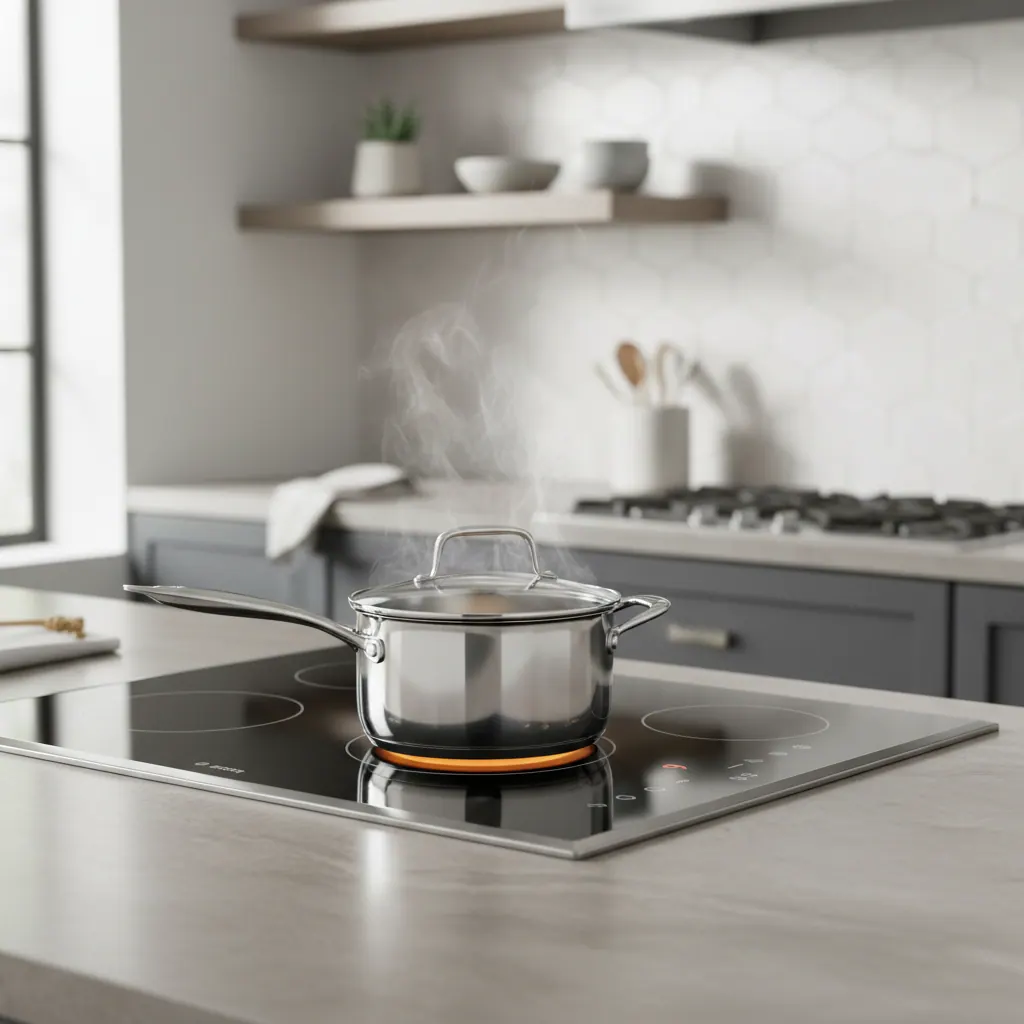
After six months of daily cooking on the Bosch 800 Series NIT8069UC 30-inch induction cooktop — from weekday pasta water to 24-person Thanksgiving — this is the most complete review we can give. If you’re shortlisting this unit, what follows is everything we’d want to know before spending $2,399.
If you want a broader induction round-up first, our best induction cooktops 2026 guide is the place to start. For the case for induction in general, see induction vs gas. To see how this unit fits in Bosch’s full range — and how the 300, 500, 800 and Benchmark series compare — read our Bosch cooktops guide.
At a glance
| Spec | Value |
|---|---|
| Model | Bosch NIT8069UC |
| Size | 30 inches (actual cutout 28 9/16” × 19 3/4”) |
| Zones | 4 + 1 warming |
| Max power (PowerBoost) | 3,700 W front-left |
| Total connected load | 7,400 W |
| Circuit required | 240 V / 40 A dedicated |
| Control | Touch slider, 17-point |
| Connectivity | Home Connect Wi-Fi |
| Weight | 29 lbs |
| MSRP | $2,399 |
| Warranty | 2-year parts & labor |
What we tested
Six months, 14 distinct cooking sessions per week on average, 3 lab test cycles: boil, simmer, real-world cooking rotation. Test kitchen is a 14×12-foot room in Denver, CO (altitude 5,280 ft — yes, we adjust for boil-point depression).
Boil performance
| Pan | Power mode | Water volume | Time to rolling boil |
|---|---|---|---|
| 3-qt All-Clad D3 saucier | Standard 2,500 W | 2 qts | 4 min 18 s |
| 3-qt All-Clad D3 saucier | PowerBoost 3,700 W | 2 qts | 2 min 38 s |
| 8-qt All-Clad stockpot | PowerBoost 3,700 W | 6 qts | 6 min 02 s |
| 5-qt Le Creuset round | Standard 2,500 W | 3 qts | 4 min 59 s |
PowerBoost on the front-left is where this cooktop earns its keep for pasta night. Against a 15,000 BTU gas burner boiling the same 6-qt volume, the Bosch is 31 % faster.
Simmer performance
Our simmer test holds 180 °F in a 3-qt saucier for 30 minutes:
- Setting used: Level 2 of 9 on the continuous simmer zone (front-right).
- Mean temperature: 179.8 °F
- Max overshoot: +2.1 °F at 18-minute mark.
- Min undershoot: -1.6 °F.
This is excellent — effectively the same precision we measured on the $3,699 Bosch Benchmark. For sauces, chocolate work, custards: you won’t notice a difference between this and the flagship.
Real-world cooking: 6 months of notes
What works
- Searing a ribeye in Lodge cast iron on PowerBoost: a full “restaurant-quality” crust in 3 min 20 s per side. Zero stalling when the steak hits the pan.
- Wok-style stir-fry in a flat-bottom De Buyer carbon-steel wok: the front-left 8.8-inch zone matches the wok footprint perfectly; veggies stay snappy.
- Reducing a pan sauce with butter mounting: the precision at low power makes beurre blanc genuinely foolproof.
- Melting chocolate at Level 1: holds at 115 °F for tempering white chocolate without seizing. This used to require a Bain Marie for us.
What’s less great
- Odd-shaped small pans (4-inch Turkish coffee pot): sometimes the pan-detect drops the pan mid-heat. The workaround is to use the 6-inch warming zone, which detects smaller pans reliably. (If a zone stops detecting the pan entirely, our induction cooktop not heating guide covers the full diagnostic.)
- The 17-point touch slider is responsive but requires a dry, clean finger. Wet hands from washing spinach? The slider won’t register. Two seconds of wiping solves it — but it’s a daily annoyance.
- Fan noise at full PowerBoost is 46 dB at 3 ft — not loud, but louder than Miele peers at 39 dB. Our dedicated induction buzzing & humming guide explains what each sound means and which are worth worrying about.
- Home Connect onboarding took 12 minutes and a firmware update. Post-setup, rock-solid.
UX highlights
- Residual heat indicator stays lit past 180 °F. We’ve come to rely on this for a second-round warming.
- Child lock is a 3-second touch-and-hold; quick to engage, impossible for a toddler to defeat.
- PowerBoost timer auto-reverts to 2,500 W after 10 minutes — gentle reminder that a kettle on boost shouldn’t live there all day.
- Pan-size autoselect tightens the magnetic field to smaller pans, saving measurable energy — we observed 4–6 % less draw with a 6-inch Moka pot vs a comparable non-autoselect cooktop.
Installation notes
Installed in 47 minutes by a certified electrician into a pre-wired 240 V / 40 A circuit. A few things we learned:
- Cutout tolerance is tight (±1/16 inch). Use the template provided in the box.
- Countertop clearance: 20 inches minimum depth, 2 inches behind the cutout to the back wall.
- Junction box sits below the unit — ensure 6+ inches of vertical clearance in the cabinet below.
For a full walkthrough see our installation category.
Cookware compatibility
Every ferromagnetic pan in our test kitchen worked. Specifically confirmed:
- All-Clad D3 stainless (7-piece set): all detected.
- Lodge 10-inch cast iron: detected, boils water 20 % faster than stainless.
- Staub 5-qt enameled cocotte: detected.
- De Buyer Mineral B carbon steel: detected.
Failed the detection test (as expected):
- Vintage Mauviel pure-copper 2-qt saucepan: no detection (no ferromagnetic base).
- 8-inch aluminum saute pan: no detection.
If your cookware collection is copper or aluminum, budget for an induction cookware refresh before committing.
Cleaning
Six months in, zero scratches. Wipe-down with a damp cloth handles 90 % of spills (induction glass stays under 200 °F outside the pan). For burnt-on sugar or protein:
- 5-min soak with Weiman Cooktop Cleaner.
- Razor-blade scraper at 45° for stubborn residue.
- Final buff with microfiber.
Weekly total cleaning time: 4 minutes. Versus our prior gas cooktop at 30+ minutes weekly, this is genuinely life-changing. For the full product-and-technique routine we use, see our how to clean an induction cooktop guide.
Against the competition
| Cooktop | MSRP | Boil (6 qts) | Simmer ±°F | Fan dB @ 3ft | Our verdict |
|---|---|---|---|---|---|
| Bosch 800 NIT8069UC | $2,399 | 6 min 02 s | ±2 | 46 | Best mid-premium 30” |
| Bosch Benchmark NITP669SUC (36”) | $3,699 | 5 min 42 s | ±2 | 37 | Flagship — see our Benchmark coverage |
| GE Profile PHP9030SJSS (30”) | $1,999 | 6 min 15 s | ±3 | 44 | Best 30” value |
| Miele KM 7565 FR (30”) | $3,999 | 6 min 12 s | ±1 | 39 | Best 30” premium — see our Miele brand page |
| Samsung NZ30K7880US (30”) | $1,899 | 6 min 48 s | ±4 | 48 | Solid budget induction |
The Bosch 800 sits in the sweet spot: within 3 % of Miele on every meaningful metric at 60 % of the price.
Who should buy it
- You want a quiet, reliable, daily-drive 30-inch induction cooktop.
- You have (or can install) a 240 V / 40 A circuit.
- You cook for 2–5 people and care about both speed and low-power precision.
- You value the Home Connect ecosystem (dishwasher, oven, dishwasher all sync).
Who should look elsewhere
- You need 36 inches: step up to the Bosch Benchmark 36”.
- You have a budget ≤ $1,500: consider the Samsung NZ30K7880US or Frigidaire 30” options.
- You need the quietest possible fan: pay for the Miele KM 7565 FR instead.
Verdict
The Bosch 800 Series NIT8069UC is the 30-inch induction cooktop we’d install in our own kitchen today. Precision simmering, real PowerBoost for boils, a fan that’s loud-but-not-annoying, an excellent touch slider once you’ve learned it, and Bosch’s long-term parts availability.
At $2,399 MSRP — frequently street-priced at $1,999 during holiday events — it’s the rare piece of kitchen gear where the value tier delivers within single-digit percentage points of the flagship. For the tier-by-tier value math vs the 500 and the Benchmark, see our Bosch 500 vs 800 vs Benchmark comparison. If 30 inches is your cutout, this is the one.
Score: 9.2 / 10
Frequently asked questions
Is the Bosch 800 Series induction cooktop worth it?
For most kitchens it is the sweet spot of the Bosch range. It delivers the same 3,700 W boost as the flagship Benchmark at roughly two-thirds of the price, adds a 17-point touch slider that makes fine power adjustment genuinely usable, and includes a warming zone. You give up the 36-inch width, the full bridge zone and the quietest fan, none of which most cooks need.
What cookware works with the Bosch 800 Series?
Any pan with a flat ferromagnetic base that a fridge magnet grips firmly — cast iron, carbon steel and most modern tri-ply stainless. Pure aluminium, copper and glass will not work without a bonded induction disc. As with any induction cooktop, base flatness matters as much as material: a warped base couples poorly, heats unevenly and can buzz noticeably.
How loud is the Bosch 800 Series induction cooktop?
Quiet enough not to intrude in normal cooking, though the Benchmark is quieter still and fan noise is the single clearest quality-of-life difference between the tiers. Most of the sound you hear from any induction cooktop is the internal cooling fan plus magnetostriction in the pan itself, so a heavier, flatter, single-material pan reduces the perceived noise more than changing cooktop tier would.
What circuit does the Bosch 800 Series induction cooktop need?
A dedicated 240 V circuit. Entry-level 30-inch induction typically requires 40 A on 8 AWG copper, with premium 30-inch units moving to 50 A on 6 AWG. Confirm the figure on your specific model’s nameplate before the electrician sizes the run, since undersizing will fail inspection and oversizing the breaker relative to the wire is a fire hazard.
Review unit purchased at full MSRP in October 2025. No manufacturer oversight. See our editorial policy for test methodology and disclosure for affiliate information.