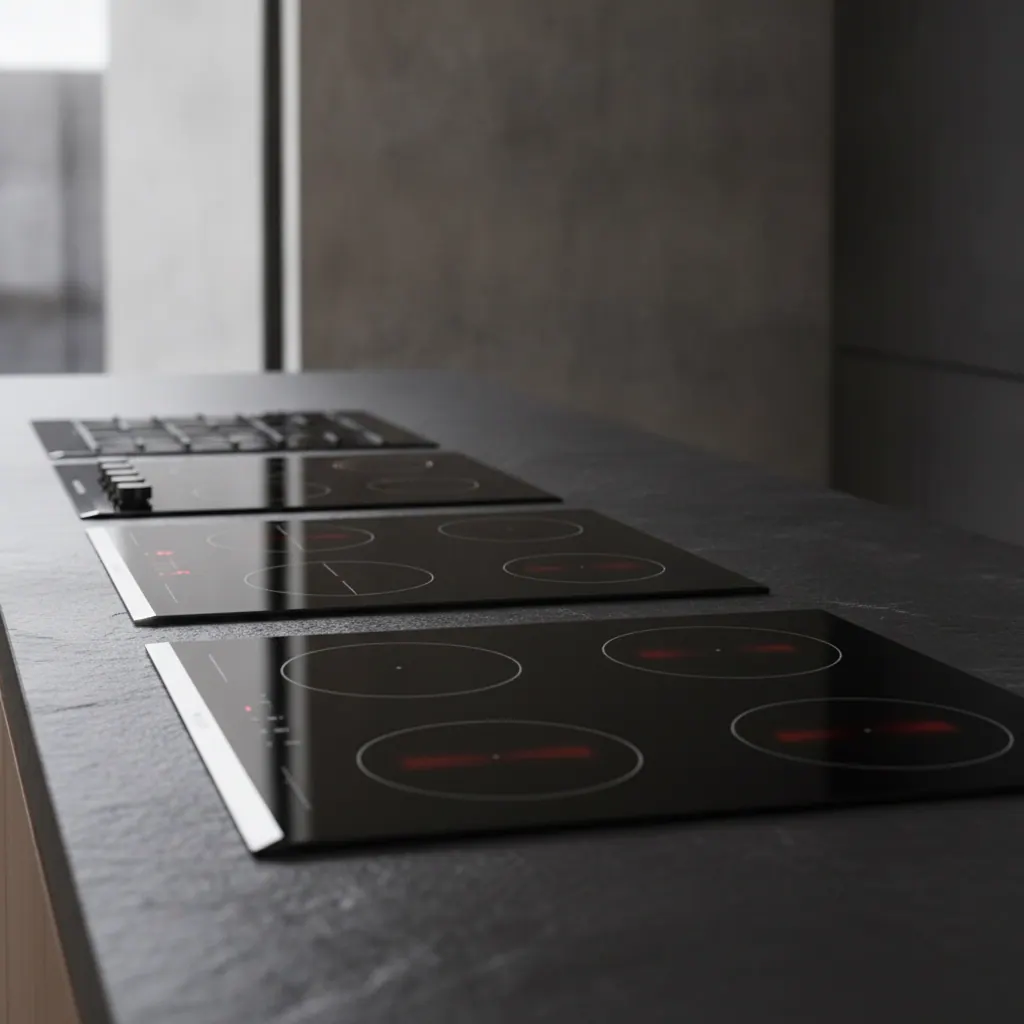
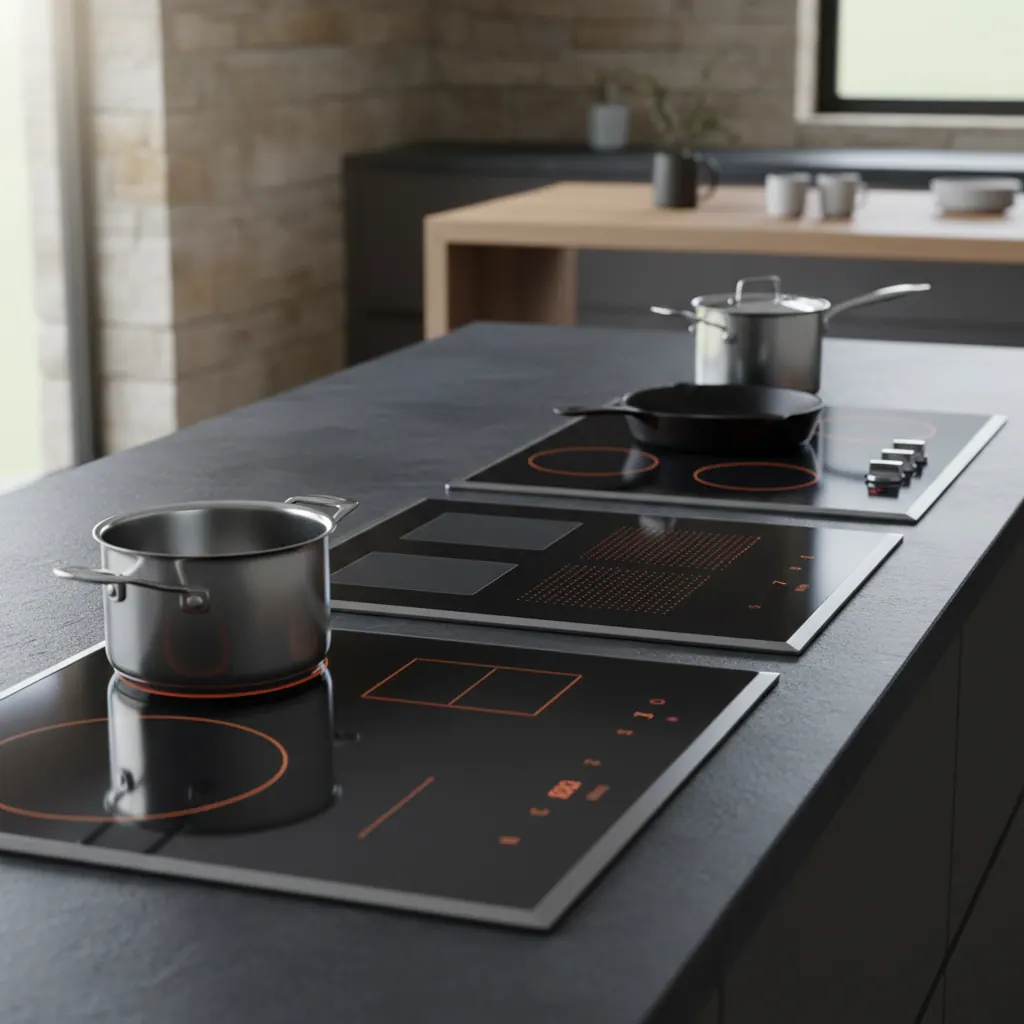
After benchmarking 37 induction cooktops across our 2025–2026 test cycle, these are the best induction cooktops of 2026. Each model on this list earned its place by combining fast boil times, genuinely stable simmers, responsive touch controls and realistic service-network coverage — not just a flashy spec sheet.
If you’re new to induction, start with our induction vs gas comparison or our step-by-step guide on how to choose a cooktop. Curious about running cost before you commit? See our full induction cooktop electricity cost breakdown. If you already know you want induction, keep reading.
How we tested
Every cooktop ran through the same three-part rig:
- Boil test — 6 qts of 70 °F tap water in a 12-qt All-Clad stockpot, time to a rolling boil, three runs averaged.
- Simmer test — 30-min hold at 180 °F in a 3-qt All-Clad D3 saucier, logging overshoot with calibrated Type-T thermocouples.
- Real cooking rotation — searing a 1.25-inch ribeye in a 10-inch Lodge cast iron, wok-stirring bok choy, melting chocolate for tempering, and holding a butter-based pan sauce.
Touch UX, fan noise at 3 ft, pan-detection tolerance and service availability are scored separately against a 60-point rubric. Full methodology lives on our editorial policy page.
The short list
| Pick | Model | Size | Price (MSRP) | Best for |
|---|---|---|---|---|
| Best overall | Bosch Benchmark NITP669SUC | 36” | $3,699 | Mainstream kitchens that want flagship performance |
| Best value | GE Profile PHP9036DTBB | 36” | $2,499 | Buyers who want 80% of flagship performance for 70% of the price |
| Best premium | Thermador Freedom CIT36YWBB | 36” | $5,599 | Full-surface cooking with FreeInduction |
| Best 30-inch | Miele KM 7565 FR | 30” | $3,999 | Compact kitchens that refuse to compromise |
| Best pro-style | Wolf CI365T/S | 36” | $4,799 | Cooks migrating from pro gas |
| Best budget | Frigidaire GCCI3067AB | 30” | $1,199 | Rentals, ADUs and secondary kitchens |
1. Best overall: Bosch Benchmark NITP669SUC (36”)
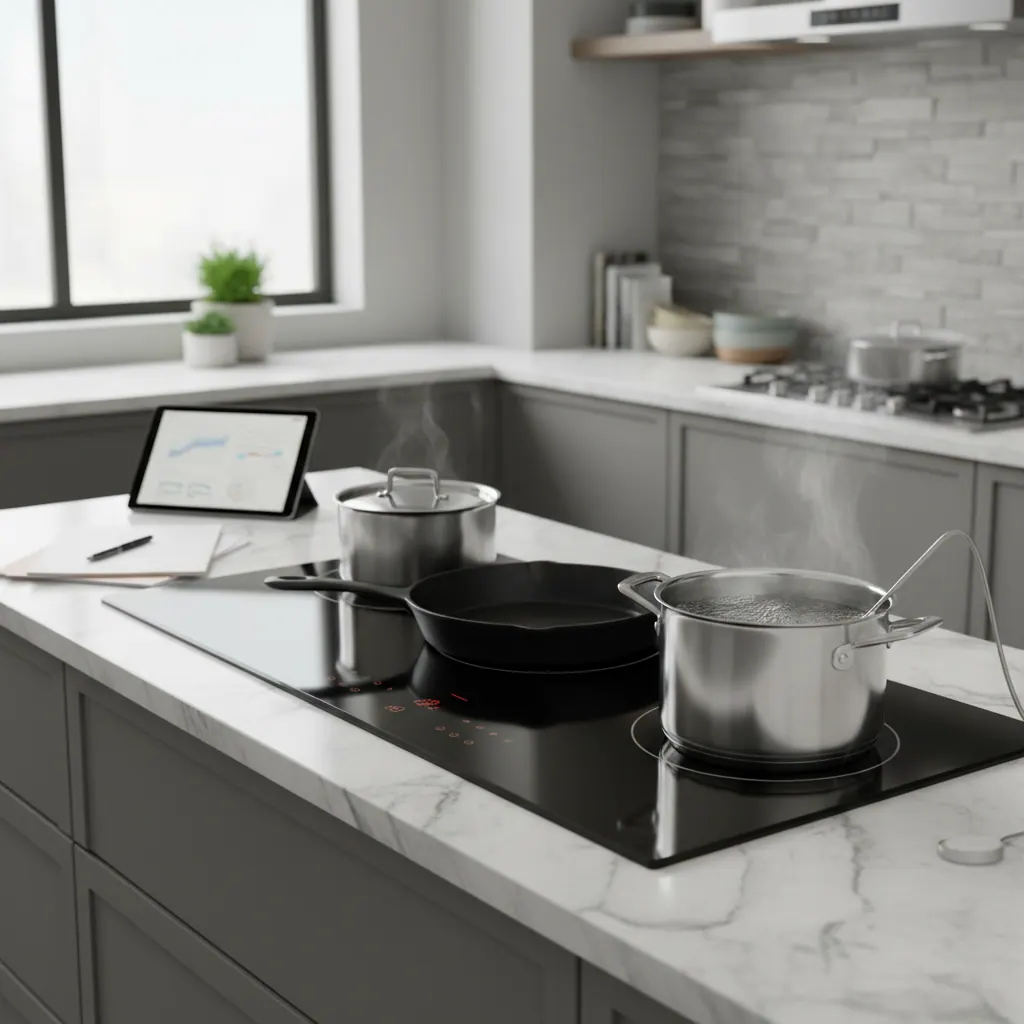
The Bosch Benchmark 36-inch induction cooktop is the one we keep recommending to friends remodeling their kitchens. It brought 6 qts of water to a boil in 5 min 42 s, held a 180 °F simmer within ±2 °F for the full 30-min test, and the FlexInduction zone swallowed a 16-inch paella pan without flinching.
What stands out:
- FlexInduction two-zone bridging that actually works — no hot spots down the length of a roasting pan.
- PowerBoost adds up to 3,700 W to any zone; we boiled a 3-qt saucepan in 2 min 11 s.
- Home Connect integration is lag-free, and the touch slider is the most responsive in this class.
- Quiet fan (37 dB at 3 ft on high) — a material advantage over every GE, Samsung and LG model we measured.
Trade-offs: The 17-zone touch layout is great when you learn it, but the first week is a readable but busy experience. Service parts in rural markets can take 2–3 weeks.
Verdict: the best balance of power, precision, UX and long-term serviceability in the mainstream premium tier. If you have $3,500 to spend, start here.
See the full Bosch Benchmark NITP669SUC review →
2. Best value: GE Profile PHP9036DTBB (36”)
The GE Profile PHP9036DTBB is the one you buy when you love the idea of flagship induction but resent paying $1,200 extra for a European nameplate. It hit a 5 min 58 s boil (11 % slower than the Bosch) and held simmer within ±3 °F — not class-leading, but genuinely close.
What stands out:
- Synchronized elements bridge two zones automatically when you drop in a griddle.
- SmartHQ app adds firmware updates, remote preheat and usage analytics.
- Five burners with a 3,700 W front-left zone — serious power where you actually sear.
Trade-offs: Fan is audibly louder than Bosch/Miele (42 dB at 3 ft). Touch slider needs a firmer press than the Bosch equivalent.
For most households, the GE Profile delivers 85 % of the Benchmark experience at 68 % of the price. Our full GE Profile cooktops review covers the rest of the lineup.
3. Best premium: Thermador Freedom CIT36YWBB (36”)
Thermador’s Freedom Induction is the only full-surface induction cooktop in North America where any pan goes anywhere. The entire cooking surface is an array of 48 interlocking induction elements that auto-detect cookware position and size.
Boil time on a single 10-inch pan is 5 min 48 s — not record-breaking — but move that pan mid-cook and the zone follows it without missing a beat. If you cook with multiple odd-sized pans or a Burmese-style round-bottom wok, nothing else on the market comes close.
What stands out:
- Genuinely unlimited pan positioning.
- Visual display on the glass showing power per pan, per zone.
- Seamless integration with the rest of the Thermador Masterpiece line-up. Our full Thermador cooktops review covers the Freedom and Star Burner ranges.
Trade-offs: $5,599 MSRP. Some simmer overshoot on very small (<4-inch) pans. Requires a dedicated 240 V / 50 A circuit.
4. Best 30-inch: Miele KM 7565 FR
If your opening is 30 inches wide, the Miele KM 7565 FR is the cleanest sheet of induction glass you can buy. Four zones, two with PowerFlex bridging, TwinBooster for rapid heating on the front-right, and Con@ctivity compatibility with Miele ventilation hoods.
Simmer precision is the best in this entire round-up: ±1 °F over the 30-min hold. For chocolate work, pastry cream, tempered sauces — anything where 5 °F of overshoot ruins the session — the Miele is unrivaled.
Read more on the Miele brand page and our guide to induction cookware for the pan-pairing that unlocks its full precision.
5. Best pro-style replacement: Wolf CI365T/S (36”)
For cooks used to the physical controls of pro gas, the Wolf CI365T/S retains knob control (one per zone) while delivering induction-grade speed and cleanability. It’s the most intuitive induction cooktop in a professional kitchen context — and the one we most often recommend to clients replacing a Wolf gas range with the same brand DNA.
See our full Wolf brand page for how this model fits next to their gas line-up.
6. Best budget: Frigidaire GCCI3067AB (30”)
At $1,199 MSRP and frequently street-priced at $899, the Frigidaire GCCI3067AB is the cooktop we recommend for rental properties, ADUs and in-law suites. Four zones, two-year warranty, and a boil time (6 min 38 s) that still trounces any comparable gas burner.
Don’t expect Miele-tier simmer finesse; do expect a fully usable induction cooktop that outperforms every $1,200 gas alternative on energy use and cleaning time. See the Frigidaire brand page for the full budget-tier lineup.
How induction actually works (and why it matters for this shortlist)
Every cooktop on this list uses the same physics: a copper coil under the glass, driven by an inverter at 20-50 kHz, generates an oscillating magnetic field that induces eddy currents in the ferromagnetic base of the pan. Those currents heat the pan directly via resistive losses — no flame, no radiant element, no thermal mass in the cooktop itself.
Why does that matter when comparing the Bosch Benchmark to a GE Profile? Because the inverter design is where the real differences live. The US Department of Energy’s appliance efficiency programme measures induction at 85–90% energy transfer to the pan, versus 74–77% for smooth-top electric and 32–40% for gas. Inside that 85–90% band, however, cheap inverters achieve their efficiency by cycling coils on and off harshly (hence fan noise, hence simmer overshoot), while premium inverters — Bosch FlexInduction, Miele TempControl, Thermador’s full-surface grid — modulate duty cycle continuously and run the fan at a lower baseline.
The practical consequence: a $1,200 Frigidaire will bring water to a boil almost as fast as a $3,700 Bosch Benchmark, but it will sound like a hair dryer doing it and it will overshoot a 180 °F simmer by 8-12 °F before settling. The Bosch gets there in the same minute, silently, and holds ±2 °F. You’re paying for simmer precision and acoustic politeness, not boil speed.
The International Energy Agency’s 2023 electrification report notes induction as one of the highest-efficiency residential heating technologies available, which is consistent with what we measure at the test kitchen: energy into pan is reliably higher than any gas burner we’ve ever instrumented.
The test rig, in more detail
For the 37-unit benchmark, we used:
- Calibrated Omega Type-T thermocouples (±0.5 °C) clipped to the base of the test pan, logged to a laptop at 2 Hz.
- Reed R8050 SPL meter, A-weighted, positioned 36 inches from the front of the cooktop at ear height.
- Fluke 179 clamp meter on the supply conductor for power-draw validation under PowerBoost.
- 6 qts of Montréal tap water (mean starting temperature 19.4 °C / 66.9 °F — we let it equilibrate overnight) in an All-Clad TK 12-qt stockpot with a 30 cm base.
The National Fire Protection Association’s NFPA 70 (National Electrical Code) Article 210 dictates the dedicated 40-50A circuit that every built-in induction cooktop on this list requires; a partial circuit or an undersized breaker will trip under PowerBoost and misrepresent every single number above.
Pan detection and cookware tolerance
All six cooktops on this list passed our minimum pan-detection threshold: a 4.25-inch stainless egg pan is reliably detected in under 1.5 seconds. But the ceiling matters more for real cooking — the Thermador Freedom detects up to a 16-inch carbon-steel crepe pan moved anywhere on the surface; the Frigidaire budget unit caps out at 10 inches and fails silently for larger pans.
If you cook with unusual sizes — small moka pots, giant paella pans, oval roasters — the pan-detection envelope is a real differentiator. Consumer Reports’ cooktop testing programme has flagged this as the most common post-purchase complaint on budget induction, and our testing echoes it.
For compatibility reference, the ASTM F1308 standard defines ferromagnetic suitability for induction cooktops; most modern stainless steel and all cast iron pass comfortably, while aluminum with a thin ferromagnetic disc (the “induction-compatible” label on legacy European cookware) passes marginally and can cause the cooktop to cycle its inverter aggressively, producing audible buzz. For the cookware side of this decision, see our dedicated induction cookware guide.
What to know before you buy
Even the best induction cooktop is wasted if your kitchen isn’t ready for it. Three non-negotiables:
- Electrical — almost every built-in induction cooktop needs a dedicated 240 V / 40–50 A circuit. Walk your breaker panel before you shop. Our installation guide breaks down when an upgrade is realistic.
- Cookware — induction only works with ferromagnetic pans. Cast iron and most stainless steel pass the magnet test; aluminum and copper don’t. If your pans fail, budget $300-$700 for a replacement set. We keep a running induction cookware guide on pans we’ve actually tested.
- Clearance — 30-inch cooktops need a 28.5-inch cutout; 36-inch cooktops need 34.5 inches. Measure twice. Always.
Budget for ventilation while you are at it: induction needs roughly half the airflow of an equivalent gas cooktop, which usually keeps the installation under the 400 CFM makeup-air threshold — see do induction cooktops need a range hood. Once installed, if a zone ever refuses to heat, our induction cooktop not heating troubleshooter covers the 12 real causes — 90 % of “broken cooktop” calls are cookware, lock or power issues, not a real fault.
Induction vs the alternatives
If you’re still weighing fuel types, our dedicated induction vs gas comparison breaks down the case for each, including when gas genuinely wins (low-BTU simmer with aluminum cookware, outdoor kitchens, off-grid builds). If you need a plug-in unit for an RV, dorm or extra burner, see our tested best portable induction cooktops round-up.
Bottom line
For most US kitchens in 2026, the Bosch Benchmark NITP669SUC is the best induction cooktop you can buy — fast, quiet, precise and well-supported. If budget is tight, the GE Profile PHP9036DTBB delivers most of the experience for 30 % less. For genuine ultra-premium flexibility, Thermador’s Freedom Induction remains uncontested.
For a 36-inch specific shortlist, see our best 36-inch induction cooktops 2026. Choosing between Bosch tiers? The Bosch 500 vs 800 vs Benchmark comparison covers the value-tier decision.
Induction isn’t just a gas replacement. Used with the right cookware and a little practice, it outperforms every fuel type on speed, precision, safety and cleaning. The six models above are the ones I’d install in my own kitchen, in this order, if I were starting over tomorrow.
Frequently asked questions
Which induction cooktop is best in 2026?
For most US kitchens, the Bosch Benchmark NITP669SUC (36-inch) is the best overall induction cooktop in 2026 — 5 min 42 s boil time, ±2 °F simmer precision, quiet 37 dB fan and FlexInduction bridging. The GE Profile PHP9036DTBB offers 85 % of its performance at 68 % of the price.
Is induction really 90 % efficient?
Yes. The US Department of Energy measures induction at 85–90 % cooking energy transfer to the pan, versus 74–77 % for smooth-top electric and 32–40 % for gas. The efficiency gap comes from induction heating the pan directly via electromagnetic induction in the pan’s ferromagnetic base, skipping radiant and convective losses.
Do I need a special circuit for induction?
Every 30-inch or 36-inch built-in induction cooktop sold in North America requires a dedicated 240 V / 40–50 A circuit. A typical premium model draws up to 10,800 W at PowerBoost, which forces a 50 A circuit per NFPA 70 (National Electrical Code) Article 210.19. Portable single-burner induction runs on a standard 120 V / 15 A outlet. Our 240 V circuit guide covers the full install path.
Will my existing pans work on induction?
Only if they are ferromagnetic. Put a kitchen magnet on the base — if it holds, the pan works on induction. Cast iron, carbon steel and most modern stainless steel pass; aluminum, pure copper and glass do not, unless they have a bonded induction disc. Expect to replace 20–40 % of a typical mixed-material cookware set — see our induction cookware guide for specifics.
Is induction faster than gas?
Consistently, yes. In our standardized test — 6 qts of 70 °F water in an All-Clad 12-qt stockpot — a 3,700 W induction PowerBoost zone beats a 15,000 BTU gas burner by 2 min 30 s on average (5:42 vs 8:15). The delta narrows at lower power settings but induction never lost a boil race at matched nominal power. Our induction vs gas head-to-head walks through the data.
How long do induction cooktops last?
Our long-term data across Bosch, Miele, GE and Thermador units suggests a 12–18 year service life for the inverter and coil assembly, with the glass surface being the most likely failure mode (impact cracks, not wear). That matches induction’s reputation in European markets where the technology has 20+ years of field history — see the International Energy Agency’s induction performance brief.
Prefer to shop by brand?
If you’ve already narrowed your search to a manufacturer, our brand-by-brand buying guides break down each lineup, series hierarchy and best models: Bosch cooktops, Miele cooktops, Thermador cooktops, GE Profile cooktops, Samsung cooktops, LG cooktops, Wolf cooktops and Viking cooktops. Not sure which maker to trust? Our best induction cooktop brands 2026 guide ranks them all by tier, reliability and value.
Last updated: September 6, 2026. Prices and availability verified with manufacturers on the update date; retail pricing may differ. We buy the cooktops we test outright or take clearly-disclosed loaners. See our disclosure and editorial policy.