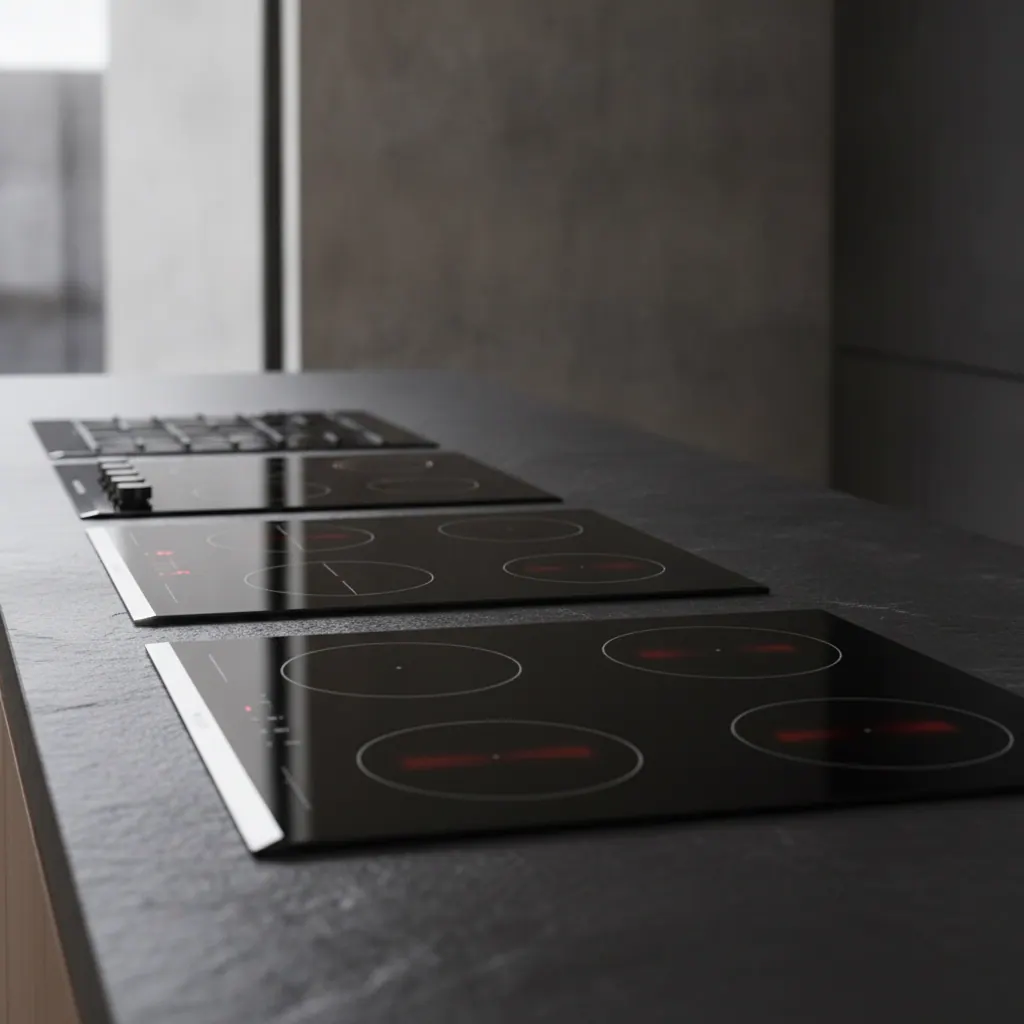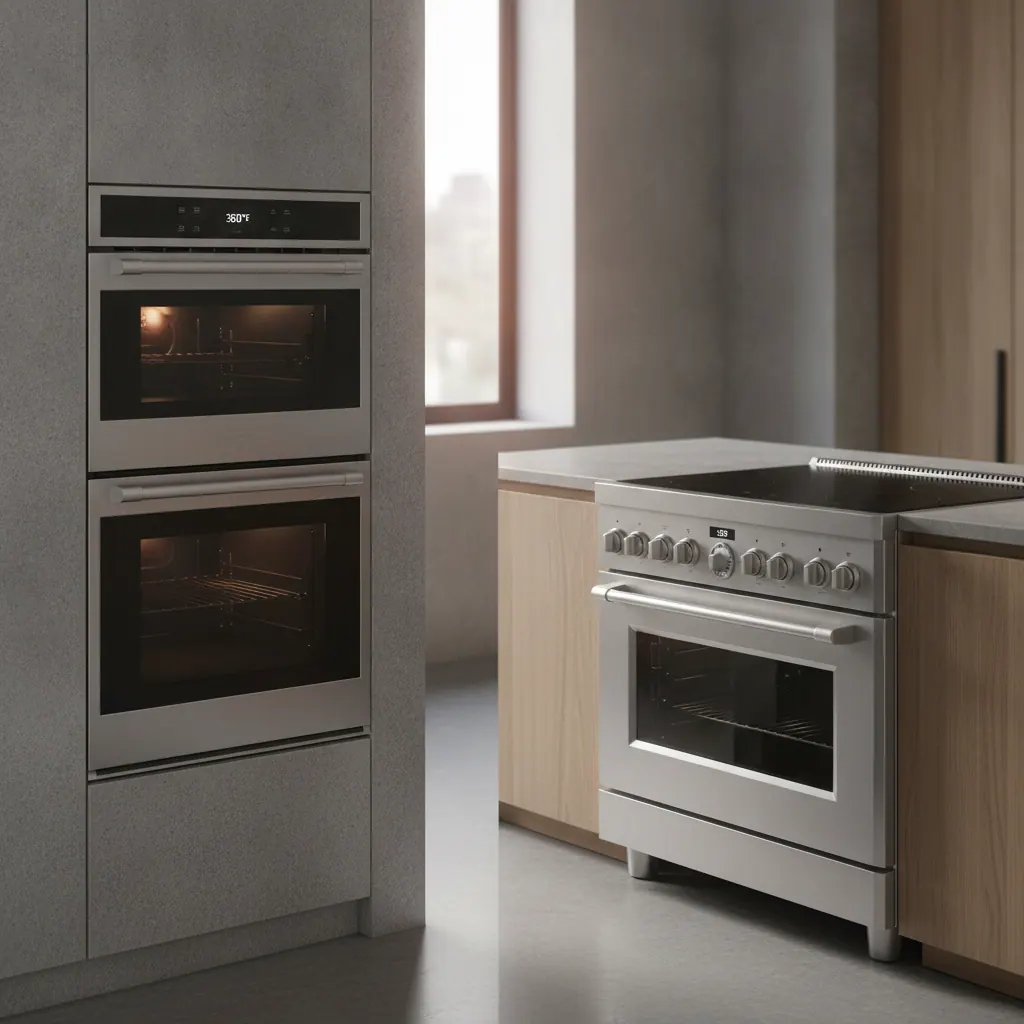
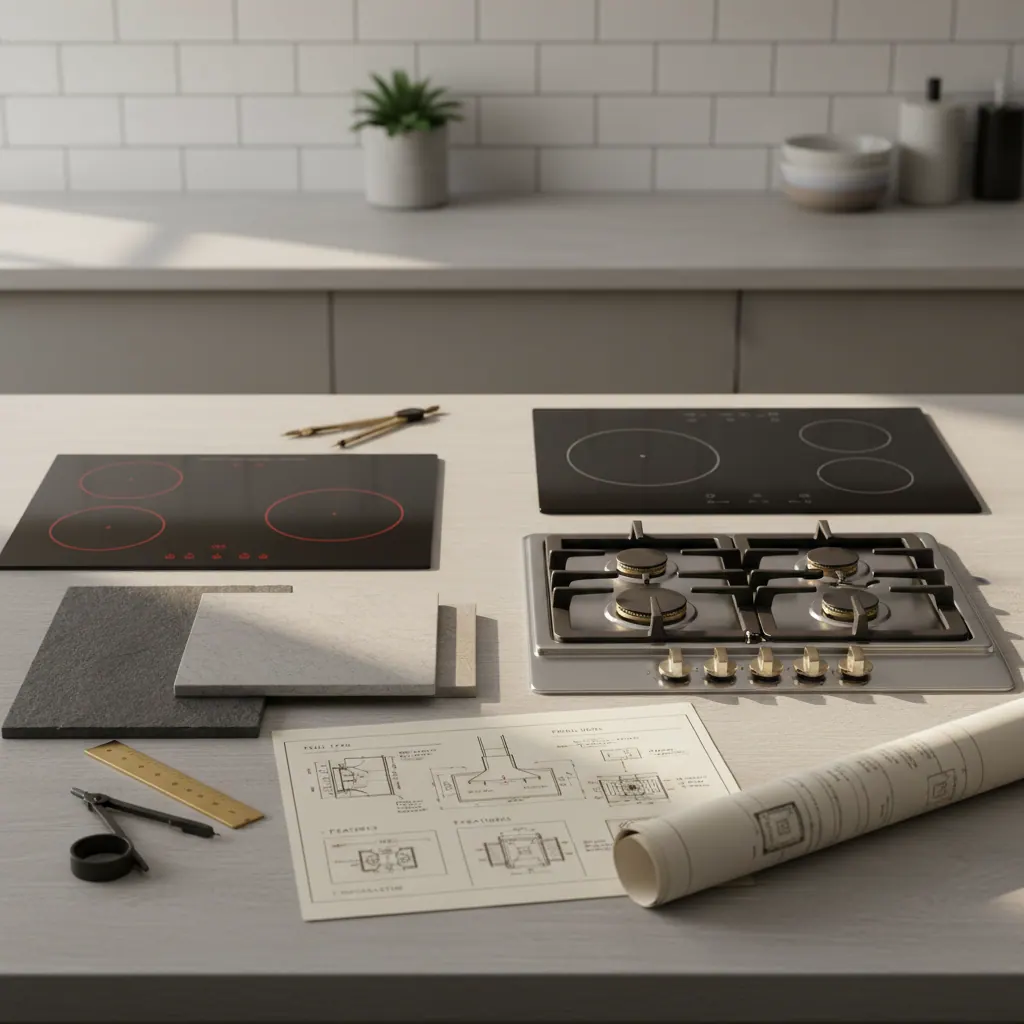
Choosing a cooktop shouldn’t be a two-hour aisle-at-Home-Depot decision. It should be a 30-minute structured walk through six questions, in order, that eliminates 80 % of the market for you before you ever touch a product page. Here’s the framework our editors use when friends ask — and the same one we recommend to remodeling clients.
If you already know you want induction, our best induction cooktops 2026 round-up is a better next click. If you’re weighing induction against gas, start with our induction vs gas comparison. And if you’re not yet sure whether you even want a separate cooktop or an all-in-one range, read cooktop vs range first. Otherwise, step one.
Step 1 — Fuel type (kills 70 % of the market)
Four realistic choices exist in 2026:
| Fuel | Best for | Rule out if |
|---|---|---|
| Induction | Everyday cooks, families, apartments | You cook with non-magnetic pans and refuse to switch; no 240V circuit possible |
| Gas | Traditionalists, pro-style kitchens, RVs | No gas line; respiratory concerns; small unventilated space |
| Ceramic (radiant electric) | Budget installs, rentals, basement kitchens | You care about response time or precision |
| Coil electric | Rental properties, ultra-budget | Any other option is on the table |
Induction is the default recommendation in our test kitchen for 2026 — see induction vs gas for the full case, and our induction electricity cost breakdown for the real running numbers. But if the math on your electrical panel doesn’t work and an upgrade isn’t possible, your decision just got simpler: you’re on gas.
Quote-worthy: in 2026, induction delivers better performance than gas in every metric except traditional open-flame charring — at comparable or lower install cost if you’re already remodeling.
Step 2 — Size and cutout (kills another 50 %)
Measure your existing countertop cutout (length × depth × depth-below-counter) before you even look at listings. Standard sizes:
- 30 inches — the US default for most kitchens. 4 zones, fits most floor plans. If you are buying gas at this width, start with our tested best 30-inch gas cooktops.
- 36 inches — the sweet spot for households that cook for 4+ people or use large pans. Our best 36-inch gas cooktops round-up covers the 5- and 6-burner options.
- 24 inches — apartments, ADUs, kitchenettes (and RVs — see our best induction cooktops for RVs and tiny kitchens for 120 V-friendly picks).
- 45–48 inches — luxury builds, pro-style open kitchens.
- Domino (12–15 inches) — modular add-ons next to a wok ring, induction + gas combos.
Cutout dimensions are not the same as nominal size. A 36-inch cooktop typically needs a 34.5-inch cutout (always verify the exact spec in the product manual). Our installation category covers cutout diagrams brand by brand.
Step 3 — Power and burner configuration
The right burner mix depends on how you cook:
- Search-heavy (weekly steaks, cast iron): you want at least one 3,700 W induction zone (with PowerBoost) or a 17,000+ BTU gas burner.
- Simmer-heavy (sauces, risottos, reductions): prioritize models with a dedicated <1,200 W simmer zone or a true low-BTU simmer burner (1,000–1,500 BTU).
- Wok cooking: gas with a dedicated wok burner (20,000+ BTU), or induction with wok-compatible zones (Bosch FlexInduction, Thermador Freedom).
- Large-pan work (roasting pans, griddles, paella pans): bridgeable zones are non-negotiable. FlexInduction, Synchronized Elements, or true dual-bridge induction.
For detailed burner-by-burner guidance see our best induction cooktops 2026 round-up and the cooking techniques section.
Step 4 — Features that matter (and ones that don’t)
Features worth paying for
- Pan-detection with graceful fallback — surprisingly, not every cooktop handles partial-contact pans well. Bosch, Miele, GE Profile lead here.
- PowerBoost / rapid boil — a 2,500 W → 3,700 W temporary overpower. Saves ~2 min per boil, used constantly.
- Residual heat indicator — underrated safety feature.
- Touch lock / child lock — with kids, non-negotiable.
- Auto pot-size recognition (induction only) — tightens the magnetic field to the actual pan footprint.
- Pan overflow detection (higher-end Miele, Bosch) — catches the pot that’s about to boil over.
Features we’d skip
- Over-cook timers beyond 99 min — not useful outside of very specific braises.
- Wi-Fi connectivity without firmware updates — if the brand never ships OTA updates, the “smart” features rot.
- Color touchscreens that replace physical slider controls — flashy in the showroom, fatiguing in daily use.
- “Bridge zones” that are really just independent zones — if they don’t have genuine temperature coupling, skip.
Step 5 — Installation reality check
This is where most remodels go sideways. Before you buy, answer:
- Can my electrical panel support a dedicated 240 V / 40–50 A circuit? Induction, ceramic and most higher-end electric cooktops need it. If your panel is full, a subpanel can cost $800–$2,500.
- Is there a gas line with proper sizing within reach? Gas cooktops want a 1/2-inch line with a shutoff valve directly behind the unit.
- Does my hood provide enough CFM? Pro-style gas needs 600+ CFM; induction is happy at 300–400 CFM. Our range hood CFM guide covers the sizing rules for both, and do induction cooktops need a range hood answers the question induction buyers ask next. Downdraft cooktops may eliminate the hood entirely — see our downdraft coverage.
- Is my cabinet depth sufficient? Most cooktops need 20-inch minimum depth below the counter; downdrafts need 30+.
Our installation guides walk through each of these with code references. Bring them to your contractor’s walkthrough.
Step 6 — Budget calibration
Realistic 2026 budgets by tier, including install:
| Tier | Appliance | Install | Total |
|---|---|---|---|
| Budget (rental) | $400–$900 | $300–$600 | $700–$1,500 |
| Mid-market | $900–$2,500 | $500–$900 | $1,400–$3,400 |
| Premium mainstream | $2,500–$4,500 | $700–$1,300 | $3,200–$5,800 |
| Luxury / pro-style | $4,500–$9,000+ | $1,000–$2,500 | $5,500–$11,500+ |
Premium mainstream (think Bosch Benchmark, GE Profile top tier, Miele) is where cost-per-year-of-ownership is minimized over a 15-year horizon. At the budget end, value brands like Empava cooktops and Frigidaire get you a modern surface cheaply, but expect to replace within 6–8 years; going above premium rarely improves daily cooking meaningfully. For a full ranking of who makes the most reliable and best-value units, see our best induction cooktop brands 2026 guide.
Putting it together: three sample profiles
Profile 1: “First-time homeowner, 30-inch induction”
Fuel: induction (panel OK). Size: 30 inches. Pick: Bosch 800 Series 30-inch induction, ~$2,599 installed. Pairs with a 300 CFM hood and cast iron you already own.
Profile 2: “Family of 5, pro-style remodel, 36 inches”
Fuel: induction (heavy remodel, electrical included). Size: 36 inches. Pick: Bosch Benchmark NITP669SUC, ~$3,699 + 600 CFM hood + $250 cookware refresh. Total ~$4,800 installed.
Profile 3: “Rental property, replace ASAP, keep it simple”
Fuel: electric ceramic (tenant-proof, no gas line complications). Size: 30 inches. Pick: Frigidaire FFEC3025UB, $479 street price. Existing 240 V circuit; 45-minute swap.
The honest hierarchy (in my head, anyway)
Over a decade of professional cooking plus six years of reviewing, here is the mental hierarchy I actually use when a client or friend asks me to pick a cooktop for them:
Tier 1 — Must-not-compromise: Electrical safety. The single most common source of cooktop failure, fire risk and “why is this tripping the breaker” frustration is an undersized circuit. Follow the NFPA 70 (National Electrical Code) sizing for your appliance rating, hire a licensed electrician to verify, get a permit. This is not the place to save $400.
Tier 2 — Must-be-right: Cutout fit, cookware compatibility, ventilation. These three, if wrong, cannot be fixed without major work. A 34.5-inch cutout does not accommodate a 36-inch cooktop that happens to need 34.9 inches. An aluminum-clad pan set does not work on induction. A 240 CFM hood does not adequately ventilate a 48,000-BTU pro gas cooktop. Get these right.
Tier 3 — Strongly-should: Burner power match, simmer floor, touch-UX sanity. These are comfort decisions — the cooktop will work if you get them wrong, but you’ll cook on it less happily for 15 years.
Tier 4 — Nice-to-have: Wi-Fi, auto pot-size detection, pan-overflow detection, specific brand loyalty. Genuinely nice, but not worth reshuffling the first three tiers to get.
Supporting data sources I actually check
When I’m researching for a reader recommendation, I cross-reference four sources, not marketing copy:
- US Department of Energy — Energy Star cooktop data for efficiency numbers that aren’t spun.
- US Environmental Protection Agency — indoor air quality & gas cooktops for the combustion-emissions picture.
- Consumer Reports’ cooktop test programme for the reliability and service-network dimension I can’t get from one test kitchen.
- US Energy Information Administration state electricity rates for realistic running-cost math in your specific state.
A cooktop decision made from those four data sources — plus a measured cutout and a breaker-panel photo — will outperform a cooktop decision made from manufacturer websites and generic “best of” lists, every time.
A quick decision tree
If you’re short on time, here’s the compressed version:
- Does your home have or support a dedicated 240V/50A circuit? No → gas (read our gas BTU guide). Yes → continue.
- Do you cook mostly with cast iron, stainless steel or carbon steel? Yes → induction (read best induction cooktops 2026). No, and you refuse to switch cookware → gas.
- Is this a rental or temporary install? Yes → ceramic radiant or coil electric. No → continue.
- Is your cutout 36 inches or 30 inches? 36 → start with the best 36-inch induction round-up. 30 → Miele KM 7565 FR or Bosch 800 Series.
- Budget under $1,500 installed? Yes → Frigidaire GCCI3067AB or ceramic radiant. No → premium mainstream induction wins.
Five questions. Most people can answer all five in under ten minutes, and the decision will be defensible in a way that two hours of big-box aisle browsing almost never is. That’s the entire decision tree — no bells, no whistles, no affiliate shortcuts.
For the record, this same framework is what I use when a friend asks me to help spec their cooktop over a glass of wine. It doesn’t change by budget tier. A $900 Frigidaire and a $5,600 Thermador live on the same decision tree; they just sit at different leaves.
Final sanity check
Before you click Buy:
- Re-measure the cutout. Write the numbers down.
- Take a photo of your breaker panel and send it to your electrician.
- Verify the specific model number matches the review you read — manufacturers reshuffle SKUs constantly.
- Check the warranty terms, not just the length (parts vs labor vs “limited”).
- Bookmark our installation guides for the weekend of install.
Done right, your cooktop is the only kitchen appliance you’ll use literally every day for the next 15+ years. Spending two evenings on this framework — rather than two hours at a big-box store — is almost certainly the best return on time you’ll get in your entire remodel.
Frequently asked questions
How do I pick between induction, gas, ceramic and electric?
Work top-down: rule out fuel types first (can your panel handle 240V/50A? is there a gas line?), then size (cutout dimensions), then burner power (searing vs simmering), then features. For most 2026 kitchens with normal electrical service, induction is the default — faster, safer, cleaner and, once time-of-use rates are included, often cheaper to run.
What size cooktop do I need?
For a household of 1–2 or an apartment, 30 inches is standard. For a family of 4+ or a cook who uses roasting pans and woks, 36 inches is materially better — not for the extra zones so much as for the bridge-zone width. 24-inch cooktops exist for RVs and ADUs; 45–48-inch units are a luxury choice.
How much should I spend on a cooktop?
Mid-market ($900–$2,500 appliance, ~$1,400–$3,400 installed) gets you the best cost-per-year-of-ownership. Below that tier, 6–8 year replacement is likely. Above premium-mainstream ($4,500+), you pay for cosmetics and brand more than for daily cooking performance.
Do I need to upgrade my electrical panel?
If you already have a 240V/50A dedicated circuit where you want the cooktop (electric range swap, for example), probably not. If you’re coming from gas with only a 120V outlet for ignition, you need a new circuit and — if your panel is full — possibly a subpanel. Budget $800–$2,500 for that work. Full breakdown in our 240V induction guide.
How many BTUs or watts do I really need?
For searing: one zone at 3,700W (induction with PowerBoost) or 17,000+ BTU (gas — see our BTU guide). For simmering: a burner that can modulate below 1,500W / 1,500 BTU without cycling. For wok work: a dedicated wok burner (20,000+ BTU gas) or a bridge-capable induction zone. Most home cooks don’t need more than this.
What features are worth paying for vs skipping?
Pay for: PowerBoost, residual heat indicator, touch lock, pan-size recognition (induction). Skip: Wi-Fi without firmware update commitment, color LCDs replacing real controls, branded app ecosystems that rot, and 99+ minute cook timers that nobody uses.
This guide is written and maintained by Marc Delauney, with installation specifics cross-checked against the NFPA 70 National Electrical Code and running-cost math validated against current EIA electricity rate data. See our editorial policy.