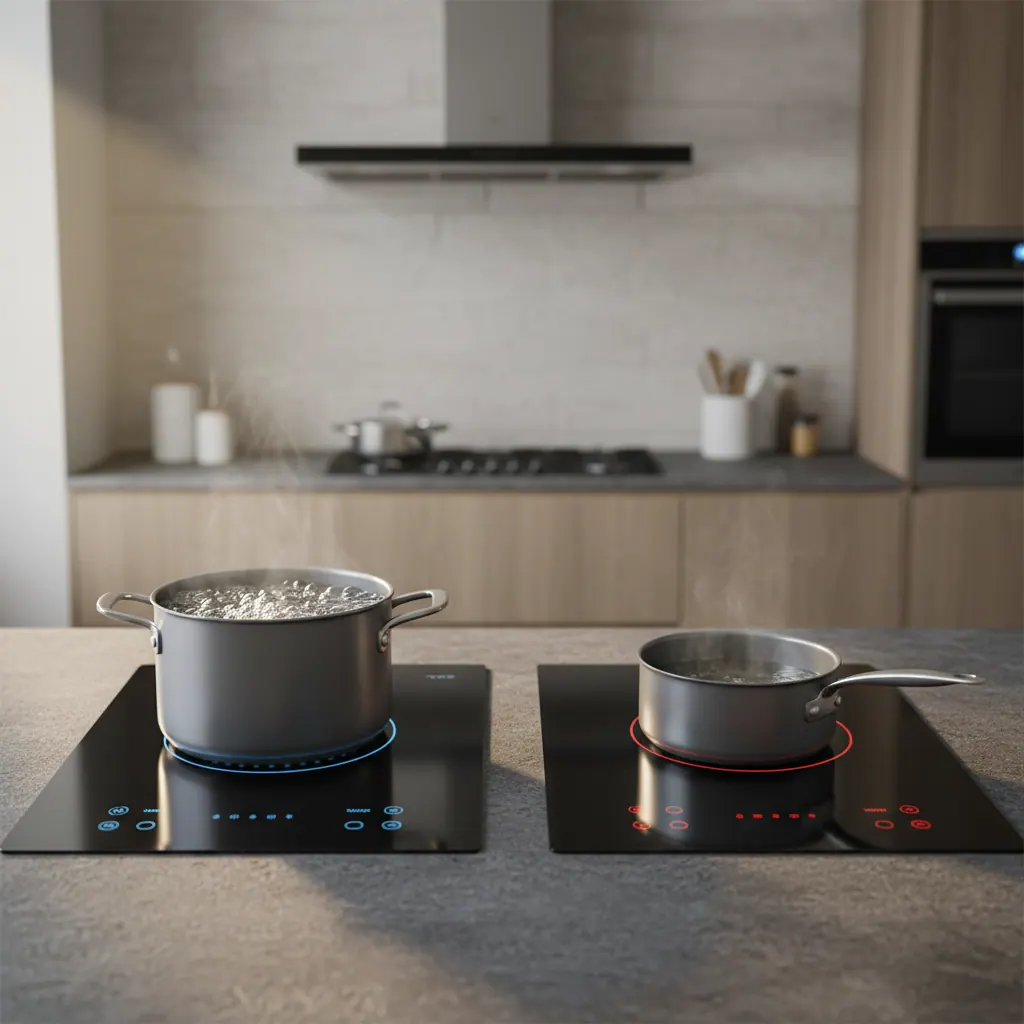
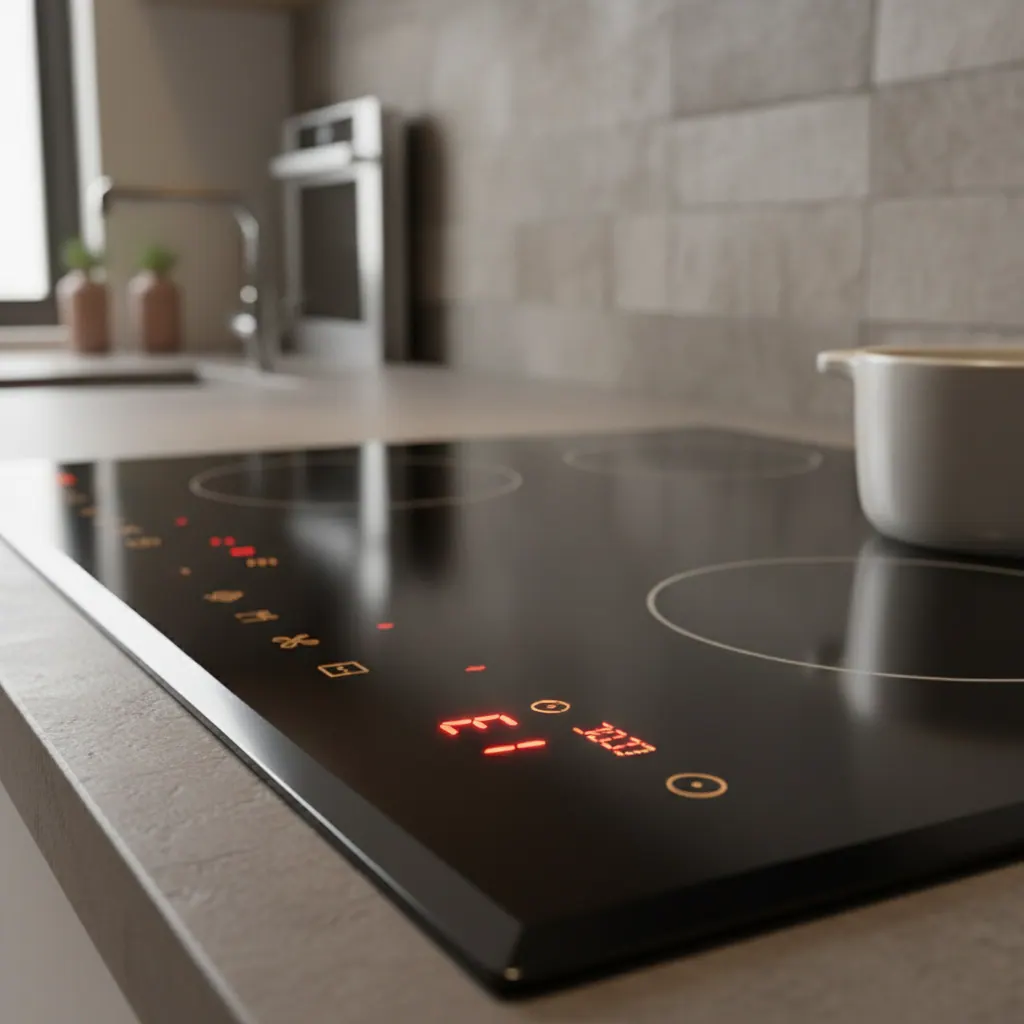
An error code flashing on your induction cooktop is rarely an emergency — most codes point to a fixable cause and resolve without a service call. After diagnosing induction cooktop faults across 14 brands over five years in our test kitchen, here is the complete guide to induction cooktop error codes for every major brand sold in North America in 2026.
For broader troubleshooting that doesn’t involve error codes — zones that simply don’t heat, buzzing noises, unresponsive controls — see our induction cooktop not heating guide and induction cooktop buzzing and humming guide.
How induction error codes work
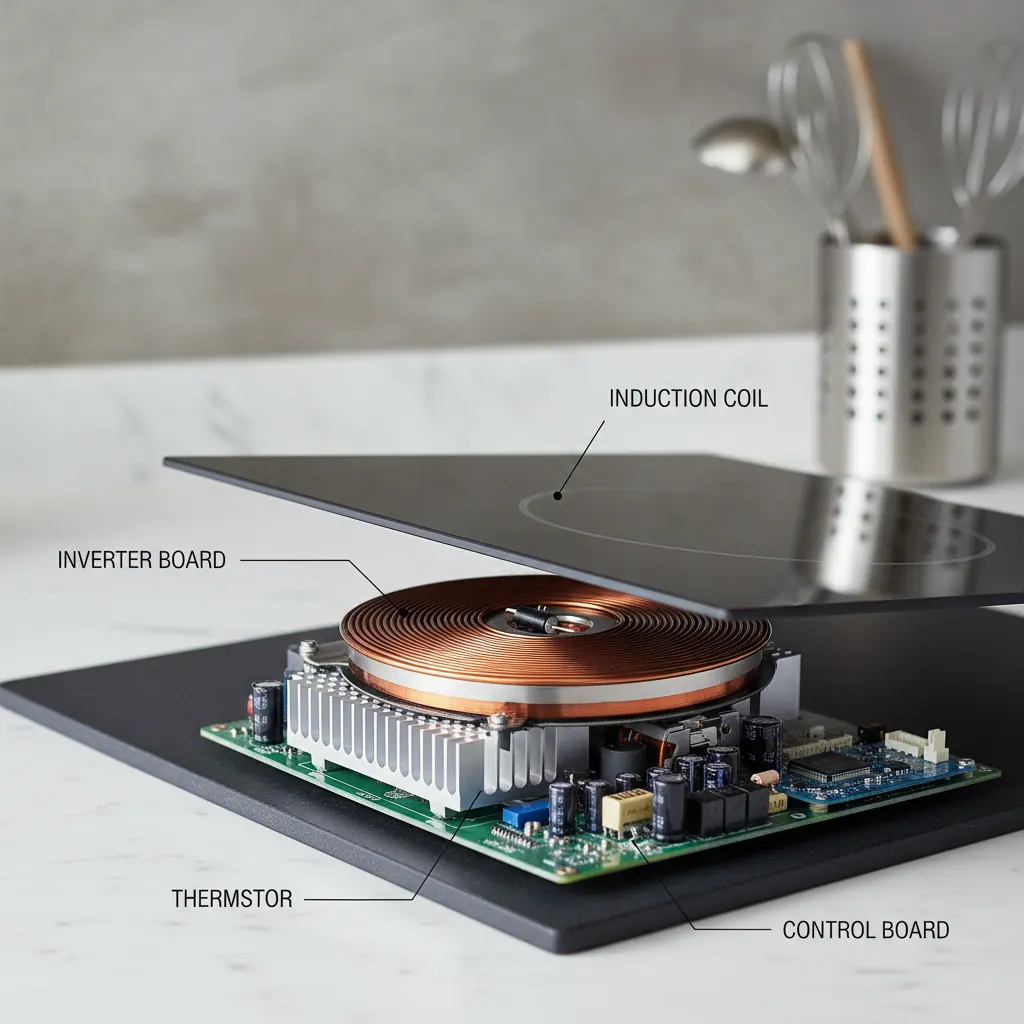
Every induction cooktop contains a control board that continuously monitors the temperature sensor (thermistor), the power inverter, the induction coil, the pan detection sensor and the cooling fan. When any of these systems reads outside its expected range, the control board displays a fault code on the touch panel and typically disables the affected zone or the entire cooktop until the fault is resolved.
Fault codes are not standardized across brands — E1 on a Bosch means something different from E1 on a Samsung. This guide covers each brand separately.
Bosch induction cooktop error codes
Applies to: Bosch 500 Series, 800 Series, Benchmark Series (models NITP series, NITE series).
| Code | Meaning | Likely cause | Fix |
|---|---|---|---|
| E0 | Main board / internal communication error | Control board failure | Service required |
| E1 | Temperature sensor (thermistor) fault | Sensor disconnected, failed or shorted | Power cycle 10 min; if persists, replace thermistor |
| E3 | Pan coupling failure | No ferromagnetic pan, pan too small (<4.5”), warped base, pan off-center | Use a compatible flat-bottomed pan centered on zone |
| E4 | Overtemperature (glass surface) | Cooktop used above rated temperature; blocked cooling vents | Allow full cooldown; check underside vents are clear |
| E8 | Overtemperature (electronics) | Cooling fan blocked or failed | Check fan clearance; if fan failed, service required |
| E9 | Overtemperature (coil) | Extended high-power operation; inadequate clearance | Reduce power; check cabinet clearance per installation manual |
| F20–F29 | Inverter fault (power board) | Inverter component failure | Service required |
| F30–F39 | EEPROM / memory fault | Control board memory failure | Service required |
How to reset a Bosch induction error code: Turn the cooktop off at the wall switch or flip the circuit breaker. Wait 10 minutes. Restore power and test. For E3, simply remove and replace the pan with a compatible, centered, flat-bottomed ferromagnetic pan.
Our Bosch 800 Series induction review covers the control interface in detail, including the lock function that is sometimes mistaken for an error.
GE Profile induction cooktop error codes
Applies to: GE Profile PHP9036DTBB, PHP9030DTBB, and all PHP-series induction cooktops.
| Code | Meaning | Likely cause | Fix |
|---|---|---|---|
| F1 | Temperature sensor failure | Thermistor open circuit | Service required |
| F2 | Temperature runaway | Pan overheated the sensor above rated limit | Allow full cooldown; check cookware — do not leave dry pans at maximum power |
| F3 | Overtemperature (electronics) | Blocked cooling vent or fan failure | Check installation clearance; if fan failed, service required |
| F7 | Inverter fault | Power board component failure | Service required |
| Cd | Cookware detection — no pan | No pan on active zone, or pan not ferromagnetic | Place a compatible pan on the zone; do the magnet test |
| LOC | Controls locked | Child lock activated | Hold the lock button 3 seconds to unlock; see manual for exact button location |
| UE | Unbalanced electrical supply | Supply voltage out of spec | Check breaker and supply voltage with a multimeter; 240V / 40–50A required |
How to reset a GE Profile induction error code: For F-codes, power off at the breaker for 5 minutes. For Cd, place an induction-compatible pan on the zone. For LOC, see the control lock section of the user manual — the lock sequence varies by model year.
The GE Profile’s SmartHQ app will display error codes in plain language; check the app before attempting a diagnosis if your unit is connected.
Miele induction cooktop error codes
Applies to: Miele KM 7565 FR, KM 7897 FL, KM 6377 and all KM-series induction cooktops.
| Code | Meaning | Likely cause | Fix |
|---|---|---|---|
| F10–F19 | Temperature sensor fault | Thermistor circuit failure | Service required |
| F20–F29 | Control panel fault | Panel communication failure | Power cycle 10 min; if persists, service required |
| F40–F49 | Coil fault | Induction coil malfunction | Service required |
| F60–F79 | Power electronics fault | Inverter component failure | Service required |
| U2 | Pan not detected | Pan not ferromagnetic, too small (<4.5” diameter), or off-center | Center a compatible pan on zone; run magnet test |
| U4 | Pan removed mid-operation | Pan lifted off active zone | Replace pan on zone |
Note on Miele: Miele displays fault codes differently from most brands — U-codes are usage notifications (not hardware faults), while F-codes indicate component failures. U-codes are nearly always resolved by cookware adjustments. For the full Miele fault code list, the service documentation is available through Miele’s dealer network.
Samsung induction cooktop error codes
Applies to: Samsung NZ36K7880UG, NZ30K7570RG and all NZ-series induction cooktops.
| Code | Meaning | Likely cause | Fix |
|---|---|---|---|
| E-1 | Temperature sensor | Thermistor open or short | Power cycle 10 min; if persists, replace thermistor |
| E-2 | Inverter fault | Power board component failure | Service required |
| E-3 | Over-temperature protection | Cooktop ran too hot — typically a cooling fan failure | Check fan; service required if fan failed |
| C-d | Pan not detected | No ferromagnetic pan on active zone | Place a compatible pan; run magnet test |
| bEEP | Child lock active | Lock engaged | Hold the lock icon 3 seconds to disengage |
| HE | Heating error | Coil or power supply issue | Power cycle; service required if persistent |
Samsung-specific note: Samsung induction units are sensitive to supply voltage fluctuations. If E-1 or E-2 codes appear and clear on their own, check the breaker for intermittent tripping and verify that the supply is a dedicated 240V circuit. Shared circuits cause intermittent faults that display as E-codes.
LG induction cooktop error codes
Applies to: LG CBIS3618BE, CBIS3016BE and all LG induction cooktops.
| Code | Meaning | Likely cause | Fix |
|---|---|---|---|
| F1 | Temperature sensor failure | Thermistor open | Service required |
| F2 | Overtemperature | Glass surface or electronics overheated | Cooldown; check installation clearance |
| F3 | Inverter fault | Power electronics failure | Service required |
| F4 | Coil fault | Induction coil failure | Service required |
| F5 | Fan fault | Cooling fan failed or blocked | Check fan; clean debris from fan vents |
| NO | No pan detected | Pan not induction-compatible or too small | Place a compatible pan |
| HOT | Residual heat | Glass surface still above 150 °F after cooking | Normal — wait for HOT to disappear before touching glass |
Note: LG’s “HOT” indicator is not an error code — it’s a residual heat warning that remains lit until the glass drops below 150 °F. Many owners mistake this for a fault. Do not attempt to reset or service a cooktop displaying only “HOT.”
Frigidaire / Electrolux induction error codes
Applies to: Frigidaire GCCI3067AB, FGIC3066TB, and Electrolux ECI30H6PSS induction cooktops.
| Code | Meaning | Likely cause | Fix |
|---|---|---|---|
| E1 | Temperature sensor | Thermistor failure | Power cycle; if persists, service required |
| E2 | Overtemperature (glass) | Surface overheated; fan blocked | Cooldown; verify venting clearance |
| E3 | No pan / coupling fault | Pan not ferromagnetic, too small, or warped base | Use compatible pan; test with kitchen magnet |
| E4 | Inverter fault | Power board failure | Service required |
| E5 | Communication error | Internal board communication failure | Power cycle 10 min; service required if persistent |
| E6 | Cooling fan fault | Fan motor failure or blocked impeller | Clear vents; service required if fan failed |
KitchenAid / Whirlpool induction error codes
Applies to: KitchenAid KCIG556JBL, KICU509XBL and all KitchenAid and Whirlpool induction cooktops.
| Code | Meaning | Likely cause | Fix |
|---|---|---|---|
| F1 E0 | EEPROM error | Memory chip failure on control board | Service required |
| F3 E1 | Temperature sensor open | Thermistor disconnected or failed | Service required |
| F5 E0 | Inverter fault | Power electronics failure | Service required |
| F6 E1 | Relay fault | Control relay failure | Service required |
| C-d | No pan detected | Pan not ferromagnetic or too small | Place a compatible pan |
| Loc | Surface lock active | Child lock engaged | Hold lock button 3 seconds |
How to diagnose an induction error: step-by-step
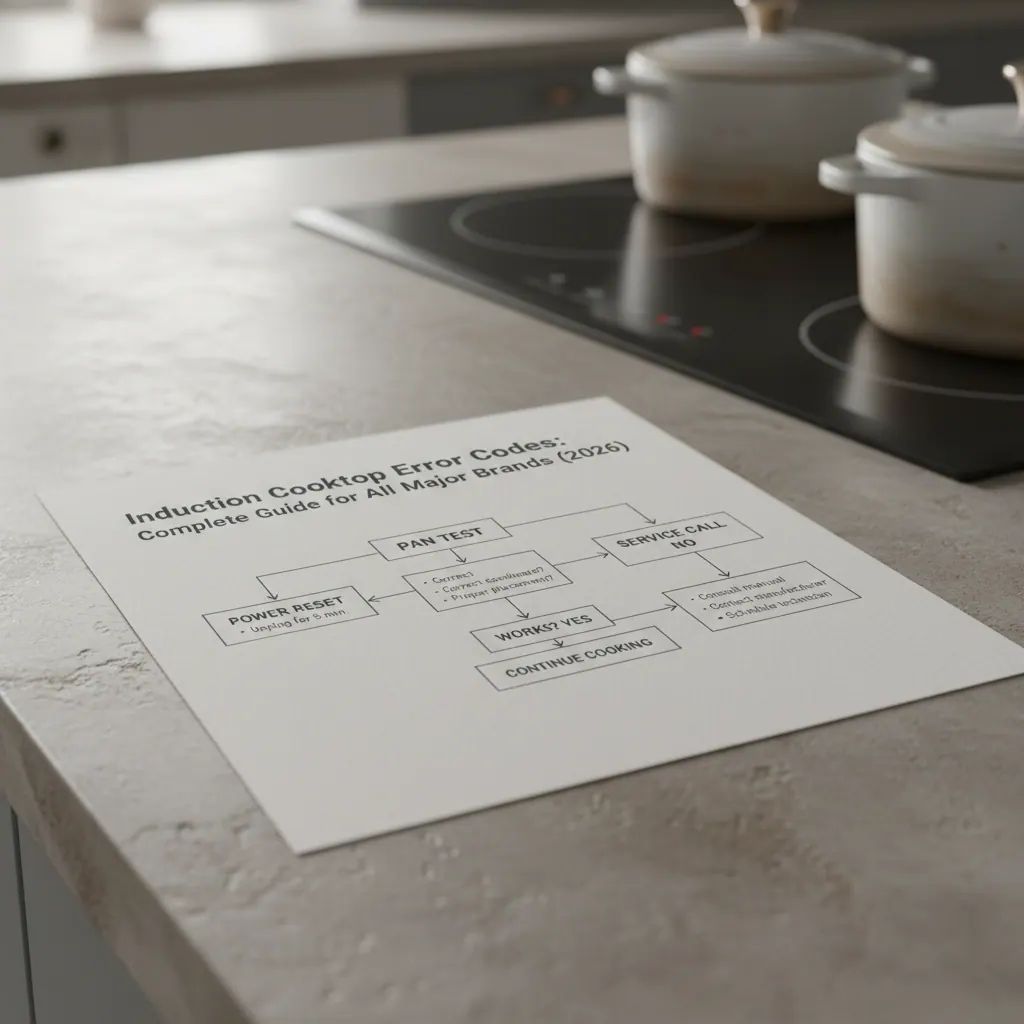
Follow this sequence for any induction error code:
Step 1 — Record the code. Note the exact code, which zone displayed it (if applicable) and what was happening when it appeared (cold start, high-power operation, boil-over, etc.).
Step 2 — Power cycle. Turn off the cooktop at the wall switch or circuit breaker. Wait 10 full minutes. Restore power and test. If the code does not return, it was likely a transient fault (voltage spike, temporary overtemperature).
Step 3 — Check the pan. If the code is a coupling/detection error (E3, Cd, U2, NO, C-d), test your pan with a kitchen magnet. If the magnet holds, the pan is ferromagnetic; if not, the pan is the problem, not the cooktop. Place the pan fully centered on the zone — most induction cooktops require the pan base to be within 1 inch of the zone center for detection. Our induction cookware guide lists compatible pan types.
Step 4 — Check clearance and vents. If the code is an overtemperature fault (E4, E8, E9, F2, F3), verify that the cooktop’s underside has the minimum cabinet clearance specified in the installation manual (typically 1.5–2 inches below the glass). Objects stored under the cooktop that block airflow will trigger overtemperature faults. Our cooktop installation guide covers clearance requirements in detail.
Step 5 — Check the power supply. Voltage fluctuations cause inverter and communication faults. Verify that the cooktop is on a dedicated 240V / 40–50A circuit. Our 240V electrical guide covers circuit verification for induction cooktops.
Step 6 — Call for service. If the code returns after power cycling and none of steps 2–5 resolve it, the fault is a hardware component failure. Do not attempt to replace inverter components, control boards or thermistors without factory service documentation — incorrect repair can create electrical safety hazards. Schedule service with an authorized technician.
When a code is not actually an error
Several displays that look like errors are normal operating states:
| Display | What it actually means |
|---|---|
| HOT (LG, Frigidaire, GE) | Residual heat warning — glass above 150 °F. Not a fault. |
| LOC / Loc (all brands) | Child lock or surface lock is engaged. Not a fault. |
| C-d / Cd / NO | Pan not detected on an active zone — a usage condition, not a hardware fault. |
| P (Bosch Benchmark) | Power boost mode indicator, not an error. |
| H (some Miele models) | Heating indicator, not an error. |
If you’re seeing a display you don’t recognize, check the user manual’s display reference section before assuming a fault exists.
When to call a technician vs DIY
DIY-resolvable codes:
- Pan coupling errors (E3, Cd, U2, NO) — always try a different induction-compatible pan first.
- Child lock displays (LOC, bEEP) — check manual for unlock sequence.
- Transient codes that clear after a 10-minute breaker reset.
- Overtemperature codes caused by blocked vents — clear obstruction and allow full cooldown.
Require a service technician:
- Inverter fault codes (Bosch F20–F29, GE F7, Samsung E-2, LG F3, KitchenAid F5 E0).
- Main board / EEPROM errors (Bosch E0, KitchenAid F1 E0).
- Temperature sensor faults that persist after power cycling (E1, F1, F10–F19).
- Fan failures (Bosch E8, LG F5, Frigidaire E6).
- Any code accompanied by burning smell, visible burn marks on the glass, or sparking.
For US warranty service, verify your cooktop is within the manufacturer warranty period before paying for a service call — most brands cover parts and labor for 1–5 years. Bosch and GE have the widest service footprints; Miele requires factory-authorized technicians.
Preventing error codes: maintenance tips
Most recurring induction fault codes are preventable:
- Keep vents clear: never store items in the cabinet directly below an induction cooktop. Maintain at least 2 inches of clearance for airflow.
- Use compatible cookware: warped pans cause repeated coupling errors and can strain the coil. See our induction cookware guide and best cast iron pans guide for our tested recommendations.
- Don’t leave empty pans at maximum power: dry pans at PowerBoost reach surface temperatures that can trigger thermal protection faults. Always have liquid or food in the pan at high settings.
- Keep the glass surface clean: liquid that enters the seal between the glass and the cooktop frame can reach electronics and cause intermittent communication errors. See our induction cooktop cleaning guide for proper technique.
- Verify dedicated circuit: shared circuits cause intermittent voltage faults that display as electronics errors. The cooktop must be on a dedicated 240V / 40–50A circuit. Our 240V guide covers the full wiring requirements.
Frequently asked questions
What does E1 mean on an induction cooktop?
On most brands (Bosch, Frigidaire, Samsung), E1 indicates a temperature sensor (thermistor) fault. First step: power off at the breaker for 10 minutes. If E1 returns, the thermistor or control board requires replacement. On GE Profile units, E1 is not used — GE uses F-codes. Always confirm against your specific model’s manual.
What does E3 mean on an induction cooktop?
E3 commonly indicates pan coupling failure — no ferromagnetic pan detected on the zone, or the pan is too small, warped or off-center. Use an induction-compatible flat-bottomed pan centered on the zone. If E3 persists with a compatible pan, the induction coil or coupling sensor may need service.
How do I clear an error code on my induction cooktop?
Turn off the cooktop at the wall switch or circuit breaker. Wait 10 minutes. Restore power. If the code was transient, it will not return. If it returns immediately, the underlying fault is still present and requires diagnosis or service.
What induction error codes require a service technician?
Inverter faults (Bosch F20–F29, GE F7, Samsung E-2), main board errors (E0, F1 E0), and temperature sensor faults that persist after power cycling. Cookware coupling errors (E3, Cd, U2) and child lock displays (LOC) are user-resolvable.
Why does my induction cooktop keep showing an error after I reset it?
A recurring error code after multiple resets indicates an active hardware fault, not a transient condition. The most common persistent faults are: thermistor failure (E1, F1), inverter component failure (F20, F7, E-2), and cooling fan failure (E8, E6, F5). These require a service technician.
Fault code data compiled from manufacturer service documentation, installation manuals and direct testing in the Cooktop Hunter lab. Verify codes against your specific model’s user manual before taking action. Updated May 2026.