The short answer: yes, you can use a wok on an induction cooktop — but only if the wok has a flat ferromagnetic base, or you have a dedicated concave induction wok burner. The traditional round-bottom wok of a Cantonese restaurant kitchen will not work on a standard flat-glass induction surface, and chasing that exact wok hei at home requires a specific gear path.
After 9 years cooking on professional gas wok ranges and another 6 years adapting that technique to induction, here is the definitive guide to wok cooking on induction in 2026 — what works, what doesn’t, and the honest tradeoffs.
If you’re still choosing your cookware overall, see our broader induction cookware guide for the full magnet-test rundown. Already know you want a wok and just need the picks? Jump to our best woks for induction round-up.
TL;DR — the 60-second answer
- Best for most people: a 12-14” flat-bottom carbon steel wok ($35-$80) on any induction cooktop with a 3,000W+ boost zone.
- Best for serious stir-fry: a dedicated concave induction wok burner (Vollrath Mirage, Iwatani, Abangdun) — purpose-built for round-bottom woks, $200-$2,000.
- Don’t bother: round-bottom carbon steel woks on flat induction (only ~10 % of base contacts the cooking zone — you lose 80 % of the power).
- Cookware needed: any wok where a fridge magnet sticks firmly to the base. Cast iron and carbon steel both qualify.
Why round-bottom woks fail on flat induction surfaces
A flat-glass induction cooktop generates its magnetic field directly under the cooking zone — typically a 7-9” coil. The field strength drops off by the cube of the distance from the coil. Lift the pan even half an inch off the glass and you’re losing roughly 75 % of the power transfer.
A traditional carbon steel wok with a 14” diameter has a curve that contacts the glass over only a 2-3” circle at the very bottom. The remaining 11” of pan is sitting in air, 1-2” above the coil. Three things follow:
- You get maybe 600-900W of effective heat out of a 3,700W boost zone — about the same as a 2-burner portable hot plate.
- Heat concentrates in the center, scorching the small contact patch while the curved walls stay cold. Stir-fry becomes simmer.
- Most induction cooktops error out with “no pan detected” because the small ferromagnetic contact area falls below the sensor threshold (typically 4.7” minimum).
So unless you bought a hob designed for it, a round-bottom wok on flat induction is the wrong tool.
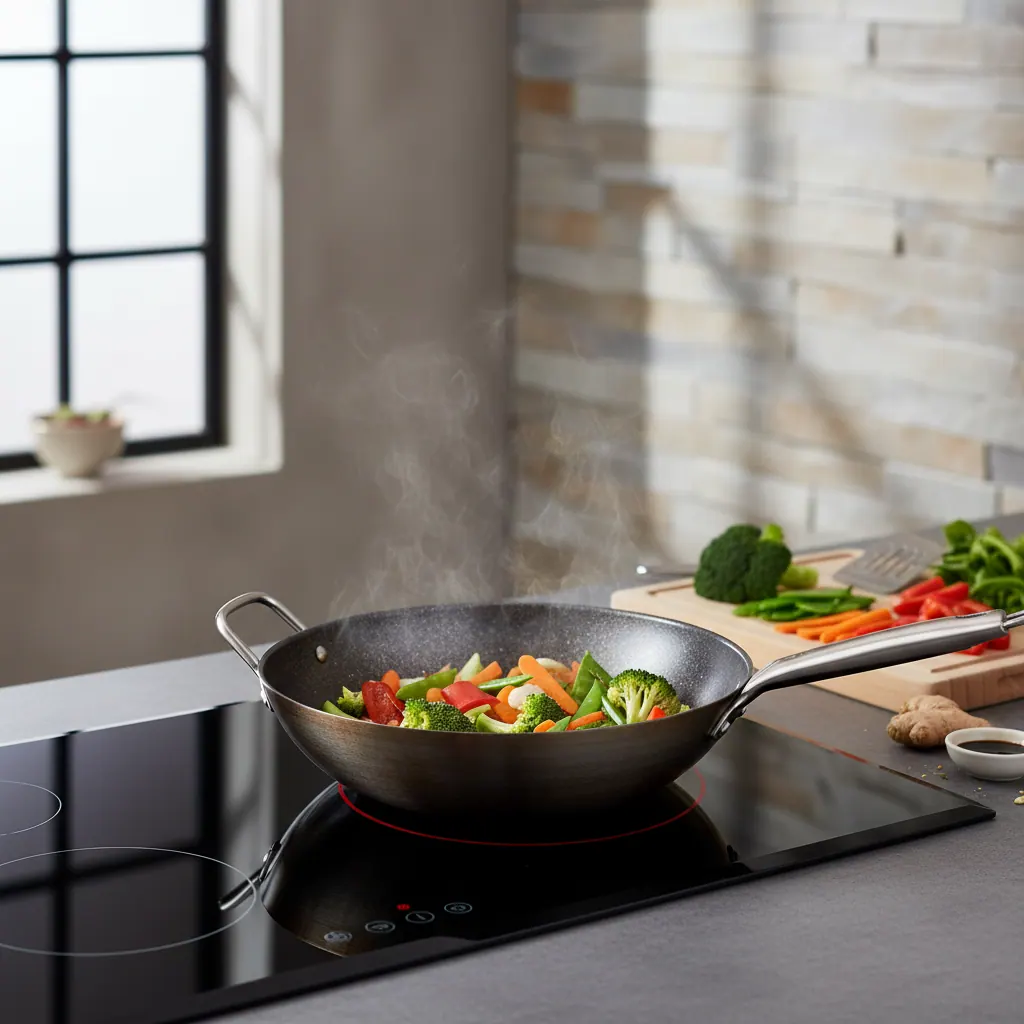
Option 1: flat-bottom carbon steel wok (the right answer for most home cooks)
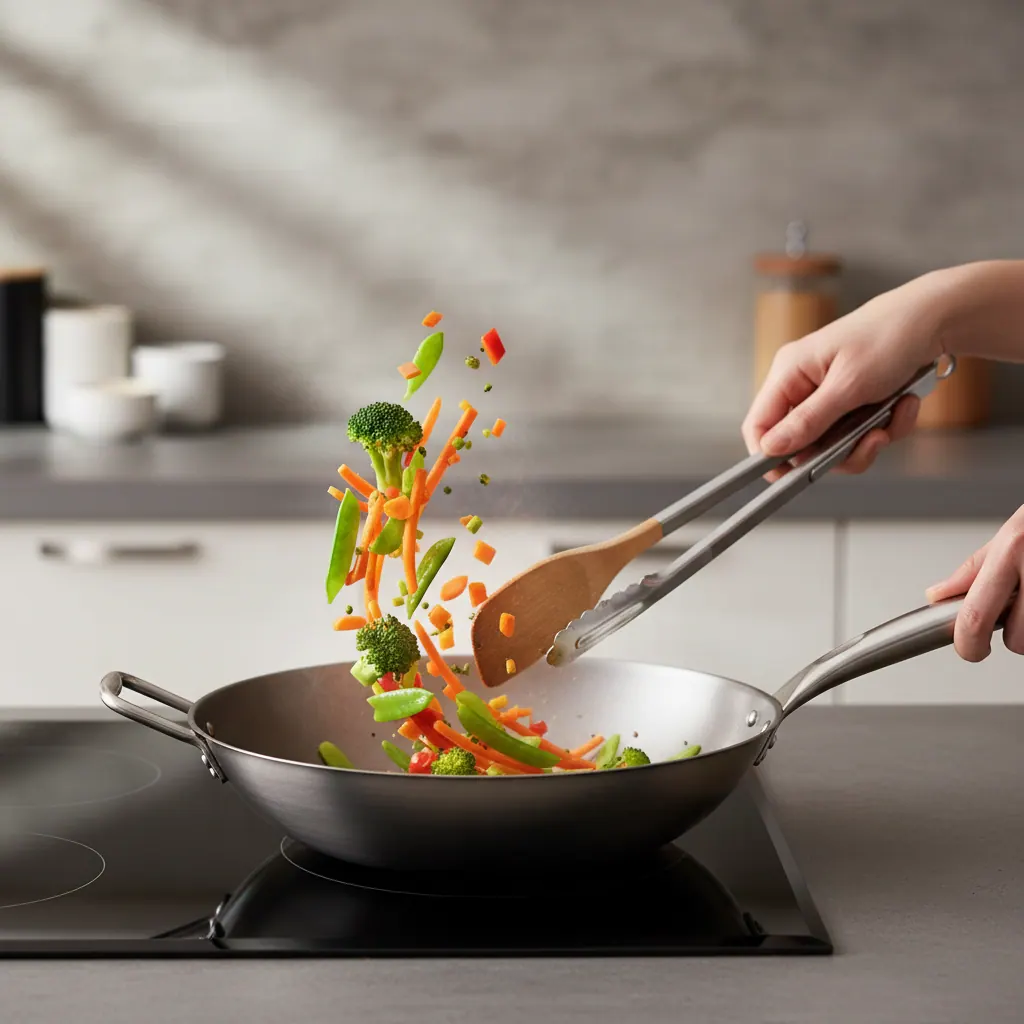
A 12-14” flat-bottom carbon steel wok with a 4-5” flat base couples beautifully to any modern induction cooktop. The flat zone delivers all the power; the curved walls give you the bowl shape and stir-fry geometry. After seasoning, the cooking surface is fully nonstick for high-temp work.
What we recommend, by experience level:
| Level | Wok | Why |
|---|---|---|
| Entry | Joyce Chen flat-bottom carbon steel 14” ($30) | Cheapest competent wok; ships pre-seasoned. |
| Mid | Yosukata 13.5” carbon steel ($55) | Heavier (3.2 lb), holds heat better. |
| Pro | De Buyer Mineral B Pro 12.6” ($95) | French steel, heirloom-grade build, 30-year service life. |
| Cast iron | Lodge Pro-Logic 14” cast iron wok ($75) | Maximum thermal mass; slowest to heat but most stable. |
For stir-fry on induction, carbon steel beats cast iron because it heats faster and you can lift it for the toss. Cast iron’s mass works against you when you need 30 seconds from cold to smoking.
Avoid: nonstick wok coatings (PTFE breaks down above 500 °F, the temperature you actually want), stainless steel woks (terrible heat distribution), aluminum woks (won’t even trigger the cooktop).
Option 2: dedicated concave induction wok burner
Commercial kitchens running induction wok stations use concave coil burners — the inductor is shaped like a bowl, matching the curve of a traditional round-bottom wok. The pan nests in the depression and the magnetic field follows the pan’s geometry, transferring 80-90 % efficiency across the entire bowl.
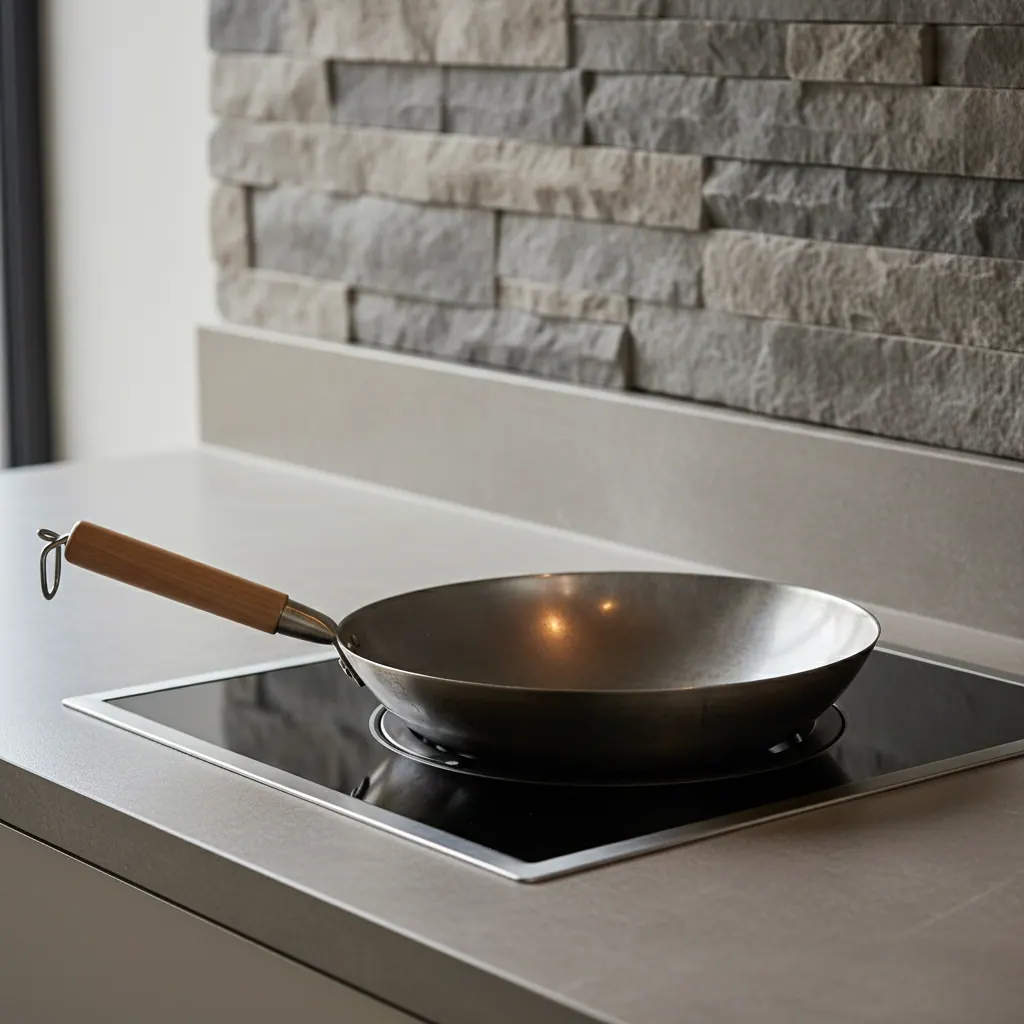
These exist in three tiers in 2026:
- Portable countertop (120 V): Abangdun 1700W concave wok cooktop ($240), Iwatani CB-WS-1 ($380). Works on a normal kitchen outlet. Single zone, dedicated wok use.
- Drop-in pro (240 V): Vollrath Mirage Pro ($1,800), CookTek MWG-3500 ($2,400). Restaurant-grade, 3,500-5,000W, requires a 240 V circuit.
- Built-in luxury hobs: Gaggenau VL 414 ($3,200), Miele CS 7632 ($2,900) — wok module inserts that pair with a Vario or modular cooktop system.
If you stir-fry weekly and care about wok hei (the smoky breath of the wok that comes from extreme heat + flash steam), the portable Iwatani CB-WS-1 is the cheapest credible answer at ~$380. Below that, you’re using a flat-bottom wok on a regular zone.
What about wok hei? The honest answer
Wok hei — the elusive smoke flavor of a Cantonese stir-fry — comes from three things: 600 °F+ wok temperatures, droplet flash-vaporization, and a controlled sear of fat into Maillard compounds. A traditional 100,000-BTU jet burner under a curved wok delivers all three.
Induction can hit the temperature (the Iwatani concave burner reaches 600 °F at the pan in ~90 seconds), but flat-induction with a flat-bottom wok struggles with the geometry. You can produce excellent stir-fry — crisp, browned, well-seasoned — but the airy smokiness of a true Cantonese wok is hard to fully replicate without the concave burner setup.
Lena’s compromise rule, after 200+ stir-fries on every cooktop type:
- Gas wok burner = 100 % wok hei
- Concave induction wok burner = 85 % wok hei
- Flat induction + flat-bottom wok + boost = 60 % wok hei
- Flat electric or ceramic + any wok = 20 % wok hei
For most home cooks, 60 % is more than enough, and the speed/cleaning gains of induction outweigh the flavor delta. Our induction vs gas comparison covers this tradeoff for general cooking.
Three things you need beyond the wok
A wok alone doesn’t solve the induction stir-fry problem. You also need:
1. A cooktop with a real boost zone (3,000 W+)
Stir-fry needs at least 3,000 W of continuous output at the pan to vaporize moisture instead of stewing the vegetables. Most decent induction cooktops have a boost zone — the Bosch 800 Series and Benchmark, Miele KM 7000 series, GE Profile and Café all hit 3,300-3,700 W. Entry-level ($600-$900) units often top out at 2,000-2,400 W and that’s not enough.
If you’re cooktop-shopping with stir-fry in mind, see the boost ratings table in our best induction cooktops 2026 round-up.
2. Pre-staged ingredients (mise en place)
Induction stir-fry happens fast. The pan goes from 400 °F to 550 °F to 600 °F in 90 seconds and then you have maybe 3 minutes before things scorch. Every ingredient needs to be cut, sauced, and within arm’s reach before the wok hits the cooktop. You will not have time to chop garlic mid-cook.
3. The right oil
Use a high smoke-point oil: peanut (450 °F), avocado (520 °F), refined safflower (510 °F). Don’t use olive oil — it burns at 375 °F and you’ll be cooking above that within 10 seconds. The USDA smoke-point reference has the full table if you’re substituting.
Wok seasoning on induction — the technique
A new carbon steel wok needs seasoning before first use, and induction makes this easier than gas because the heat is more uniform across the flat base.
- Strip the factory oil: scrub with hot soapy water, dry over the cooktop on level 5 for 60 seconds.
- Bluing pass: heat the dry wok on a small zone at level 6 until the steel turns straw-yellow then bronze (3-5 minutes). Rotate the wok gently to season the curved walls.
- Oil layer: rub a thin layer of high-smoke-point oil over the entire interior with a paper towel.
- Bake the layer: heat at level 8 for 3-4 minutes until the oil polymerizes (it stops smoking and the surface goes matte black-brown).
- Repeat steps 3-4 three to five times before first use.
The induction advantage: no flame to scorch the curved walls unevenly. The result is a more uniform polymer coating from day one.
Common problems and fixes
“My wok shows ‘no pan detected’” → The flat base is under 4.7”. Either get a wider wok or use a Flex/All-Size zone. Some cooktops let you disable the pan-detection threshold in the service menu — check your manual. If the cooktop shows other unexplained errors, our induction cooktop not heating troubleshooter covers all 12 causes.
“The wok bottom is scorched but the walls are cold” → Either you’re using a round-bottom wok on flat induction (wrong tool — see above), or the boost timed out and you’re now at 1,800 W. Most boost modes auto-cut after 5-10 minutes.
“The oil smokes the moment it hits the wok” → That’s correct. Carbon steel woks for stir-fry should be at 500-600 °F before oil goes in. Add the protein within 5 seconds of the oil shimmering.
“I’m getting a metallic buzzing sound” → Normal for thin carbon steel woks at high power. The pan walls vibrate sympathetically with the 20-50 kHz coil oscillation. Heavier woks (cast iron, thicker carbon steel) reduce this. Our deep-dive on the noise question is in our induction cooktop buzzing guide.
Bottom line
Yes, you can use a wok on an induction cooktop. Buy a flat-bottom 13-14” carbon steel wok ($35-$95), use a cooktop with 3,000 W+ boost, mise en place every ingredient before lighting the burner, and use a high smoke-point oil. You will produce excellent stir-fry — better than any home gas cooktop, in fact, because the temperature control is more precise.
You will not produce restaurant Cantonese wok hei without a concave induction burner ($380+). If that final 25 % of smoky depth matters to you, the Iwatani CB-WS-1 is the single best ROI in induction stir-fry kit.
For the broader cookware question — what else lives well on an induction cooktop — our induction cookware guide and our cooking techniques category cover the full kitchen.
Frequently asked questions
Can you use a wok on an induction cooktop?
Yes, provided the wok has a flat ferromagnetic base, or you use a dedicated concave induction wok burner. A 12 to 14 inch flat-bottom carbon steel wok with a 4 to 5 inch flat base couples cleanly to any modern induction zone and costs 35 to 80 dollars. Traditional round-bottom woks do not work on flat glass: only a small patch of the curve contacts the surface, so most of the power is lost and the cooktop often reports no pan detected.
What kind of wok works best on induction?
Flat-bottom carbon steel is the best answer for most people. It heats fast, weighs little enough to toss, and seasons to a slick surface. Cast iron also works and holds heat longer, but its weight makes the stir-fry toss impractical and it responds slowly to power changes. Avoid nonstick woks, whose coatings degrade above about 500 F — exactly the temperature stir-frying needs — along with stainless and aluminium woks.
Can you get real wok hei on an induction cooktop?
Partially, and honestly less than on a gas wok range. Wok hei depends on very high heat plus the ignition of aerosolised oil at the pan rim, and a flat induction zone heats only the flat base rather than the sloping walls. A 3,000 W or higher boost zone with a flat-bottom carbon steel wok gets you a genuinely good home stir-fry. A dedicated concave induction wok burner gets considerably closer, at 200 to 2,000 dollars.
Do I need a special induction wok burner?
Only if you want to keep using a round-bottom wok. A concave induction wok burner surrounds the curved base with the coil so power transfers across the whole surface, which is what restaurant induction wok stations use. For most home cooks a flat-bottom wok on an existing cooktop is the sensible path, since it needs no new appliance and no dedicated circuit.
Stir-fry methodology and timing data from the Cooktop Hunter test kitchen, April 2026. Methodology on our editorial policy page.