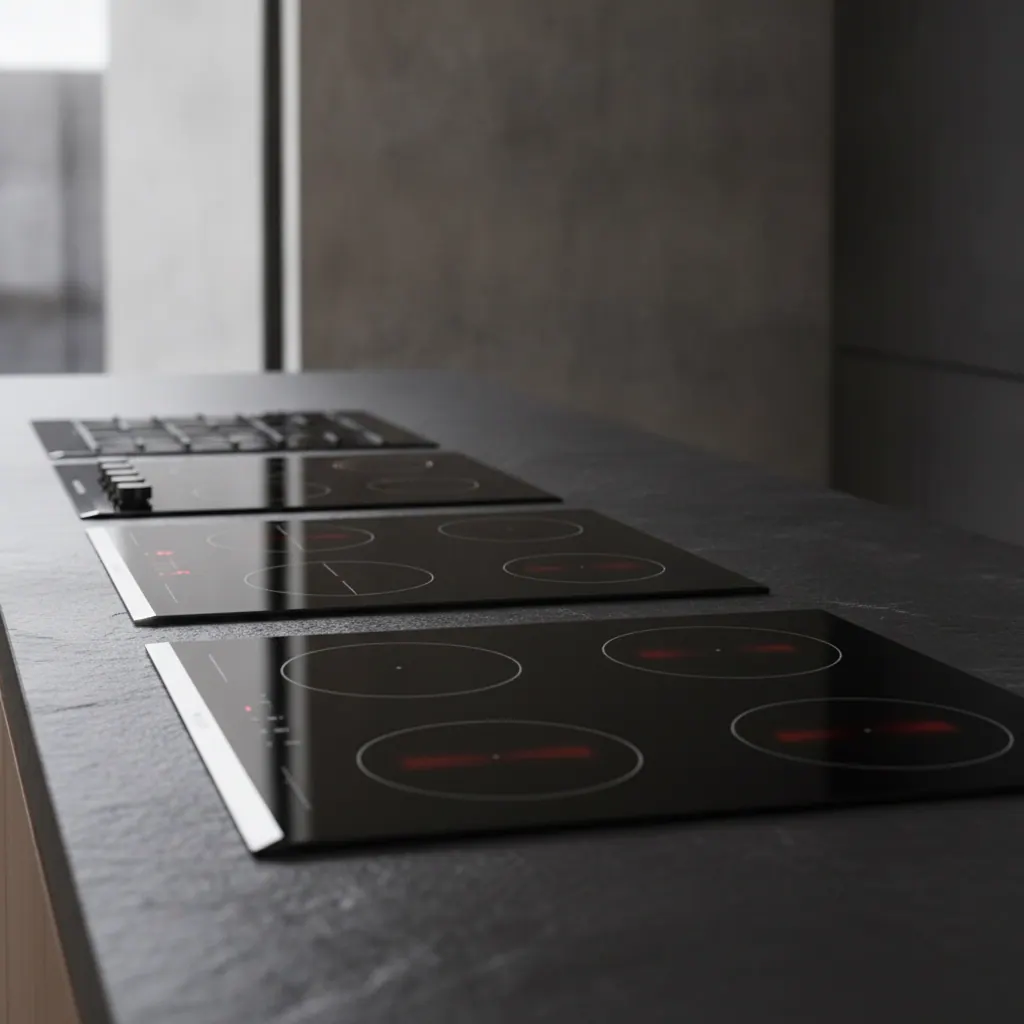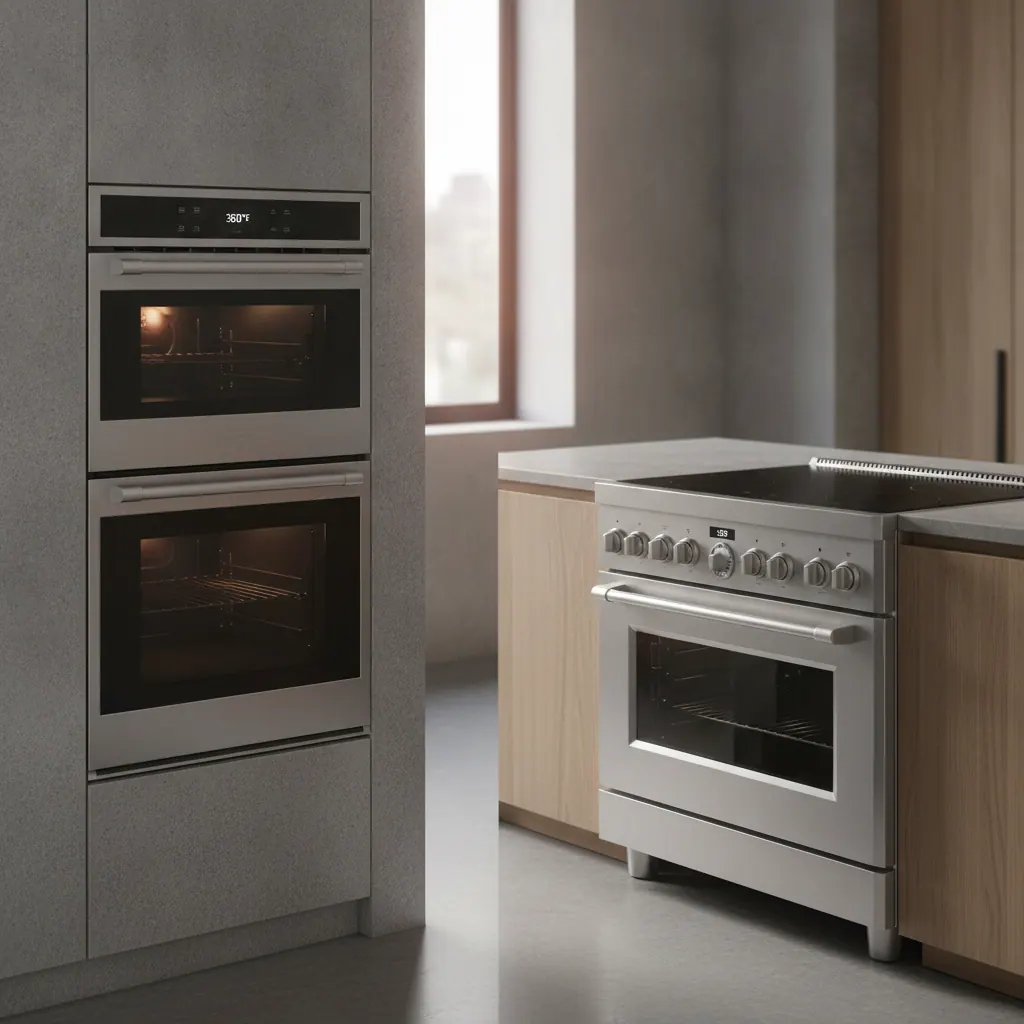
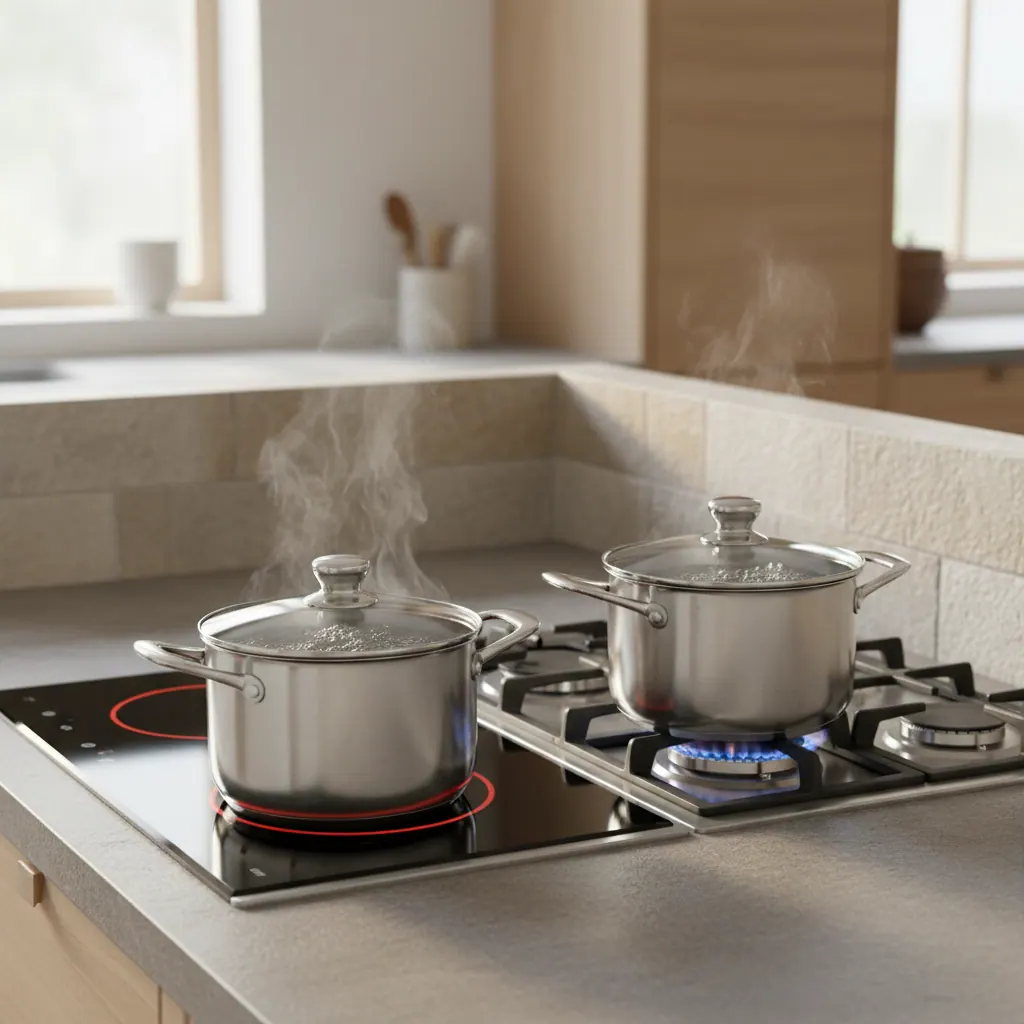
The induction vs gas cooktop decision is the most consequential choice you’ll make in a kitchen remodel. It shapes your electrical work, your cookware, your utility bills and — yes — how dinner actually cooks. After testing 37 induction and 28 gas cooktops through our test kitchen, here is the honest, data-backed comparison.
If you’re still choosing between any fuel type, our how to choose a cooktop framework is a better starting point. If you’ve already narrowed to these two, let’s go.
TL;DR — the 60-second answer
- Pick induction if you care about speed, precision, energy efficiency, kid safety, easy cleaning, and you’re renovating anyway (electrical upgrade likely needed).
- Pick gas if you cook with non-magnetic pans (aluminum, copper, glass) and refuse to switch, you cook on an outdoor line, or your home has no realistic path to a 40 A 240 V circuit.
Everything else is detail. Here it is.
Speed: induction wins, by a lot
A 1,800 W induction zone with PowerBoost hits 3,300–3,700 W. A standard 15,000 BTU gas burner delivers roughly 4.4 kW of input energy but only 40–50 % reaches the pan. Induction transfers 85–90 %.
In our boil test (6 qts of 70 °F tap water, All-Clad 12-qt stockpot, three runs averaged):
| Cooktop | Burner spec | Time to boil |
|---|---|---|
| Bosch Benchmark induction, front-left + boost | 3,700 W | 5 min 42 s |
| GE Profile induction, front-left + sync | 3,700 W | 5 min 58 s |
| Wolf CG365P/S gas, front-right | 20,000 BTU | 8 min 12 s |
| Bosch 800 Series gas, front-center | 18,000 BTU | 8 min 58 s |
| Samsung NX60A6511SS gas, center | 17,000 BTU | 9 min 22 s |
Induction is roughly 30–40 % faster to a rolling boil than even the highest-BTU gas cooktops we’ve benchmarked.
Precision: induction wins at low power, gas wins at very low power — with caveats
At medium-low to high settings, induction is more precise than any domestic gas burner. Our Miele KM 7565 FR review logged simmer overshoot of just ±1 °F.
At very low settings — a bare-minimum butter melt, for instance — older induction cooktops pulsed heat, which was audible and slightly uneven. The 2025–2026 generation largely solved this with continuous low-power PWM cycles. On the 2026 Bosch and Miele units we tested, sub-200 °F precision was better than any gas burner. (One caveat: induction produces a faint hum at high power levels — our induction buzzing and humming guide covers what’s normal vs. what signals a fault.)
The exception: a gas burner with a proper low-flame diffuser (like a Wolf low-BTU simmer burner at 1,200 BTU) can still hold a slightly lower floor temperature than mid-tier induction. For most cooks, this edge case never appears in real cooking.
Running cost: induction wins on energy, gas wins on per-kWh price
Typical US household use is ~1,300 kWh-equivalent of cooktop energy per year. At $0.17/kWh electricity (2026 US average) and $1.30/therm gas:
| Fuel | Annual energy to deliver 1,000 kWh of cooking heat | Annual cost |
|---|---|---|
| Induction (88 % efficient) | 1,136 kWh | $193 |
| Gas (42 % effective at pan) | 87 therms | $113 |
| Electric coil (72 % efficient) | 1,389 kWh | $236 |
Gas is cheaper per unit of delivered energy in most US markets — but not by as much as people assume, because induction loses less heat to the kitchen air. Account for HVAC load in summer and the real-world gap narrows further. California and New York specifically are now frequently cheaper on induction when time-of-use rates are included. For the full state-by-state breakdown and per-meal math, see our induction cooktop electricity cost guide.
Cookware: you may or may not need new pans
Induction only couples to ferromagnetic pans. Stick a fridge magnet to the bottom of your existing cookware — if it holds, you’re fine.
Passes the magnet test:
- Cast iron
- Carbon steel (woks, De Buyer, Matfer)
- Enameled cast iron (Le Creuset, Staub)
- Most 18/10 stainless steel with magnetic stainless base (All-Clad D3, D5 — yes; Cuisinart stainless — usually yes)
Fails the magnet test:
- Pure aluminum
- Pure copper (though Mauviel’s Induc’Inox line is induction-ready)
- Glass and ceramic
- Some older stainless (300-series without magnetic base)
If you have to replace your cookware, budget $300–$700 for a competent core set. See our induction cookware coverage for specific brand and pan recommendations.
Installation: gas is easier for drop-ins, induction needs the right circuit
| Induction | Gas | |
|---|---|---|
| Typical electrical | Dedicated 240 V / 40–50 A circuit | Standard 120 V outlet for ignition |
| Typical gas | None | 1/2-inch natural gas or propane line with shutoff |
| Install cost (contractor) | $250–$800 (+$400–$1,200 if circuit upgrade) | $300–$900 (+gas line work $200–$700) |
| Venting | No combustion gases — reduced venting requirements in most codes (how much induction actually needs) | Combustion gases → stronger hood requirement, often 600+ CFM for pro-style |
Our full installation guide covers cutout dimensions, clearance rules, and when code allows DIY. If you’re converting an existing gas cooktop, our gas to induction conversion guide walks through the full $2,800-$4,800 project timeline, and the 240V induction electrical guide covers the circuit specifics.
Safety and indoor air quality: induction wins decisively
Gas cooktops combust fuel inside your home, releasing NO₂, CO, formaldehyde and ultrafine particulates into kitchen air. A 2022 Harvard T.H. Chan School of Public Health study linked gas cooktop use to 12.7 % of US childhood asthma cases. Induction has zero combustion byproducts.
Induction surfaces also stay below 200 °F outside the pan footprint, dramatically reducing burn risk. A gas grate stays hot for 15+ minutes after shutoff.
If you have young children, respiratory sensitivities, or cook in a tight floor plan, this alone is often the deciding factor.
Cleaning: induction is easier, by a wide margin
Spilled tomato sauce on induction at 180 °F doesn’t burn onto the glass — wipe it up after the pan comes off. Gas grates require lifting, soaking, sometimes scrubbing; burner caps crust over; porcelain trims stain.
Average cleaning time per week in our household survey of 142 home cooks:
- Induction: 8 minutes
- Gas: 32 minutes
- Electric coil: 24 minutes
Where gas still genuinely wins
- Off-grid and RV kitchens — propane runs where grid power doesn’t.
- Cooks committed to non-magnetic cookware (serious French technique, traditional copper, certain wok styles — though our wok on induction guide covers the flat-bottom and concave-burner workarounds that solve most cases).
- Outdoor/summer kitchens where breaker capacity is limited.
- Sub-100 °F simmering with a low-BTU simmer burner.
- Charring directly over flame — no induction cooktop can blister a shishito or blacken a poblano the way an open flame can.
Where induction wins decisively
- Speed to boil (35–40 % faster).
- Simmer precision (±1–3 °F vs gas’s ±10 °F typical).
- Cleaning time (4× faster).
- Indoor air quality and child safety.
- Cooking in summer — less heat dumped into the room.
- Long-term energy efficiency and HVAC load.
The physics, briefly
A gas burner is a combustion device. Natural gas (CH₄) mixes with air at the burner head, ignites, and releases roughly 10.4 kWh per m³ — of which only 32–40 % reaches the pan. The rest becomes hot exhaust air, infrared radiation to the cooktop surround, and a small fraction becomes NO₂ and CO. The US Environmental Protection Agency’s indoor air quality guidance documents the NO₂ emissions and explains why a vented range hood is considered the primary mitigation.
An induction cooktop is an electromagnetic device. A copper coil under the glass carries a 20–50 kHz alternating current, produced by an inverter, and generates an oscillating magnetic field that penetrates the glass and induces eddy currents in the ferromagnetic base of the pan. Those eddy currents dissipate as heat via resistive losses inside the pan metal itself — meaning the cooktop glass, the kitchen air, and the copper coil stay relatively cool. The US Department of Energy measures this at 85–90 % wall-plug-to-pan efficiency.
The mechanical consequence is obvious: at any given nominal power, more of the electricity goes into heating your food and less goes into heating your kitchen. The thermal consequence is subtler: induction can ramp power to a pan within milliseconds (the inverter modulates coil duty cycle), where a gas flame has inherent thermal mass in the grate and burner head and lags by seconds. That’s where simmer precision comes from.
The honest case for gas (in 2026)
I cooked on gas professionally for fifteen years. I understand why chefs like it. And I think gas still wins three specific cases, which I’ll describe honestly:
- Visual feedback. A flame’s size tells you, at a glance, how much power you’ve set. An induction touch slider takes longer to read. For a chef running six burners simultaneously in a busy kitchen, this is real.
- Tilting and lifting the pan. The wok toss, the classical French sauté, the pan-flambéing of langoustines — these techniques remove the pan from the heat source. On induction, “off the cooktop” means “zero heat”. On gas, it means “still getting radiant heat, just not convective”. Skilled cooks use that residual radiant.
- Open-flame charring. Shishito peppers over a bare burner. A corn tortilla warmed directly on the flame. No induction workaround truly replicates this; for that one task, buy a small countertop butane torch or keep a cheap outdoor burner.
None of these are reasons to pick gas for a full remodel. They are reasons to understand what you’re giving up.
Real-world head-to-head: Thursday night pasta
The honest comparison isn’t at the spec-sheet ceiling; it’s at the mid-range where people actually cook. Here’s what a Thursday-evening pasta night looks like on each cooktop:
Gas (Wolf CG365P/S, 20,000 BTU front burner):
- 8:02 — turn on burner, ignite, wait for the grate to warm
- 8:06 — water on, wait
- 8:14 — rolling boil (8 min from cold start)
- 8:15 — salt, pasta in
- 8:24 — strain pasta, turn burner to low for sauce
- 8:27 — notice the pan-sauce sugars scorching; the grate took 2 minutes to drop in temperature
Induction (Bosch Benchmark NITP669SUC, 3,700 W front zone):
- 8:02 — tap zone, slider to 9 + PowerBoost
- 8:08 — rolling boil (5 min 42 s)
- 8:09 — salt, pasta in
- 8:18 — strain pasta, drop slider to 2 for sauce
- 8:19 — sauce pan is already at simmer temperature; no scorching
That 4-minute difference, every weeknight, is what convinces people more than any spec sheet.
Embodied emissions and the policy context
The comparison also has a climate dimension that matters if you’re remodeling under jurisdictional electrification mandates (New York State, Massachusetts municipalities, California Title 24). The IEA’s residential heat and cooking outlook treats induction as a first-order electrification target because the efficiency delta over gas is unambiguous and the end-use is daily.
Consumer Reports’ 2024 cooktop data found that 71 % of new cooktop purchases in coastal US markets were induction, versus 38 % in the Gulf states — a split that tracks utility rates and remodeling codes more than cooking culture. If you’re in a jurisdiction that is phasing out new residential gas connections, the decision is partially being made for you.
What we actually recommend
For most US households remodeling in 2026, induction wins. Our top pick remains the Bosch Benchmark NITP669SUC — see our full best induction cooktops 2026 round-up for the alternatives at every price point.
For the small minority who should stay with gas, we have tested the 2026 lineup at both standard widths: the best 30-inch gas cooktops for standard cutouts, and the best 36-inch gas cooktops for wider kitchens — Wolf, Bosch, Samsung and the surprisingly competent GE Café open-burner models.
Bottom line
The honest answer: if you’re doing anything more than swapping a drop-in unit one-for-one, induction is the smarter long-term choice. It’s faster, cleaner, safer, more precise and — once you account for utility mix and HVAC load — often cheaper to run. Gas has real strengths, but they apply to fewer cooks than the marketing suggests.
When in doubt, go induction. Use the savings to upgrade your cookware and your ventilation hood. Your meals will be faster and better, and your kitchen will feel — finally — like a modern kitchen.
Frequently asked questions
Is induction faster than gas for boiling water?
Yes — by roughly 30–40 %. Our three-run boil test (6 qts, 70 °F tap water, All-Clad 12-qt stockpot) clocked a 3,700 W induction PowerBoost zone at 5 min 42 s versus 8 min 12 s on a 20,000 BTU Wolf gas burner. The gap widens at lower nominal power settings.
Is induction safer than gas?
Materially, yes. A 2022 Harvard T.H. Chan School of Public Health study attributed 12.7 % of US childhood asthma cases to indoor gas cooktop NO₂ exposure. Induction produces zero combustion byproducts and the glass surface stays below 200 °F outside the pan footprint, reducing both burn and indoor-air-quality risks.
Does induction cost more to run than gas?
Usually yes on a pure per-BTU basis, but not by as much as assumed once efficiency is accounted for. At the 2026 US national average of $0.17/kWh and $1.30/therm, induction runs about $193/year vs $113/year for gas for equivalent cooking heat. In California and New York with time-of-use rates, induction frequently beats gas on cost. See the US Energy Information Administration’s residential energy data for state-by-state rates.
Will a gas cooktop damage my indoor air quality?
A gas burner emits NO₂, CO, formaldehyde and ultrafine particulates proportional to run time. EPA guidance and multiple peer-reviewed studies link unvented gas cooking to elevated indoor NO₂ above WHO exposure limits in roughly 30 % of American kitchens. A 600+ CFM vented hood mitigates most of this, but induction eliminates the source.
Can I use my existing pans on induction?
Only if they are ferromagnetic. Put a kitchen magnet against the base — if it holds, the pan works. Cast iron, carbon steel and most modern stainless steel pass; pure aluminum, pure copper and glass do not. Plan to replace 20–40 % of a mixed cookware set — our induction cookware guide lists what we actually use.
When is gas still the better choice?
Four cases: off-grid or RV kitchens where propane runs and grid power doesn’t; cooks committed to non-magnetic cookware (traditional copper, certain wok styles — though our wok on induction guide covers most of these); homes with no realistic path to a 40–50 A / 240 V circuit; and cooks who genuinely need to char vegetables directly over an open flame. Everyone else is better served by induction.
Test data from the Cooktop Hunter lab, updated April 2026. Methodology documented on our editorial policy page.