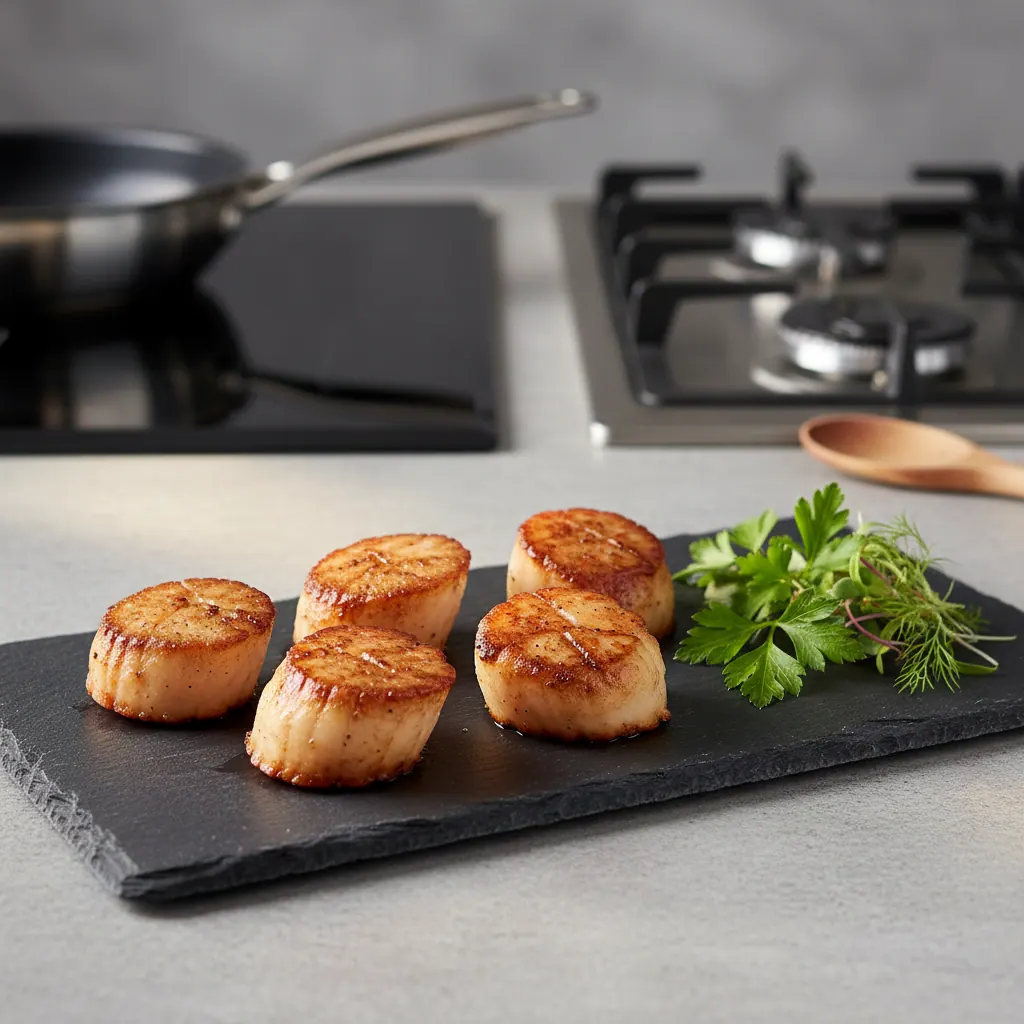
A perfectly-seared scallop has a 1mm thick caramel-colored crust on top and bottom, a snow-white translucent center, and a soft yielding texture that suggests it was barely cooked. A badly-seared scallop is a tough, rubbery, grey-white puck. The difference is 60 seconds of cooking and one decision at the fish counter (dry-pack vs wet-pack).
After 22 years cooking scallops in restaurants and five years comparing the technique on every cooktop technology in our kitchen, here is the complete guide — including the single buying decision that determines 80% of your result before you ever turn the cooktop on.
For broader pan-searing technique, see our how to sear steak on induction which covers the same Maillard fundamentals. For frying applications, our how to deep fry on induction has the oil temperature management.
The make-or-break decision: dry-pack vs wet-pack
Before any technique discussion: only buy dry-pack scallops. Wet-pack scallops cannot be properly seared, regardless of pan, technique, or cooktop.
What’s the difference?
Wet-pack scallops are treated with sodium tripolyphosphate (STPP) — a phosphate solution that the scallops absorb during processing. They look plumper, weigh more (up to 20% added water), and have a slightly soapy white appearance. When you put them in a hot pan, they release this absorbed water, which drops the pan surface temperature below the browning threshold (300°F+) and produces a grey-white steamed result instead of a seared crust.
Dry-pack scallops (also called “diver scallops” or “day-boat scallops”) are untreated. They have a cream or pale-pink color, a slight off-white outer skin, and a firm-yet-soft texture. They sear properly because their surface moisture is normal — minimal liquid release in the pan, full Maillard reaction.
How to identify each at the counter
| Marker | Dry-pack | Wet-pack |
|---|---|---|
| Label | ”Dry pack” / “Untreated” / “Diver” / “Day boat" | "Wet pack” / often unlabeled / “Treated” |
| Color | Cream, pale-pink, sometimes slight tan | Bright white, slightly translucent |
| Texture | Slightly tacky to touch | Slick, almost wet |
| Smell | Briny, ocean | Mild, faintly soapy |
| Price (per lb) | $25–$40 | $14–$22 |
If the label doesn’t clearly say “dry pack,” ask the fishmonger directly. If they don’t know, assume wet-pack and skip them. The price differential ($10–$15 per pound) is meaningful, but wet-pack scallops are the wrong product for searing entirely.
Sizes (count per pound)
Scallops are sold by count per pound — the number of scallops in one pound:
| Size | Count per lb | Diameter | Best technique |
|---|---|---|---|
| U-10 (jumbo) | Under 10 | 1.5–1.75” | Pan-sear; 90 sec per side |
| U-12 | 10–12 | 1.25–1.5” | Pan-sear; 80 sec per side |
| U-15 | 13–15 | 1–1.25” | Pan-sear; 60–75 sec per side |
| 20-30 | 20–30 | 0.75–1” | Quick sear; 45 sec per side |
| Bay scallops | 70–110 | 0.4–0.5” | Stir-fry; 30–45 sec total |
For pan-searing, U-10 to U-15 is the practical range. Larger scallops (U-10) are easiest to sear because the longer cook time gives a more developed crust before the interior overcooks. Smaller scallops (20-30 count) sear so fast that getting a proper crust without overcooking the center is genuinely difficult.
Equipment: what to use
Pan
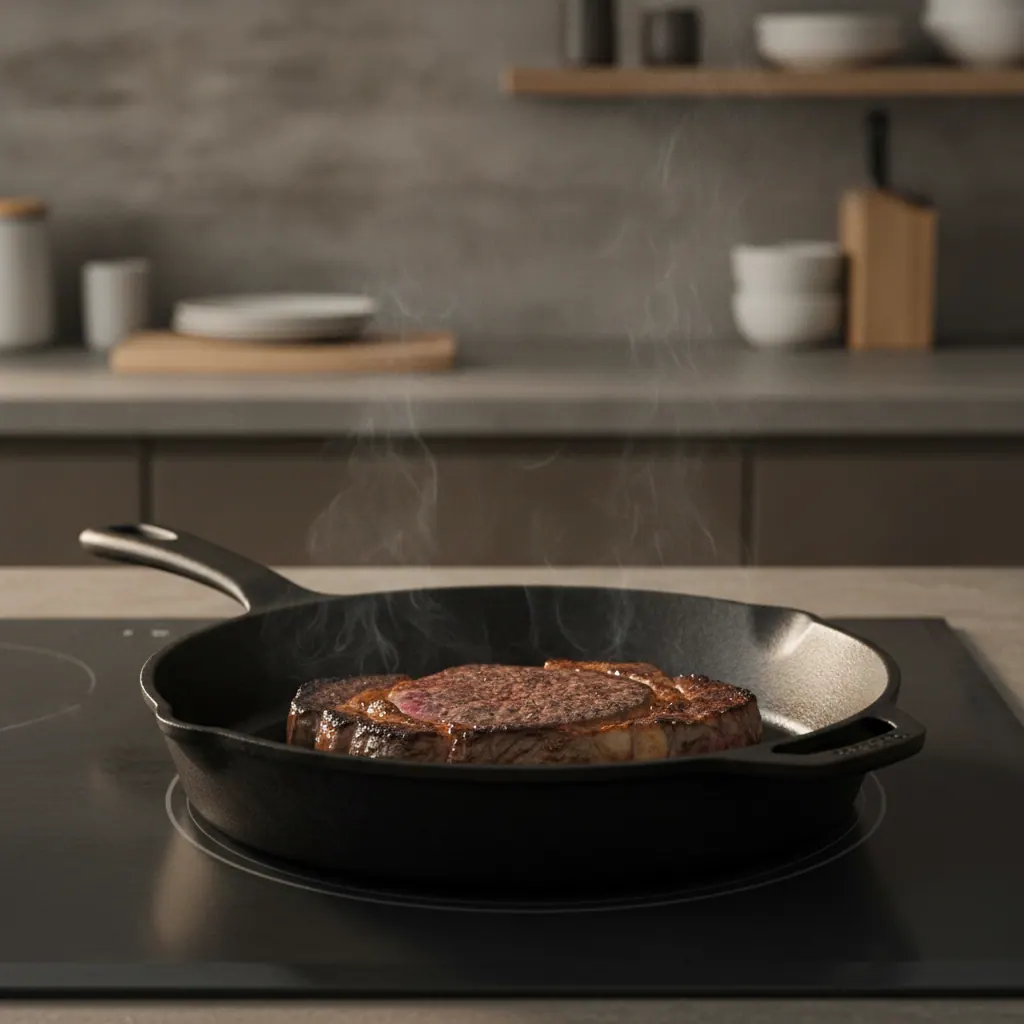
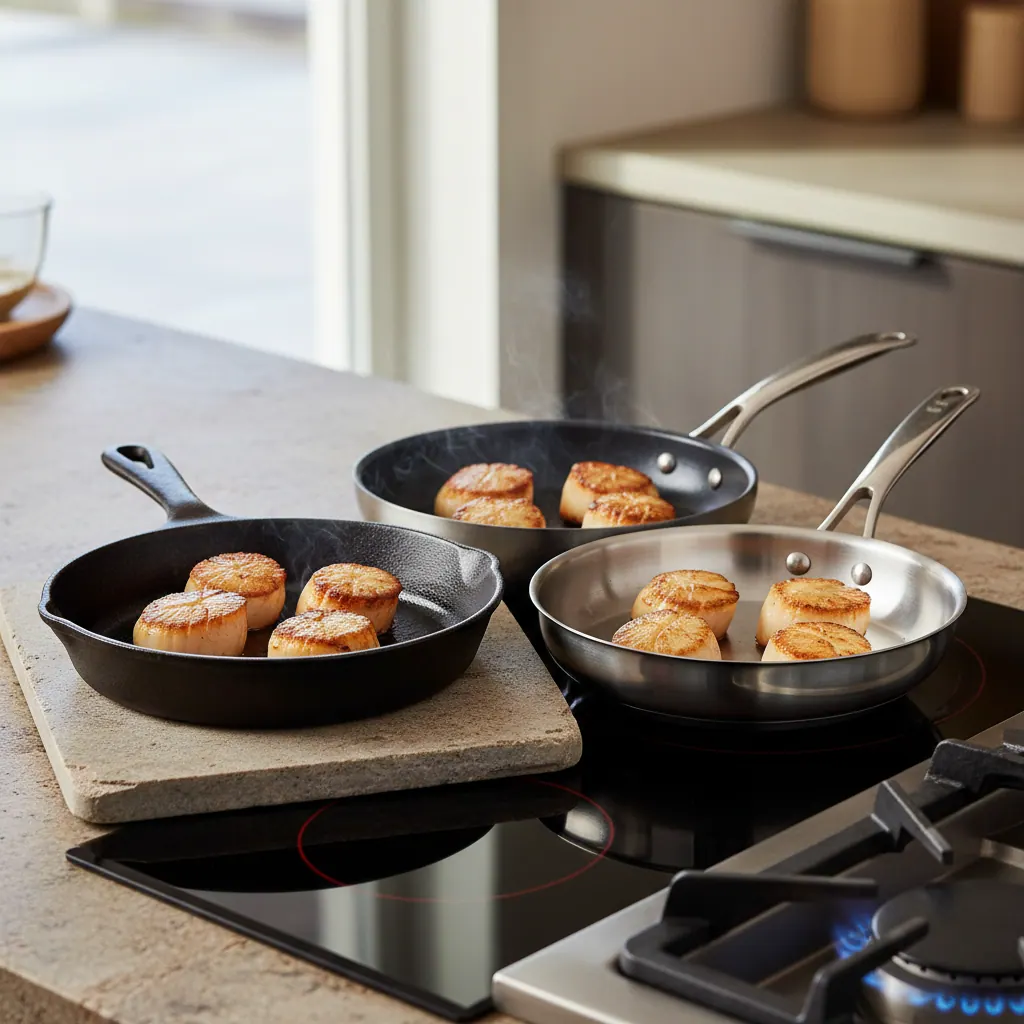
Best: 12-inch cast iron skillet (Lodge Classic, Field No. 8, Smithey No. 12).
- Heavy thermal mass holds temperature when scallops hit the surface.
- Naturally non-stick when properly seasoned.
- Even heat distribution.
Alternative: 12-inch carbon steel (De Buyer Mineral B, Made In carbon steel).
- Lighter than cast iron; heats faster.
- Excellent searing; good for scallops with practice.
Alternative: tri-ply stainless (All-Clad D3, Made In stainless).
- Slowest preheat but doesn’t hold heat as long when scallops drop the temperature.
- Works but requires careful temperature management.
Avoid: nonstick pans. PTFE coatings degrade above 500°F and cannot reach the surface temperature needed for proper scallop searing. The “non-stick” property is also unnecessary — properly seared scallops release naturally from a hot pan.
For the specific pans we use in test, see best cast iron pans for induction and gas and best stainless steel pans for induction.
Oil
High smoke-point neutral oil:
| Oil | Smoke point | Best for |
|---|---|---|
| Refined avocado oil | 520°F | Highest smoke point — best margin |
| Refined peanut oil | 450°F | Good searing, classic flavor |
| Grapeseed oil | 421°F | Neutral, widely available |
| Refined canola | 400°F | Budget option, neutral flavor |
Never use: extra virgin olive oil (smoke point 375°F — too close to scallop searing temps), butter (burns), unrefined coconut oil (smoke point 350°F).
For ghee or butter: add at the end for finishing flavor, never as the searing oil.
Thermometer
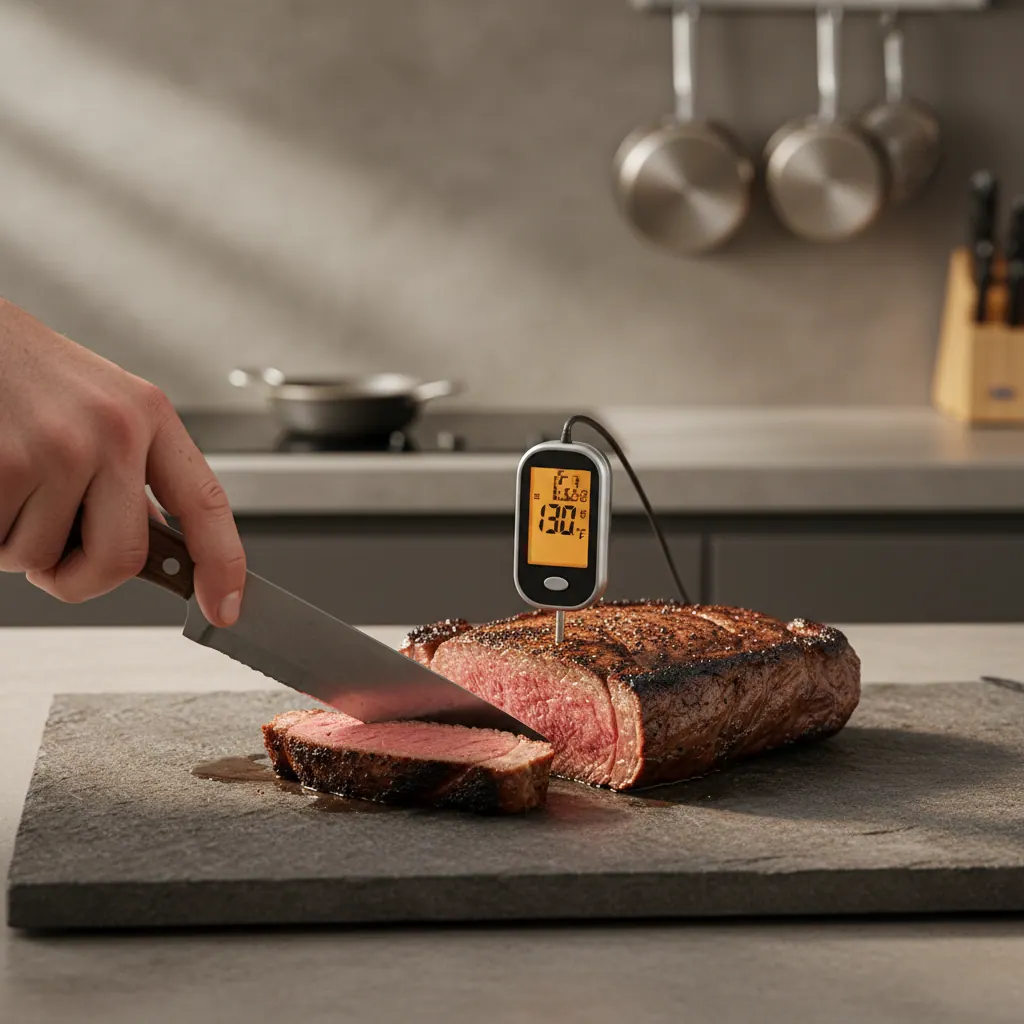
Optional but useful: an instant-read thermometer (ThermoWorks ThermaPen, Lavatools Javelin Pro) for verifying internal temperature on large scallops. For U-10 scallops, target 115–125°F internal at the center — though accurate measurement is difficult due to scallop size.
For pan surface temperature, an infrared (IR) thermometer is the most reliable verification of pan readiness ($25 — Etekcity, Klein Tools).
The technique: 7 steps to perfect scallops
1. Remove the side muscle (if present)
The “side muscle” is a small rectangular tab of tougher tissue on the side of each scallop. Most processors remove it, but some leave it. Pull it off with your fingers — it comes off easily. Cooking scallops with the side muscle attached produces a chewy strip on each piece.
2. Pat dry vigorously
Place scallops on three layers of paper towels. Press another paper towel firmly on top — change the bottom paper towel and repeat. The surface must be completely dry. Any surface moisture flash-vaporizes in the hot pan and prevents the Maillard reaction from starting until all the water has boiled off — the result is a steamed grey edge.
For dry-pack scallops, this takes 30 seconds. For wet-pack scallops, it’s actually impossible — the absorbed water keeps releasing during cooking regardless of how much surface drying you do.
3. Salt right before cooking
Sprinkle kosher salt (Diamond Crystal preferred) on both flat sides, just before the pan. Salting earlier draws moisture to the surface — the opposite of what you want for searing. For scallops, the 30-minute pre-salt that works for steak does NOT work — surface moisture management is the critical factor.
Pepper at the end (after cooking) — pepper added before searing burns and turns acrid in the pan.
4. Heat the pan
Cast iron in cold pan; turn cooktop to high. On induction at level 9 (3,700W), preheat 6–7 minutes. On gas at full burner, 8–9 minutes. Verify temperature with the water-drop test — a single drop should hit the pan and vaporize in under 1 second with a sharp hiss. If it sizzles slowly, the pan isn’t hot enough.
Add 1 tablespoon high-smoke-point oil. Within 5 seconds, the oil should shimmer and produce thin wisps of smoke.
5. Lay scallops in the pan
Place each scallop flat-side down in the pan, leaving 1.5 inches of space between each one. Crowding the pan drops the temperature and produces steamed scallops.
For 6 large U-10 scallops, a 12-inch pan is the minimum. For 10+ scallops, work in two batches.
After placing, do not move the scallops. Resist all urges to peek, lift, or rotate.
6. Sear, flip once, sear
For U-10 scallops: 90 seconds first side, flip, 60 seconds second side. For U-15 scallops: 75 seconds first side, flip, 45 seconds second side.
The scallop will tell you when to flip — when the crust is properly developed, the scallop releases easily from the pan. If it sticks, give it 15–20 more seconds.
Use tongs or a fish spatula — never pierce the scallop with a fork.
7. Pull early — they overcook in seconds
The second side is finished when there’s a 1-2mm golden ring developing around the perimeter. This is typically 60 seconds after flipping for U-10 scallops.
Internal temperature target: 115–125°F. Translucent center, just-cooked. Above 130°F, the scallop becomes tough and rubbery.
Transfer immediately to a warm plate or a wire rack (NOT a paper towel — scallops steam against absorbent surfaces). Optional: finish with a small pat of butter, fresh herbs (chive, parsley), and a squeeze of lemon.
Total cook time: 2 minutes 30 seconds for U-10 scallops.
Cooktop-specific notes
Induction
The best surface for scallops. Two reasons:
- Faster preheat. A 3,700W boost zone reaches 470°F pan surface in 6–7 minutes versus 8–9 minutes on a 15,000 BTU gas burner.
- Faster recovery. When 6 cold scallops hit a 470°F pan, the surface drops 50–60°F. Induction recovers to 460°F+ in under 90 seconds; gas takes 2+ minutes. The faster recovery means scallops sear continuously rather than steam-then-sear.
For the precision required for scallops, induction’s 12-step power control on premium models (Bosch Benchmark, GE Profile) is the right tool.
Gas
Gas works for scallops but requires more attention. Use a high-BTU power burner (15,000+ BTU) and watch the recovery — you may need to wait 30 seconds for the pan temperature to recover before adding the next batch.
For high-BTU gas cooktops, see wolf vs thermador gas cooktop — both brands’ 18,000–20,000 BTU power burners handle scallop searing well.
Electric smooth-top
The slowest preheat and slowest recovery of any cooktop technology. Possible to sear scallops on electric smooth-top, but expect more variance — pull scallops earlier (the slower recovery means longer surface contact, which means easier overcooking).
For better technology, see best induction cooktops 2026 and best 30-inch gas cooktops.
Common mistakes and the fixes
| Mistake | Result | Fix |
|---|---|---|
| Buying wet-pack scallops | Steam, no crust, watery result | Dry-pack only — verify with fishmonger |
| Wet scallop surface | Steam ring, no Maillard | Pat dry vigorously 3+ times |
| Pan not hot enough | Pale grey scallop, no crust | Verify with water-drop or IR thermometer at 450°F+ |
| Crowding the pan | Steam, batch cooks unevenly | Leave 1.5” between scallops; cook in batches |
| Too much oil | Scallops swim, no crust | Thin film only — 1 tablespoon |
| Salting 5 min ahead | Surface moisture | Salt right before the pan |
| Flipping early or repeatedly | Crust tears, no proper Maillard | One flip only; let the scallop release naturally |
| Cooking past 60 sec second side | Tough, rubbery, shrunken | Pull at 90+60 sec for U-10; smaller sizes faster |
| Using nonstick | Can’t reach searing temperature | Cast iron, carbon steel, or tri-ply stainless |
| Resting on paper towel | Bottom crust softens | Wire rack or warm plate |
Bay scallops: a different technique
Bay scallops (the small 0.4–0.5 inch variety, 70–110 per pound) are too small for traditional searing — by the time the crust forms, the interior is overcooked. Three good techniques:
- High-heat stir-fry: 30–45 seconds total in a screaming hot wok or pan with garlic, soy, and ginger.
- Quick scampi: 60 seconds in butter and garlic — lightly cooked, served with pasta.
- Ceviche: raw, cured in citrus juice — bay scallops are excellent for this.
Bay scallops are not pan-searable in the way sea scallops are. Don’t try to apply U-10 technique to them.
Bottom line
Scallop searing is 80% buying decision (dry-pack only), 15% pan temperature (450°F+), 5% technique. Get the first two right and the technique becomes simple — 90 seconds per side, flip once, pull at 2 min 30 sec total for U-10s.
A perfectly seared scallop is one of the most impressive home-cooked dishes — restaurant-quality, 5 minutes total work, and forgiving once you’ve nailed the buying and pan-temperature decisions.
For the gear we use to cook scallops in our test kitchen, see best cast iron for induction and gas and best induction cooktops 2026.
Frequently asked questions
How do you sear scallops perfectly?
Six steps: dry-pack scallops only, pat completely dry, salt right before cooking, heat pan to 450–470°F, sear 90 seconds first side without moving, flip once, sear 60 seconds second side, pull immediately. Total cook time 2 min 30 s for U-10 sea scallops. Internal target 115–125°F.
What temperature do you cook scallops at?
Pan surface temperature: 450–470°F — verify with an IR thermometer or water-drop test (drop should vaporize in under 1 second). On induction at level 9 with cast iron, 6–7 minutes preheat. Internal scallop target: 115–125°F at the center.
How long does it take to cook scallops?
U-10 sea scallops: 90 sec first side + 60 sec second side = 2 min 30 s total. U-15: 75+45 sec. Bay scallops: 30–45 sec total (stir-fry technique). Smaller scallops cook faster — adjust by size.
Should you buy wet or dry pack scallops?
Dry-pack only. Wet-pack scallops contain sodium tripolyphosphate solution that prevents browning — they steam-cook and become tough. Look for “dry pack,” “untreated,” “diver,” or “day boat” labels. Cost difference ($10–$15/lb) is meaningful but worth it.
Why don’t my scallops have a golden crust?
Five common causes: wet-pack scallops, wet surface (insufficient drying), pan not hot enough, crowded pan, or salt too early. Fix: buy dry-pack, pat dry 3+ times, verify pan at 450°F+, leave 1.5” between scallops, salt right before searing.
Cooking technique data from 60+ scallop cooks tested in the Cooktop Hunter test kitchen, May 2025–April 2026. Type-T thermocouples for pan surface measurement. Scallop sourcing verified through Marine Stewardship Council certified fishmongers in Vancouver and Boston for dry-pack quality controls.