Salmon at 145°F is dry. Salmon at 125°F is silky. Salmon at 120°F (wild) is restaurant-quality medium-rare. The difference between perfect and overcooked is 20°F — and it happens in about 60 seconds of additional cooking on a hot pan. Cooking salmon well is fundamentally a temperature problem.
After 22 years cooking fish in restaurants and five years testing salmon technique on every cooktop technology, here is the complete guide — internal temperatures by variety, how to identify doneness without a thermometer (you still need one), and the exact technique for crispy-skin pan-seared salmon at home.
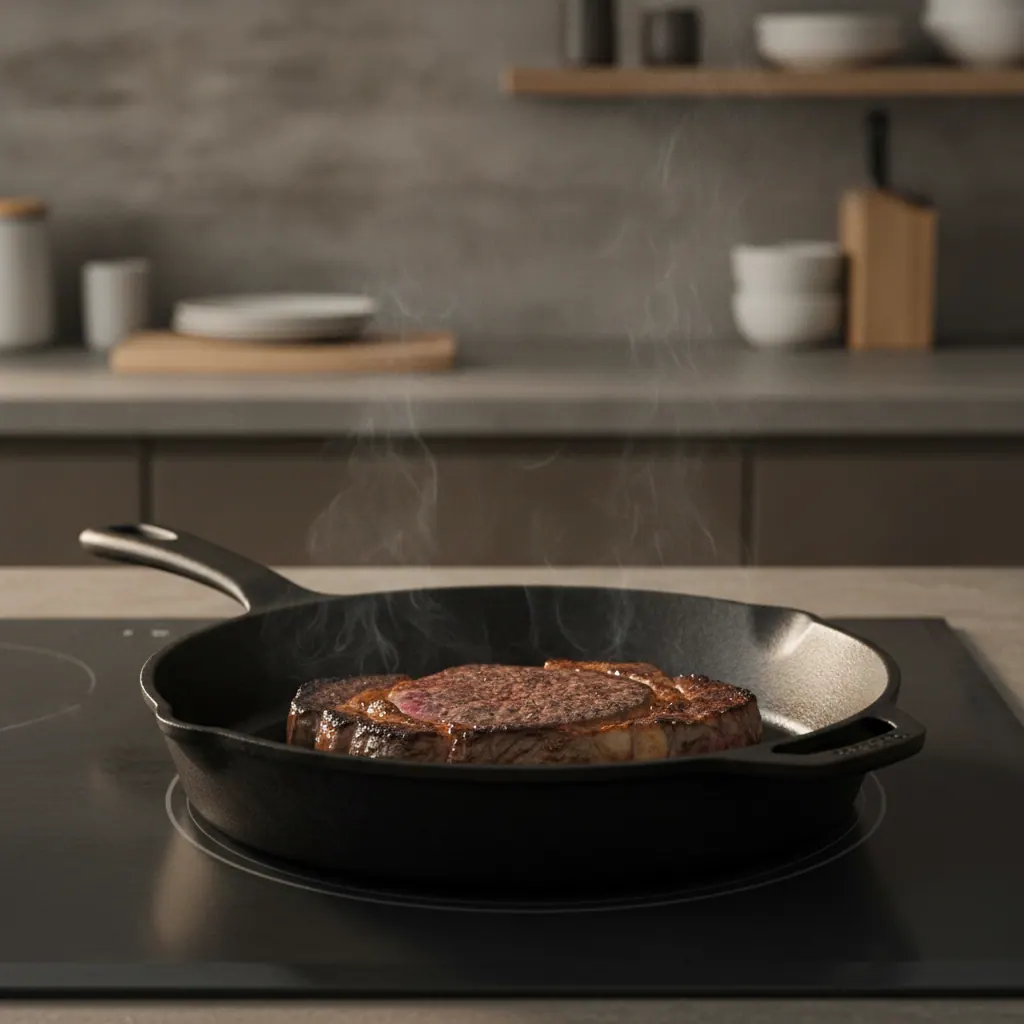
For broader fish-on-cooktop technique, see our how to sear steak on induction which covers similar high-heat principles. For deep-fried fish, our how to deep fry on induction has the oil temperature management.
The salmon temperature chart
Salmon doneness varies more than any other commonly-cooked protein because of the difference between wild and farmed varieties. Wild salmon (king, sockeye, coho) is leaner — overcooks fast. Farmed Atlantic salmon is fattier — more forgiving.
| Doneness | Pull temp | Final temp | Texture and color |
|---|---|---|---|
| Sashimi (raw) | n/a | 38°F | Translucent; silky; only with frozen-for-7-days protocol |
| Très saignant (very rare) | 105°F | 110°F | Center barely warm; mostly translucent; sushi-style |
| Saignant (rare) | 115°F | 120°F | Translucent center; soft and silky |
| Medium-rare ⭐ | 120°F | 125°F | Best for most wild salmon — just-set, pink, juicy |
| Medium | 125°F | 130°F | Best for farmed Atlantic — firm but moist |
| Medium-well | 135°F | 140°F | Fully opaque; firm flake; drier |
| Well-done (USDA) | 140°F | 145°F | Fully cooked; firm flake; significantly drier |
USDA target: 145°F. This is the food-safety mandate. For consumers who want fully cooked salmon with no compromise on safety, 145°F is the standard. For everyone else (including most restaurants), 125–130°F final temperature is the optimal eating point — and salmon properly handled (frozen at -4°F for 7 days) is parasite-safe at any internal temperature.
Why pull-and-rest matters for salmon
Salmon carryover cooks faster than red meat because it’s leaner with less thermal mass. For a 1-inch thick fillet:
| Piece | Carryover rise | Rest time |
|---|---|---|
| 1-inch fillet (6 oz) | 4–6°F | 2 minutes |
| 1.25-inch fillet (8 oz) | 5–8°F | 3 minutes |
| 1.5-inch center cut (10 oz) | 6–10°F | 4 minutes |
| Whole side (2.5 lb) | 8–12°F | 5–7 minutes |
This is why pulling at 120°F gets you to 125°F — and why pulling at 125°F gets you to 132°F (already past medium-rare for wild salmon).
Wild vs farmed: the temperature differs
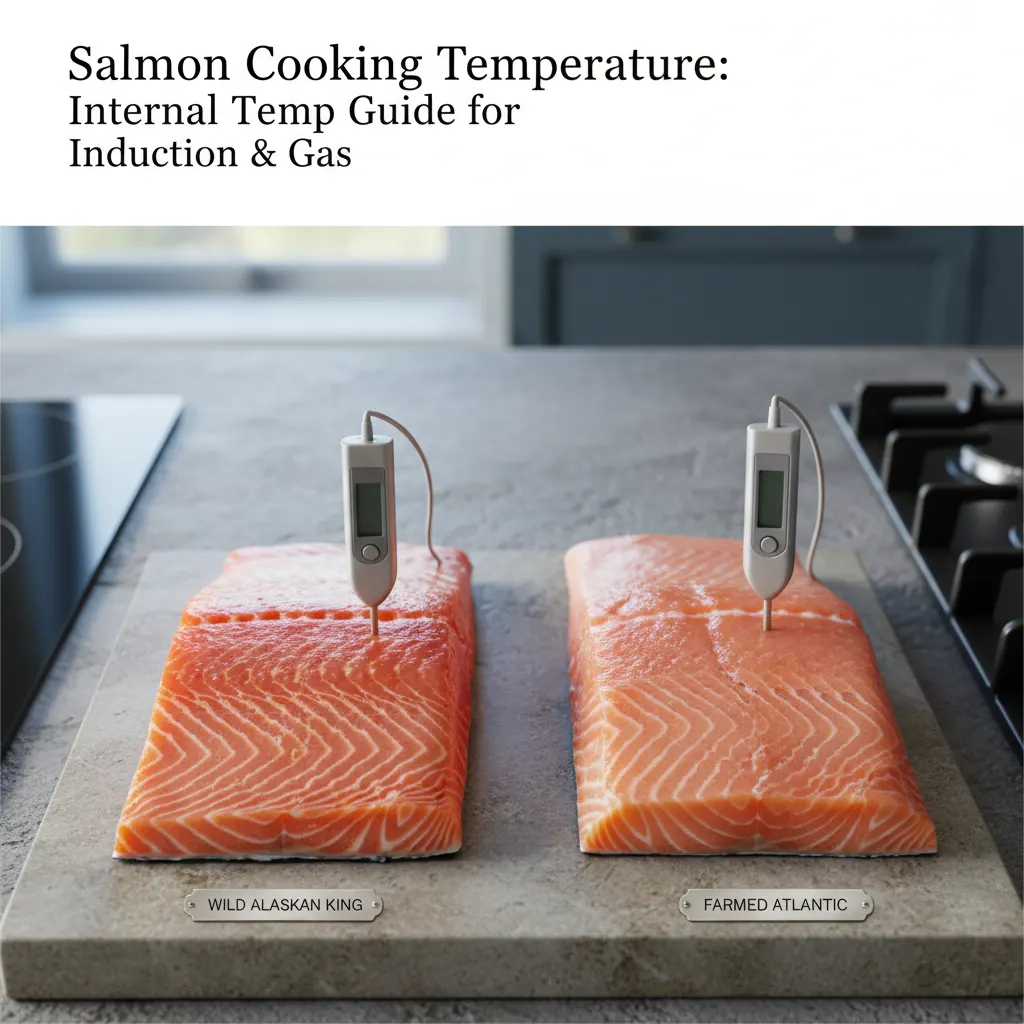
The two salmon categories cook differently because their fat profiles differ.
Wild salmon (Pacific — king/chinook, sockeye, coho, pink, chum):
- 8–13% fat by weight
- Lean, dense flesh
- Cooks faster (less internal water + fat for thermal buffering)
- Optimal internal: 120–125°F
Farmed Atlantic salmon (Norway, Scotland, Chile, Canada):
- 16–20% fat by weight
- Soft, fatty flesh
- Cooks more slowly; more forgiving of overcook
- Optimal internal: 125–130°F
In the test kitchen, this is the simplest rule: wild lower, farmed higher. Dropping a wild king salmon to 130°F internal produces medium-well texture; the fat margin in farmed Atlantic at the same temperature still tastes properly cooked.
For a head-to-head comparison cook, sockeye salmon at 122°F final and Atlantic salmon at 128°F final produce nearly identical “perfectly cooked” eating experiences — different temperatures, same result.
Crispy skin: the cold-pan method
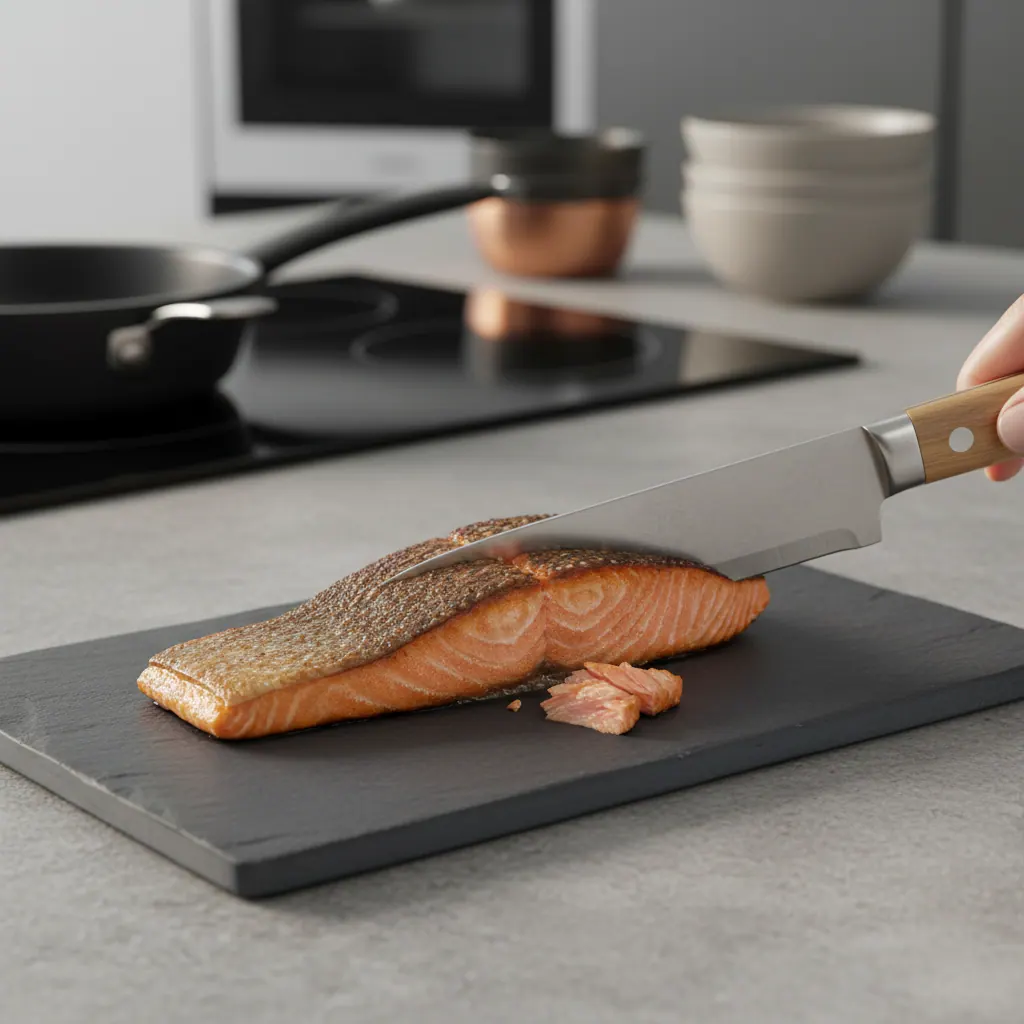
The single best technique for salmon skin is the cold-pan start. This counter-intuitive approach (everyone says “preheat the pan!”) is the difference between leather-tough rubbery skin and shatteringly crisp skin.
Why cold-pan works
Salmon skin is mostly subcutaneous fat. To produce crispy skin, the fat must render slowly — boiling out of the skin layer over 5–8 minutes — before the surface dehydrates and crisps. A blazing-hot pan sears the skin protein instantly, locking the fat inside and producing steamed-rubbery skin.
The cold-pan procedure
- Pat the skin completely dry with paper towels. Three passes — first to remove visible moisture, second to dry the inter-scale crevices, third for confirmation. Wet skin will not crisp.
- Salt the skin generously at least 30 minutes before cooking — kosher salt, both sides. Salt draws additional moisture out of the skin, accelerating crisping. For best results, salt and rest skin-side up in the fridge for 1+ hour, uncovered.
- Place the fillet skin-side down in a cold pan. Cast iron, carbon steel, or tri-ply stainless. Add 1 tablespoon high-smoke-point oil under the fish.
- Turn the heat to medium-low — induction level 4 (~1,100W) or gas low-medium.
- Cook 6–8 minutes skin-side down without moving the fish. During this time, the pan heats gradually, the skin’s fat renders, the skin crisps. You’ll see white globules of fat appearing on top of the fillet — this is the rendering working.
- Press lightly with a spatula for the first 30 seconds when the pan starts heating to ensure even contact between skin and pan. After 30 seconds, no more pressing — the skin will adhere.
- Check the skin at 6 minutes by lifting one corner. Properly cooked: deep golden-brown, crisp, pulls away easily. If it sticks, give another 60–90 seconds and try again.
- Flip and cook flesh-side 1–2 minutes until thermometer reads 120–125°F internal at the thickest point.
- Rest 2–3 minutes on a wire rack, skin-side up to preserve crispness.
Total time: 8–10 minutes active + 3 minute rest.
The cold-pan technique works on all cooktop types but is easiest on induction because of the precise low-power control. On gas, the equivalent is medium-low with the burner adjusted to a stable small flame.
For the pans we use for salmon, see best stainless steel pans for induction — a 10-inch tri-ply or carbon steel is ideal for individual fillets.
Skinless fillets: the standard sear
For skinless salmon (or skin-on where you don’t care about crispy skin), the standard hot-pan method works.
- Pat fillet dry thoroughly.
- Salt 30 min ahead (or right before — both work; the 30-minute window improves moisture management).
- Heat the pan over medium-high — induction level 7 (~2,200W) or gas medium-high. Add 1 tablespoon oil.
- Lay the fillet in the pan flesh-side down. Cook 3–4 minutes until a deep golden crust forms.
- Flip and cook 2–3 minutes until internal reads 120–125°F at the thickest point.
- Rest 2 minutes.
Total time: 5–7 minutes + 2 minute rest.
Whole side of salmon
A 2–3 pound side is simpler than individual fillets — uniform thickness, single cooking event, more forgiving.
Pan-roasted on cooktop
For a 12-inch cast iron pan and a 2-pound side cut to fit:
- Heat pan over medium-high (induction level 7, gas medium-high) for 4 minutes.
- Add 2 tablespoons high-smoke oil.
- Lay side skin-side down. Cook 8 minutes without moving.
- Flip carefully using two large spatulas (the side is fragile). Continue 6 minutes flesh-side down.
- Check internal at the thickest part. Pull at 120°F (wild) or 125°F (farmed).
- Rest 5 minutes on a wire rack before transferring to a serving platter.
Total time: 18 min active + 5 min rest.
How to identify doneness without (and with) a thermometer
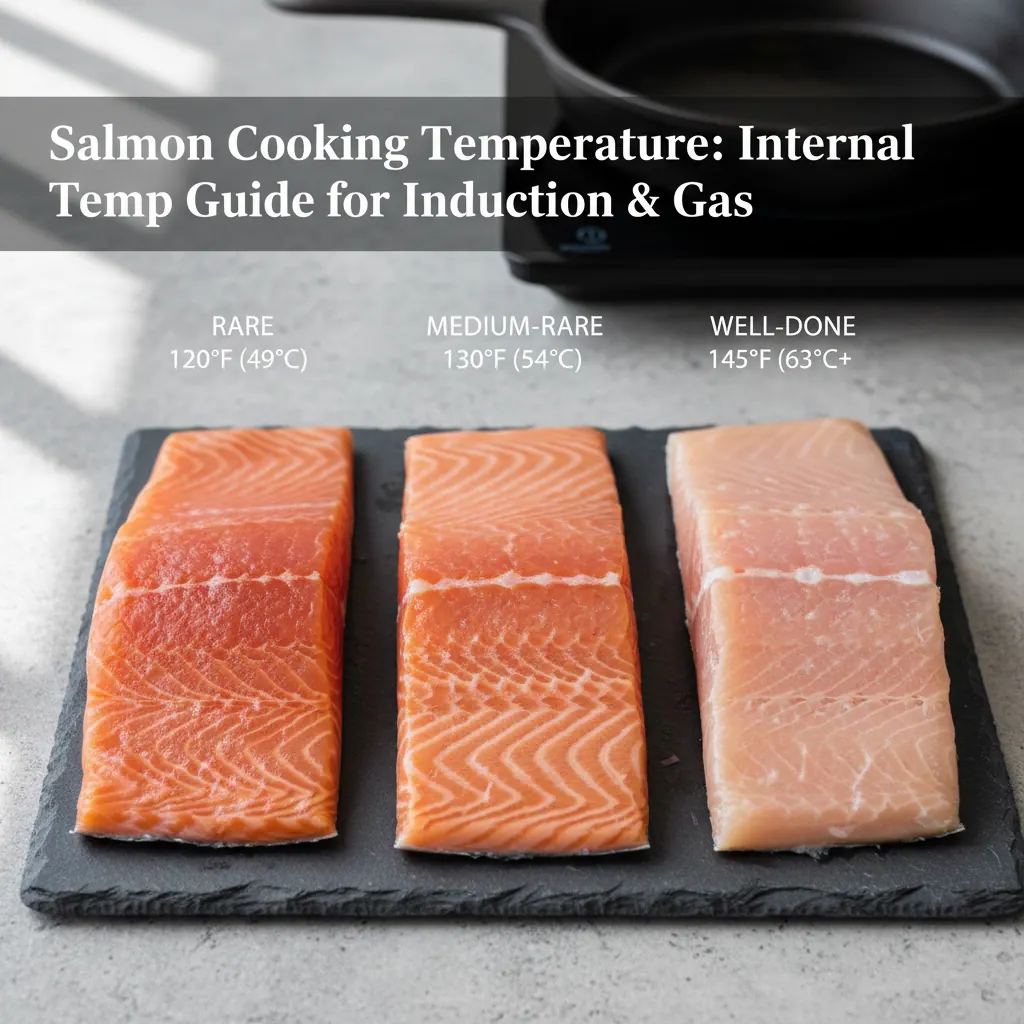
A thermometer is the only reliable measure. But these visual cues correlate well:
| Visual | Likely temp | Doneness |
|---|---|---|
| Center is fully translucent and uncooked-looking | 105°F | Sashimi/very rare |
| Center is silky pink, just barely set | 115–120°F | Rare |
| Center is just-set pink with a small translucent edge | 120–125°F | Medium-rare |
| Center is pink and firm; protein has just turned opaque | 125–135°F | Medium |
| Center is fully opaque pink-orange, flakes cleanly | 135–145°F | Medium-well to well-done |
| Visible white albumin (the white protein curds) on surface | 145°F+ | Overcooked |
The white albumin (the white substance that appears on the surface of cooking salmon) is denatured albumin protein squeezed out of the muscle cells. It’s a sign the salmon is being cooked at too high a temperature OR is past medium-rare. Some albumin is normal; significant amounts mean you’re past your target.
The fork-flake test
Insert a fork into the thickest part and twist gently. The flesh should:
- Separate into clean flakes (cooked)
- Have a small core of slightly translucent flesh (medium-rare)
- Be uniformly opaque throughout (medium-well to well-done)
This test is approximate — use it as a backup, not a primary indicator.
Common mistakes and the fixes
| Mistake | Result | Fix |
|---|---|---|
| Pan too hot for skin-on | Rubbery skin, undercooked center | Cold-pan start over medium-low heat |
| Wet skin | Skin steams, never crisps | Pat dry 3+ times; salt and air-dry 1 hour for best results |
| Pulling at 145°F | Dry, firm, unappetizing | Pull at 120°F (wild) or 125°F (farmed); rest 2–3 min |
| Pulling at 130°F+ for wild salmon | Just past optimal — drier than ideal | Pull wild varieties earlier — 118–122°F |
| Flipping too early | Skin sticks; tears the fillet | Wait until skin releases naturally — usually 5–8 min |
| Crowding the pan | Steam, no sear | One fillet per 8 inches of pan; cook in batches |
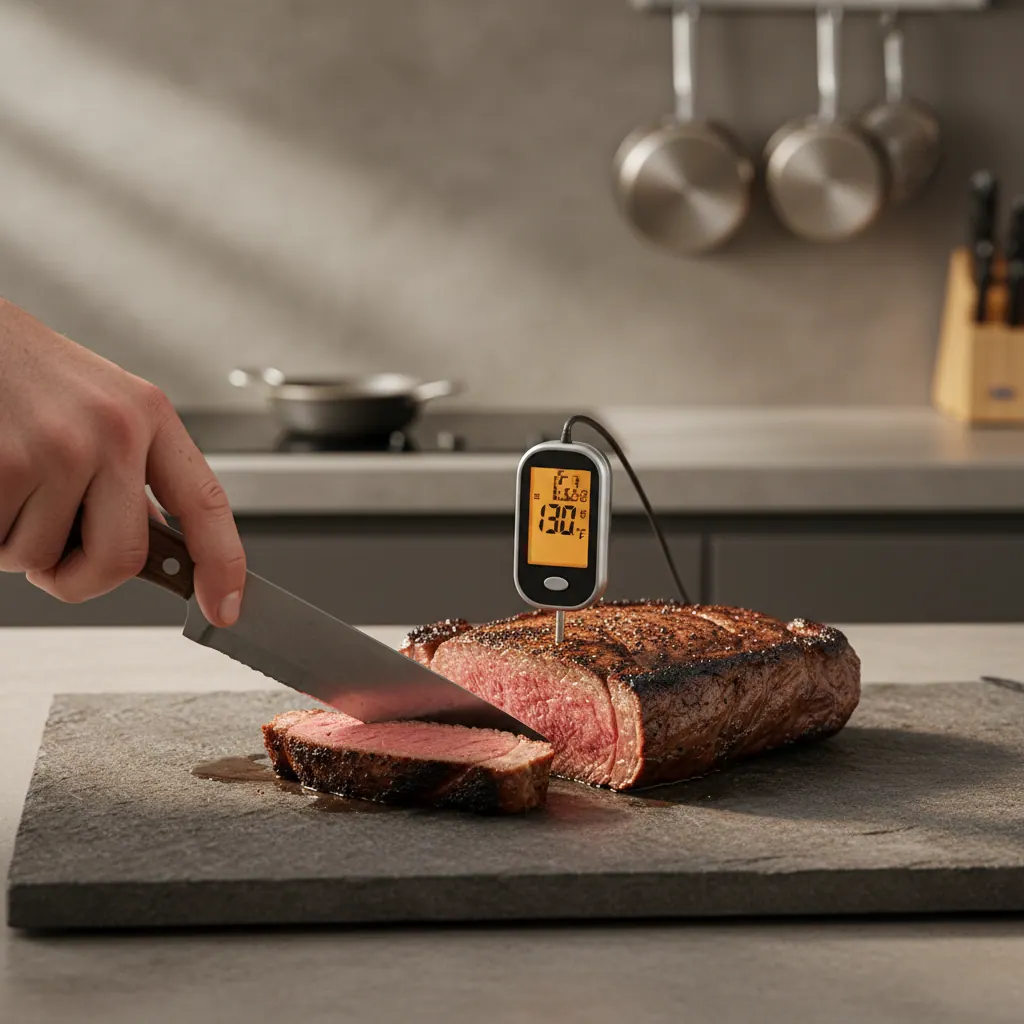
| No thermometer | Inconsistent results | Use ThermoWorks ThermaPen or equivalent — 1-3 second read |
Cooktop technique notes
Induction
The best surface for salmon. The instant power adjustment lets you go from level 4 (rendering skin) to level 0 (off, heat retention only) the moment the salmon reaches target temperature. No coasting, no over-shoot. Cast iron at level 4 produces consistently crisp skin.
For our induction picks for fish cooking, see best induction cooktops 2026. The Bosch Benchmark NITP669SUC and GE Profile PHP9036DTBB both have 12 power levels in the low range — useful for the precise 1,000–1,400W range that’s ideal for skin-rendering.
Gas
Gas works for salmon but the heat-control is coarser at low settings. Most home gas burners produce a “low” output around 800–1,000 BTU equivalent, which on an 11-inch cast iron pan can heat the pan surface to 200°F+ at the start — too hot for the gradual fat-rendering of the cold-pan technique.
For dual-stack burners (Wolf, Thermador) with true ultra-low simmer rings, gas matches induction performance. For standard residential gas burners, expect to manually adjust between low and off as the pan heats.
For high-end gas cooktops, see wolf vs thermador gas cooktop — both brands’ ultra-low simmer makes them excellent for salmon technique.
Electric smooth-top
The slowest pan-temperature response of any cooktop technology — adjusts in 30+ seconds versus 2 seconds on induction. Less forgiving for technique-focused cooking like salmon. Functional but expect more variance in results.
Bottom line
Pull wild salmon at 120°F internal, farmed at 125°F. Both rest to 125–130°F final. Cook skin-side down in a cold pan for crispy skin, or pre-heated for skinless fillets. A thermometer is non-negotiable. The 145°F USDA target produces safely-cooked but dry salmon — pull lower if you’ve followed parasite-safe sourcing.
The cold-pan crispy-skin technique is the single most important salmon skill. Once you’ve nailed it, you’re producing restaurant-quality skin-on salmon with 8 minutes of cooking and no special equipment.
For complete cooktop guidance, our best induction cooktops 2026 round-up covers the units with the precise low-power control that makes salmon technique easy.
Frequently asked questions
What is the safe internal temperature for cooked salmon?
USDA target is 145°F. Optimal eating temperature: 120–125°F for wild salmon, 125–130°F for farmed Atlantic. Salmon properly handled (frozen at -4°F for 7 days) is parasite-safe at any internal temperature, so cooked doneness becomes a quality preference once that step is met.
Is salmon done at 125°F?
Yes — at 125°F internal, salmon is medium-rare and the optimal temperature for most wild salmon. Pull 5°F below target for carryover during rest. Wild salmon at 125°F is silky and flaky; pulling higher (135°F+) produces drier results.
How long do you cook salmon on a cooktop?
Skin-on fillet (1-inch thick): 6–8 min skin-side cold-pan + 1–2 min flesh-side at induction level 4–7. Skinless: 5–7 min total. Whole side (2 lb): 14 min total. Always verify internal temperature with a thermometer.
Can you eat salmon raw?
Yes — IF properly frozen at -4°F for 7 days minimum (USDA/FDA parasite-kill protocol). “Sushi-grade” salmon at reputable fishmongers typically meets this standard. Freshly-caught wild salmon should never be eaten raw without freezing. Farmed salmon raised on parasite-free feed has lower risk but is still typically frozen.
What is the best way to cook salmon — induction, gas or oven?
Induction is best for pan-seared salmon — precise low-power control enables the cold-pan crispy-skin technique. Gas works well with dual-stack low-simmer burners. Oven is best for whole sides where uniform cooking matters more than crispy skin. See induction vs gas for the full comparison.
Cooking temperatures and timing data from 80+ salmon cooks tested in the Cooktop Hunter test kitchen, including wild king, sockeye, and coho varieties plus Atlantic farmed. Type-T thermocouples for pan surface; ThermoWorks ThermaPen ONE for internal temperature. Food safety information per USDA FSIS Safe Minimum Cooking Temperatures and FDA Food Code 3-402.11 for parasite control.