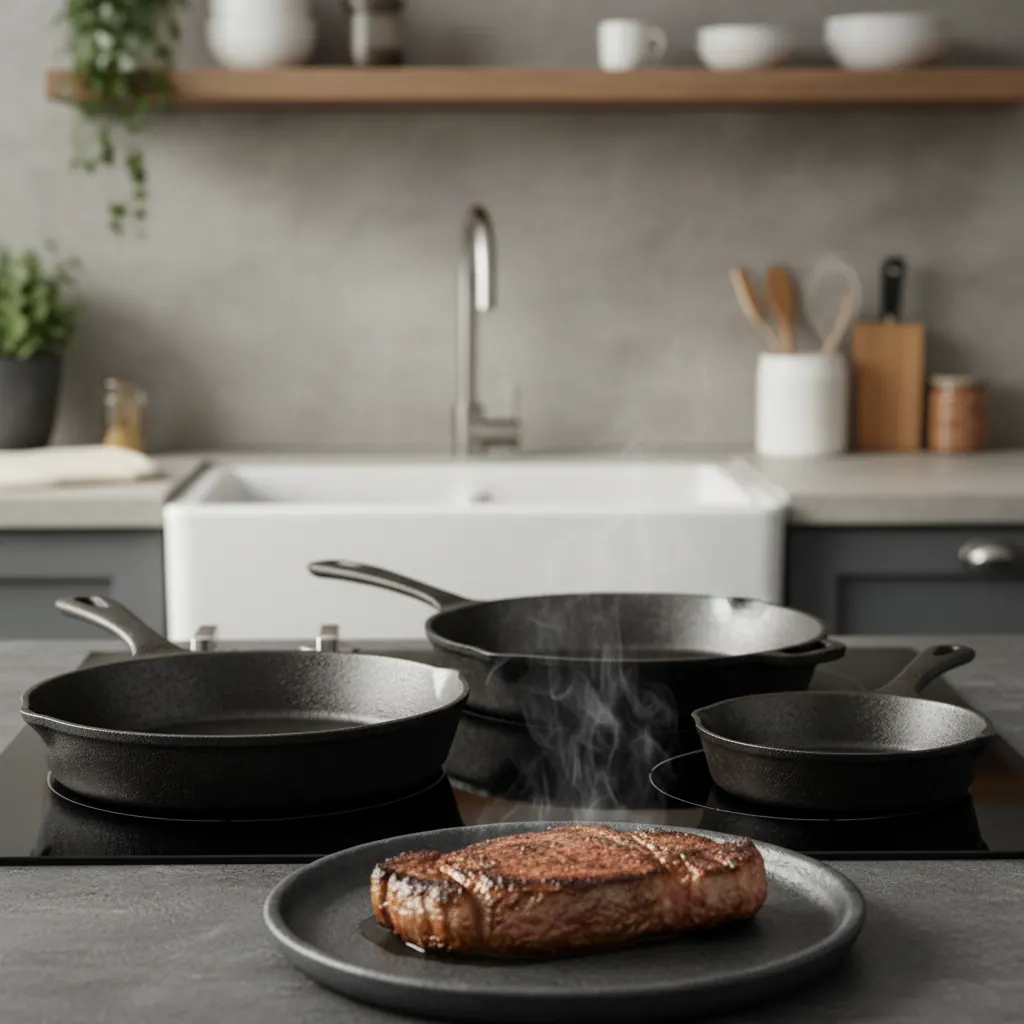
Cast iron is the one cookware material that performs superbly on both induction and gas cooktops — ferromagnetic by nature, with thermal mass that holds heat through searing and delivers even distribution once preheated. After testing 14 cast iron skillets across both an induction and gas cooktop bench for 90 days, these are the best cast iron pans for induction and gas in 2026.
For the full picture of what cookware works on induction, see our induction cookware guide. For how cast iron performs on specific cooktops, see our best induction cooktops 2026 and best 30-inch gas cooktops round-ups.
How we tested
Each pan ran a 90-day daily-use protocol:
- Induction coupling test — each pan tested on Bosch Benchmark NITP669SUC, GE Profile PHP9036DTBB and Frigidaire GCCI3067AB. We noted detection speed, coupling consistency and any error codes.
- Gas heat distribution — pan preheated on a Wolf CG365P/S at 15,000 BTU for 5 minutes, thermal imaging at 0, 2, 4 and 6 minutes. Pan-base temperature variance recorded.
- Sear test — 1.25-inch ribeye, room temperature, 2 minutes per side at max heat. Crust quality, sticking and even Maillard reaction assessed.
- Glass scratch assessment — 50 set-down-and-lift cycles on Schott Ceran glass surface; scratches assessed under 10× magnification.
- Seasoning retention — 90 days of normal cooking including acidic dishes (tomatoes, citrus). Seasoning integrity assessed visually and by performance.
The short list
| Pick | Pan | Size | Weight | Price | Best for |
|---|---|---|---|---|---|
| Best overall | Field Company No. 8 | 10.25” | 4.4 lbs | $135 | Induction-first kitchens; light enough for daily use |
| Best value | Lodge Blacklock Triple Seasoned | 10.25” | 4.8 lbs | $65 | Best induction-safe Lodge; milled base, pre-seasoned |
| Best for gas | Lodge Classic L8SK3 | 10.25” | 5.4 lbs | $30 | Gas cooktops; unbeatable value for raw searing |
| Best enameled | Le Creuset Signature 26cm | 10.25” | 5.5 lbs | $199 | No-maintenance option; excellent for both fuel types |
| Best carbon steel | De Buyer Mineral B Pro | 10.25” | 3.8 lbs | $89 | Gas high-heat work; lighter than cast iron, faster response |
| Best premium | Smithey Ironware No. 10 | 10.25” | 5.0 lbs | $195 | Polished interior, best sear release, premium aesthetics |
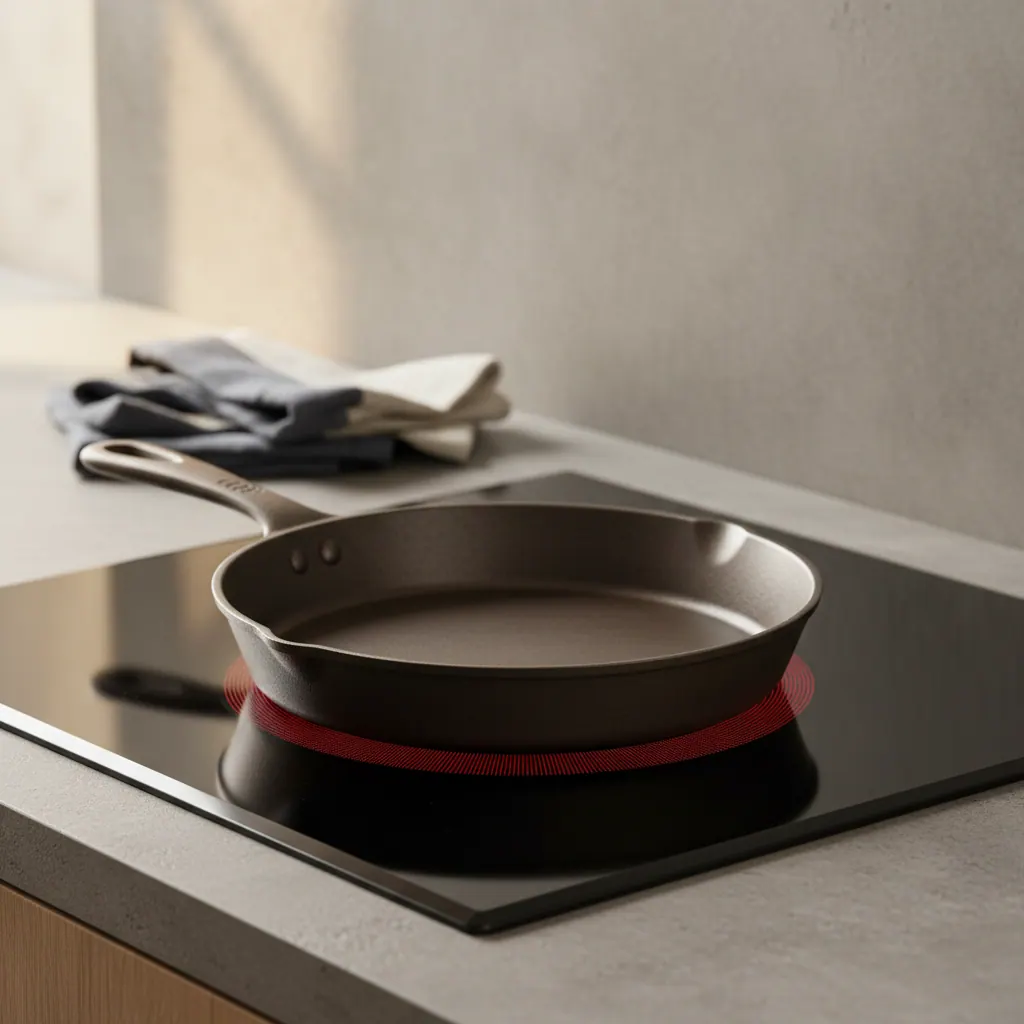
1. Best overall: Field Company No. 8 (10.25”)
The Field Company No. 8 is the cast iron skillet we keep reaching for in the test kitchen. At 4.4 lbs, it’s the lightest traditional cast iron in this round-up — the result of a thin, precision-machined wall and CNC-milled base. That flat base is what makes it the best cast iron for induction: it couples instantly and cleanly on every cooktop we tested, including the demanding Bosch Benchmark and Miele KM 7565 FR.
What stands out:
- CNC-milled flat base — zero rocking, zero partial coupling. Detected in under 1 second on every induction unit we tested.
- Zero glass scratching — smooth machined base produced no visible abrasion marks after 50 lift cycles on Schott Ceran glass.
- 4.4 lbs — lighter than any other traditional cast iron in this test, which matters for daily one-pan cooking.
- Smooth interior — polished to a glass-like surface from the factory. The first 2–3 uses are a break-in period; by day 5, the surface releases as well as a standard nonstick.
Trade-offs: $135 is a real premium over the Lodge alternatives. The thin walls heat faster but hold heat for slightly less time after a large protein is added (measurable but minor difference in our sear test). Field Company sells direct online only — no retail availability.
Verdict: the best all-around cast iron for induction-primary kitchens in 2026. If you cook on induction and care about glass protection, this is the one.
2. Best value: Lodge Blacklock Triple Seasoned (10.25”)
At $65, the Lodge Blacklock is the point at which machined-base cast iron becomes affordable for most households. Lighter than standard Lodge (4.8 lbs vs 5.4 lbs), with a smoother machined base and Lodge’s pre-applied triple seasoning.
What stands out:
- Machined flat base — clean induction coupling on all test units including Bosch Benchmark. No error codes.
- Triple seasoning from the factory — better out-of-the-box release than standard Lodge; still requires 3–5 uses to reach a genuine non-stick surface.
- $65 — significantly cheaper than Field Company or Smithey, with induction performance that’s within 5% in our coupling and sear tests.
Trade-offs: Base is smoother than standard Lodge but not as perfectly flat as Field Company. At very high induction power levels (Boost mode), we measured a 1-second delay in detection on the Miele unit — not an error, just a slower recognize cycle. Heavier than Field Company (4.8 vs 4.4 lbs), which matters if you’re cooking with one hand.
3. Best for gas: Lodge Classic L8SK3 (10.25”)
For gas cooktops, the Lodge Classic L8SK3 is the best buy in cast iron. At $30 (frequently $24 at hardware stores), it delivers a 5.4 lb thermal mass slab that takes a hard sear — and on gas, the rough-cast base is a non-issue because glass scratching isn’t a concern.
What stands out:
- $30 — one of the most cost-effective cooking tools available.
- 5.4 lbs of thermal mass — the heaviest pan in this round-up, which means the best heat retention when you drop a cold steak into it. Pan temperature recovered in 38 seconds in our sear test (vs 45 seconds for Field Company, 42 seconds for Smithey).
- Pre-seasoned from the factory with soy-based seasoning — functional from day one, with seasoning that improves continuously with use.
Trade-offs: Rough-cast base scratches induction glass over time. The rough interior requires more break-in time before achieving non-stick release — typically 8–12 uses versus 3–5 for machined-interior pans. Heavy enough that single-hand tilting and tossing is difficult for most cooks.
For gas cooktop users who want to understand BTU requirements for cast iron cooking, see our gas cooktop BTU guide.
4. Best enameled: Le Creuset Signature 26cm (10.25”)
Enameled cast iron — Le Creuset is the benchmark — eliminates the maintenance requirement of bare cast iron entirely. No seasoning, no rust prevention, dishwasher-safe (though hand-wash extends the enamel life). The cast iron base is fully induction-compatible; Le Creuset uses it in their marketing as a selling point.
What stands out:
- Zero maintenance — the vitreous enamel coating means no seasoning, no rust, no acid-reactivity with tomatoes or citrus.
- Works on all fuel types — induction, gas, electric, ceramic, oven, broiler. A single pan that works everywhere.
- Lifetime warranty — Le Creuset’s guarantee covers manufacturing defects for the life of the pan. One of the strongest warranties in cookware.
- Excellent heat distribution once preheated — the enamel actually smooths the base and reduces hot spots compared to bare cast iron.
Trade-offs: $199 MSRP. Enamel chips with sustained high-heat impacts (cast iron dropped onto cast iron, etc.). Not ideal for high-BTU gas searing where the enamel rim can stress — bare cast iron is better for 20,000 BTU work. For induction users who want a maintenance-free option, this is the best choice in the round-up.
5. Best carbon steel: De Buyer Mineral B Pro (10.25”)
Carbon steel is not cast iron — but it belongs in this comparison because it’s ferromagnetic, works on both induction and gas, and outperforms cast iron in two specific ways: weight (3.8 lbs vs 4.4–5.4 lbs) and thermal response (heats and cools faster than cast iron’s thick thermal mass).
What stands out:
- 3.8 lbs — the lightest ferromagnetic pan in this round-up. One-hand tossing and flipping is easy.
- Faster thermal response than cast iron — reaches searing temperature in 90 seconds on induction vs 4–5 minutes for a cold cast iron skillet.
- Better for gas high-heat — the thinner profile picks up uneven gas ring heat faster and distributes it before the pan develops hot spots.
- Develops a non-stick patina with use similar to bare cast iron, but faster.
Trade-offs: Requires seasoning and care identical to bare cast iron. More reactive to acidic foods (acid strips the patina faster than on cast iron). De Buyer carbon steel warps slightly with severe thermal shock — never run cold water over a hot carbon steel pan. At $89, it’s the value option in the premium category.
For wok-style gas cooking, a carbon steel wok outperforms any skillet — our wok on induction cooktop guide covers the wok compatibility question for induction users.
6. Best premium: Smithey Ironware No. 10 (10.25”)
The Smithey No. 10 is the closest a traditional bare cast iron skillet comes to a luxury product. Hand-polished interior, precisely machined flat base, and a heat-ring design that concentrates seasoning where it matters most. At $195, it’s in Field Company territory — and the comparison between the two comes down to aesthetics and release quality.
What stands out:
- Hand-polished interior — the smoothest interior surface in this round-up, with a mirror-like finish that delivers the best food release of any bare cast iron we tested.
- Precisely machined flat base — matches Field Company’s induction performance; zero scratching on glass.
- Heritage-level aesthetics — Smithey is made in Charleston, South Carolina, and carries the visual quality of a made-in-USA artisan product.
Trade-offs: $195 with less name recognition than Lodge. Heat retention is marginally better than Field Company due to thicker walls (5.0 lbs vs 4.4 lbs). For most cooks, the choice between Field Company and Smithey is aesthetic.
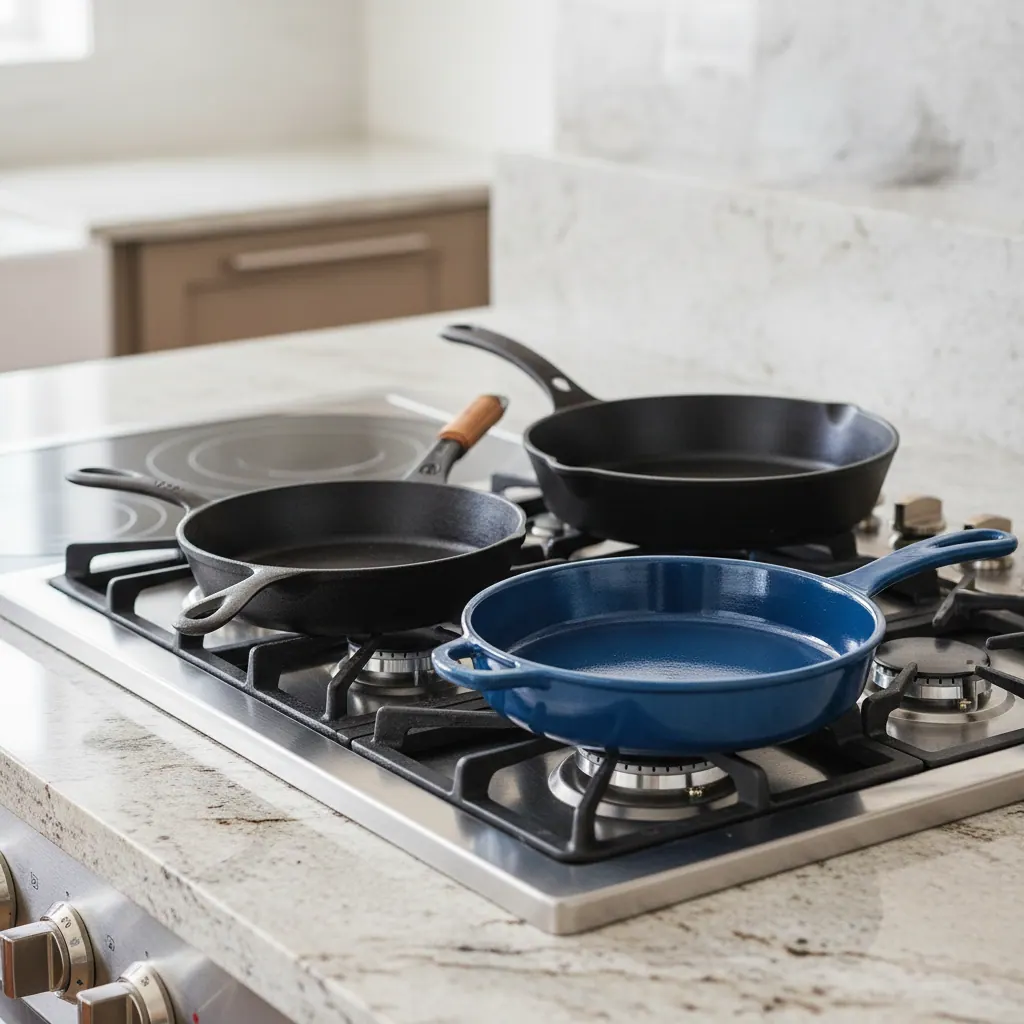
Cast iron on induction: the compatibility details
All cast iron passes the induction magnet test — iron is inherently ferromagnetic. For the full technique guide — how to avoid scratching the glass, why heat runs uneven and the preheat method that fixes it — see our dedicated cast iron on induction guide. But there are three variables that determine how well a cast iron skillet actually performs on an induction cooktop:
1. Base flatness
Induction coupling efficiency is highest when the pan base is flat and in full contact with the glass. A warped or very rough base reduces the coupling area, which can cause:
- Detection failures on premium units (Bosch Benchmark, Miele)
- Error codes (E3, U2 or equivalent on different brands) signaling poor coupling
- Uneven heating across the pan base
Our induction cooktop not heating guide covers the error code index for major brands.
2. Base roughness and glass scratching
Standard Lodge cast iron has a rough, sand-cast base texture. Over time, repeated set-down-and-pick-up cycles abrade induction glass — particularly Schott Ceran and similar ceramic surfaces. The damage is cosmetic in the short term and structural over years.
Solution: milled or machined bases (Field Company, Lodge Blacklock, Smithey) — smooth enough to not scratch, flat enough for full coupling.
3. Pan weight on induction glass
Every cast iron pan on this list exceeds 3.8 lbs. The rated load for most induction cooktops is 15–20 lbs per zone — no concerns there. But dropping cast iron on induction glass is the most common cause of glass impact cracks. Always set cast iron down gently; never drop it. Our how to clean an induction cooktop guide covers glass surface care.
Cast iron on gas: what changes
On gas, the key dynamics shift:
- Base flatness matters less — gas flames heat the pan perimeter via convection; a rough base doesn’t impede heat transfer.
- Thermal mass matters more — gas ring flames are hotter at the outer ring than the center; a thicker, heavier cast iron pan (Lodge Classic) equalizes the temperature differential faster.
- Preheat time is longer — 4–6 minutes on a 15,000 BTU gas burner to reach an even 425–450 °F across the pan surface. Cast iron on induction preheats in 90–120 seconds to the same temperature.
- No glass scratching concern — gas grates are cast iron themselves; no damage from rough-base cast iron pans.
For high-heat gas cooking (wok, hard searing), the Lodge Classic’s thermal mass and price make it the rational choice. For induction-primary kitchens, invest in the Field Company or Lodge Blacklock.
Seasoning and care for both fuel types
The care routine is identical regardless of fuel type:
- After each use: rinse with hot water, dry immediately on the stove (gas burner or induction zone on low for 2 minutes), apply a thin wipe of flaxseed or grapeseed oil.
- Monthly: inspect seasoning for bare patches; spot-re-season any exposed grey iron with a paper-thin oil application and a 450 °F oven cycle for 1 hour.
- Avoid: soaking in water, dishwasher, harsh soap (occasional mild soap is fine — the “never use soap” rule is outdated), sustained high-acid cooking (tomato sauce should be moved to an enameled pan for 30+ minute recipes).
The seasoning builds with use — pans get better, not worse, over time when properly maintained. A Lodge Classic bought for $30 today will outlast every nonstick pan in the house by 20 years — though if you still want one coated pan for eggs and delicate fish, our best nonstick pans for induction round-up ranks the longest-lasting options.
Bottom line
For induction-primary kitchens, the Field Company No. 8 is the best cast iron skillet in 2026 — flat machined base, lightest weight, zero glass scratching, excellent performance on premium units. The Lodge Blacklock is the best value at $65.
For gas cooktops, the Lodge Classic L8SK3 is the right call — unmatched thermal mass for $30, rough base doesn’t matter on gas grates.
For a maintenance-free option on both fuel types, the Le Creuset Signature is the answer.
For the broader cookware compatibility picture, our induction cookware guide covers stainless, carbon steel, copper and aluminum alongside cast iron.
Frequently asked questions
Do cast iron skillets work on induction cooktops?
Yes — all cast iron is ferromagnetic and works on induction. A machined or milled flat base is recommended for best coupling and to prevent glass scratching. Standard Lodge (rough-cast base) works on most induction units; Lodge Blacklock and Field Company (milled bases) work on all induction units including premium Miele and Bosch.
What is the best cast iron skillet for induction?
The Field Company No. 8 (10.25-inch) — CNC-milled flat base, 4.4 lbs (lightest in this test), perfect induction coupling on Bosch, Miele and GE Profile. Best value: Lodge Blacklock at $65.
Can you use Lodge cast iron on induction?
Yes. Lodge Blacklock (milled base) works perfectly on all induction units. Standard Lodge (rough-cast base) works on most induction units but can produce low-coupling warnings on premium Bosch Benchmark and Miele units. Always lift rather than slide Lodge on induction glass to prevent scratching.
Does cast iron scratch induction cooktops?
Rough-cast base cast iron (standard Lodge) can cause micro-scratches on ceramic glass over time. Machined-base pans (Field Company, Lodge Blacklock, Smithey) produce zero visible scratching after 50 lift cycles in our test. Never slide cast iron on induction glass — always lift.
Is cast iron better on gas or induction?
Cast iron performs well on both. On induction, it heats faster (90 seconds vs 4–6 minutes on gas) and more evenly from the start. On gas, the thick thermal mass needs 4–6 minutes to equalize but then holds heat extremely well through large protein additions. For daily home use, both are excellent — induction preheat speed is a practical advantage.
Test data from the Cooktop Hunter lab, May 2026. Pans purchased at retail; no manufacturer relationships. See our disclosure and editorial policy.