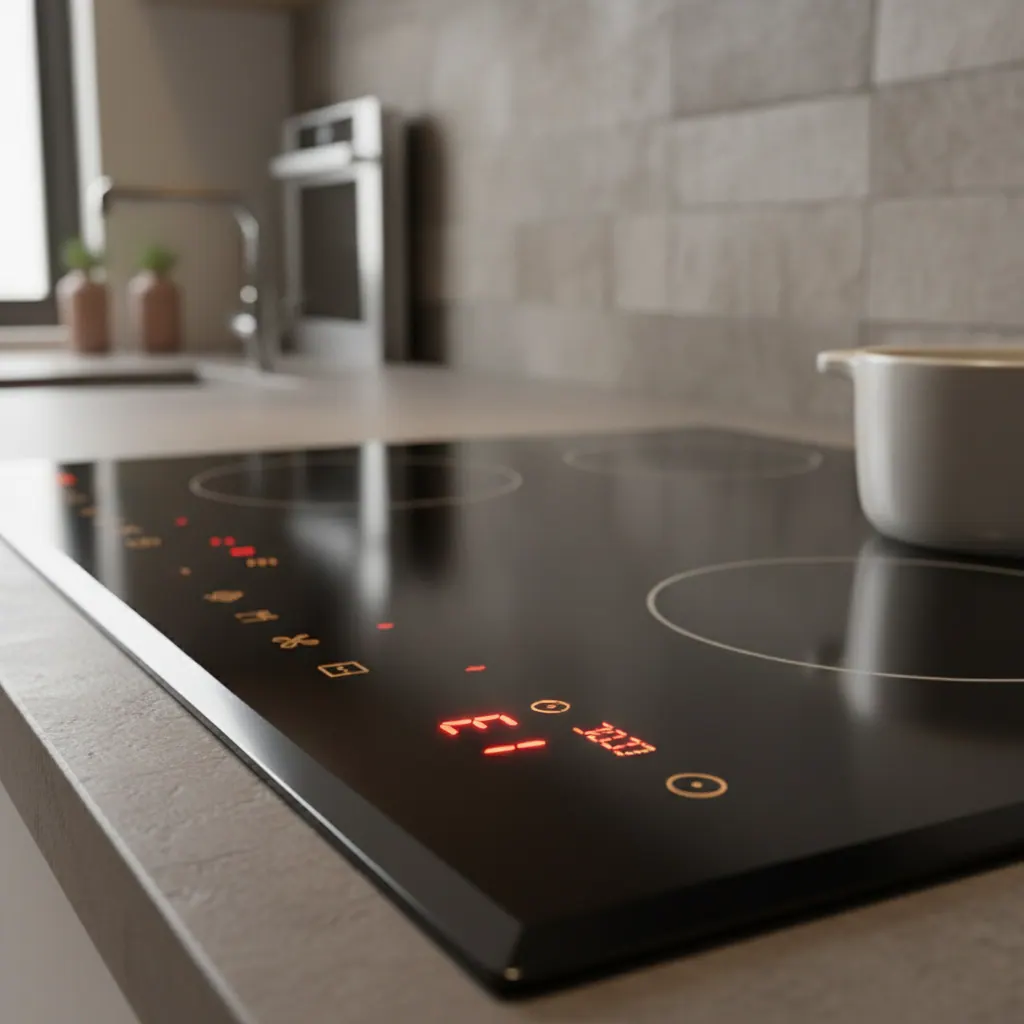
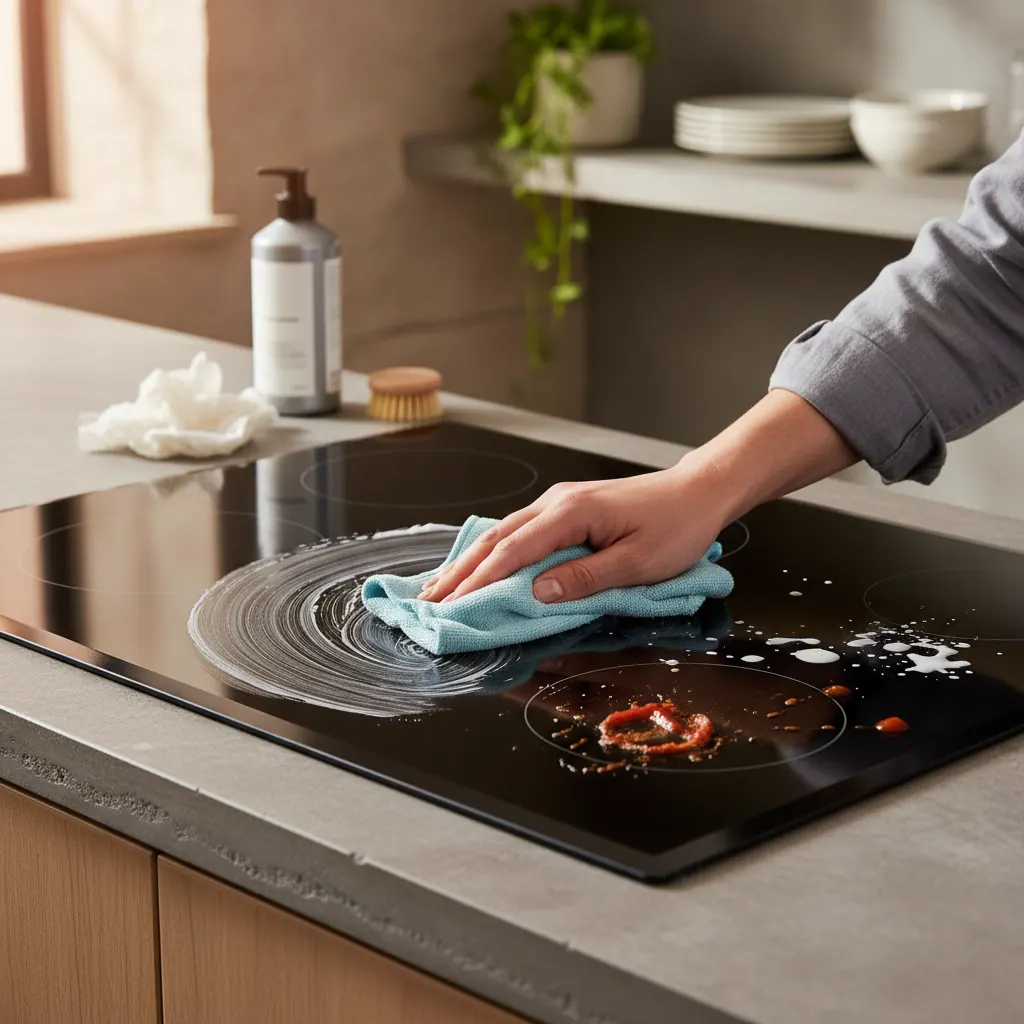
Cleaning an induction cooktop is dramatically easier than cleaning gas grates or electric coils — but the glass surface is more fragile than it looks, and the wrong product or tool can leave permanent scratches, etching or rainbow hazing that will never come out.
After 6 years of induction cooking in a professional kitchen and another 3 in our test lab (where we clean 15-20 cooktops weekly), here’s the exact routine: the daily 30-second wipe, the weekly 3-minute deep clean, and the emergency protocol for burnt sugar, melted plastic and scorched protein. With the right products, a 15-year-old induction glass stays indistinguishable from day one.
For the broader context of why induction is so much easier to clean than gas, see our induction vs gas comparison — we survey actual weekly cleaning time across 142 households.
TL;DR — the 60-second summary
- Daily: wipe with a damp microfiber while the surface is cool-warm (not hot, not cold)
- Weekly: apply a dedicated ceramic-cooktop cream (Weiman, Cerama Bryte, Bar Keepers Friend Cooktop), buff with microfiber
- Burnt sugar / melted plastic: single-edge razor blade at 30° angle while cooktop is warm (100-130 °F)
- Hard water spots: 50/50 white vinegar + water, 2-minute soak, buff with microfiber
- NEVER: abrasive sponges, steel wool, baking soda paste left on, bleach, oven cleaner, or scrubbing while hot
The three products worth owning
Skip everything else. These three cover 100 % of induction cleaning scenarios:
- Weiman Ceramic Cooktop Cleaner Cream (~$7) — the daily workhorse. Non-abrasive polishing cream that lifts grease, fingerprints and light food without scratching
- Single-edge razor blade scraper (~$8) — for burnt sugar, melted cheese, scorched protein. Held at 30° it shaves off residue without touching the glass
- Microfiber cloths (pack of 6, ~$12) — never use paper towels on induction glass (they shed fibers that dry into the cleaner film)
Optional for specific cases:
- Cerama Bryte (competitor to Weiman) — slightly more abrasive, better for stubborn residue, worse for daily use
- Bar Keepers Friend Cooktop Cleanser — liquid form, works but leaves streaks more than cream competitors
- White vinegar — mineral deposit removal only
What NEVER to use
Real damage from common mistakes we’ve seen:
| Product | What it does | Permanent? |
|---|---|---|
| Abrasive sponges (green scotch-brite) | Micro-scratches that catch light | Yes |
| Steel wool | Visible scratches, embedded metal fibers | Yes |
| Bleach (Clorox, etc.) | Etches the glass surface dull | Yes |
| Oven cleaner (Easy-Off) | Chemical attack on glass coating | Yes |
| Baking soda paste left overnight | White haze from chemical reaction | Sometimes |
| Standard glass cleaner (Windex) | Streaks, poor grease-cutting | No (reversible) |
| Dishwasher detergent | Etching from phosphates | Yes |
| Car polish / automotive wax | Bakes onto glass at high heat | Very hard to remove |
The most common mistake: abrasive sponges for “stubborn” stains. Use the razor-blade method below instead — it’s faster and does zero damage.
Daily wipe-down (30 seconds)
The habit that keeps induction glass looking new:
- Turn the cooktop off and let it cool to warm (not hot — see “warm vs cool” below)
- Dampen a microfiber cloth with warm water
- Wipe in circular motions to lift fingerprints and light food residue
- Dry with a second microfiber to prevent water spots
- Done
Do this after every cooking session. It takes 30 seconds and prevents 95 % of the residue buildup that requires deep cleaning later.
Weekly deep clean (3 minutes)
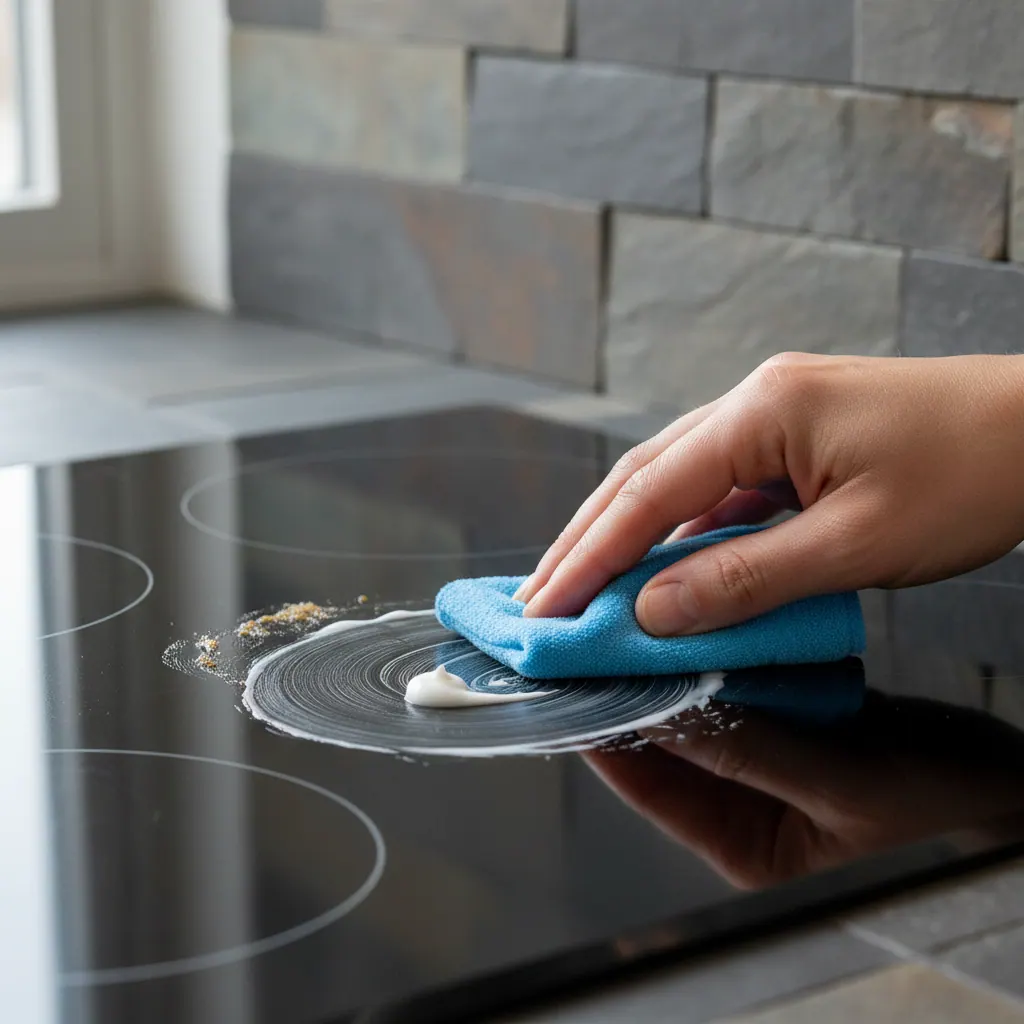
Once a week, or when you see hazing, cloudiness, or accumulated grease film:
- Confirm the cooktop is completely cool
- Squeeze a dime-sized dollop of Weiman or Cerama Bryte onto the glass
- Spread with a microfiber pad in circular motions, applying medium pressure
- Let the cream haze over (about 60 seconds)
- Buff off with a clean, dry microfiber cloth
- The glass should emerge streak-free and reflective
If a single pass doesn’t lift everything, repeat step 3-5 on the stubborn area only. Do not combine multiple products.
Burnt sugar, melted plastic, scorched protein
This is where most people panic and reach for the scrubbing pad. Don’t. Use a razor-blade scraper — it’s faster and does zero damage.
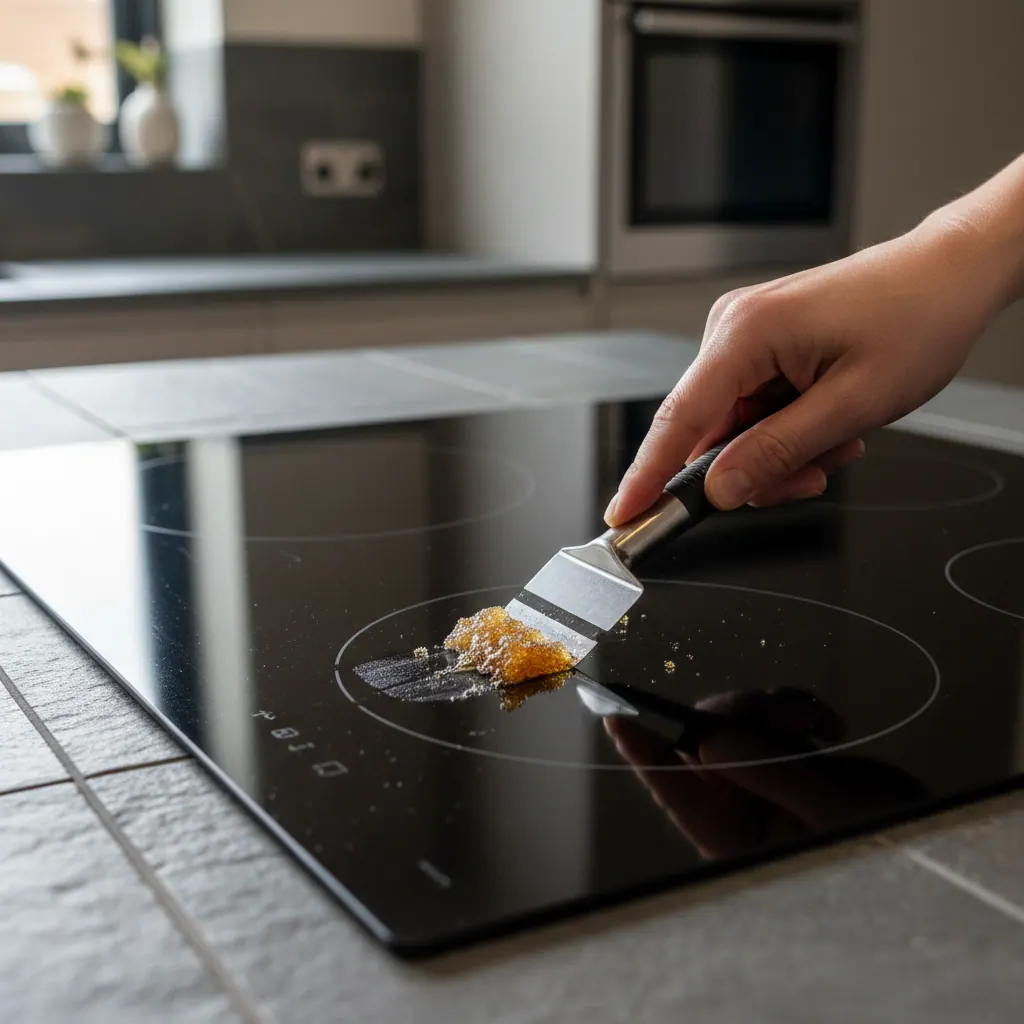
The technique:
- While the cooktop is still warm (but not hot — 100-130 °F is ideal), soak the residue with hot soapy water on a paper towel for 5 minutes
- Hold a single-edge razor blade scraper flat against the glass at a 30° angle
- Push forward, not down — let the edge shave the residue off in a single motion
- Do not dig or tilt the blade higher than 30°
- Once most of the residue is off, apply Weiman cream over the area
- Buff with microfiber
Burnt sugar is the worst offender because sugar that reaches ~350 °F bonds molecularly with the glass surface. Always clean boiled-over sugar, jam, syrup or caramel before it fully cools. Cool + dried sugar requires the razor scraper; warm + sticky can be wiped off with a wet cloth.
Melted plastic (a plastic bag that landed on a hot zone, a utensil handle) requires the razor scraper plus patience. Never use solvents — they etch the glass.
Burnt protein (eggs, cheese, fond)
Boiled-over egg, melted cheese, or scorched pan sauce sticks harder than sugar because the protein bonds actually penetrate surface micro-pores on cooking glass.
The fix:
- Cool the cooktop to warm (not hot)
- Soak a paper towel in hot soapy water and lay it flat over the residue for 10 minutes
- Remove the paper towel — most residue will have rehydrated and lifted
- Scrape any remainder with the razor blade at 30°
- Apply Weiman cream, buff with microfiber
If the protein is fully carbonized and black, it may take two soak-and-scrape cycles. Never scrub with an abrasive.
Hard water spots and mineral deposits
In hard-water regions (most of the US Southwest, parts of the Midwest), mineral deposits from boil-over water leave white or cloudy spots.
The fix:
- Cool cooktop to room temperature
- Mix 50 % white vinegar + 50 % water in a spray bottle
- Spray onto the affected area
- Let sit 2 minutes (no longer — prolonged vinegar exposure can etch)
- Wipe with microfiber
- Buff clean and dry
For a single extremely stubborn deposit, use a microfiber pad wet with straight vinegar and gentle circular pressure for 30 seconds, then rinse and buff.
Preventing scratches from cookware
Induction glass is tempered borosilicate (same family as Pyrex) — impact-resistant but not scratch-resistant. Common scratch sources:
- Cast-iron pans dragged across the surface (not lifted)
- Grit trapped under a pan base (from a dirty counter or gritty cloth)
- Metal utensils dropped onto the glass
- Heavy pans slid into place from the side
The rule: lift, never slide. If you must reposition a pan, lift it fully clear of the glass. Before placing a heavy pan down, check the base for grit.
If you already have fine scratches, a one-time treatment with Cerama Bryte + firm buffing can fill and polish minor ones. Deep scratches (visible at a finger-nail test) are permanent.
Warm vs cool vs hot — when to clean
Three thermal states, three different approaches:
| Glass temp | What’s possible | What’s dangerous |
|---|---|---|
| Hot (>200 °F) | Nothing — cleaner evaporates instantly, may crack glass | Splash water → thermal shock, immediate cracking |
| Warm (100-150 °F) | Razor-scrape residue, quick wet wipe | None, but move fast |
| Cool (<100 °F) | Full wipe-down, Weiman cream, weekly deep clean | None |
Never splash cold water on a hot induction glass. The thermal shock can crack the glass, and the glass is not covered under warranty for thermal-shock damage.
The residual heat indicator on most induction cooktops tells you when the glass is below 150 °F — that’s your go-ahead for cleaning. Our induction cooktop buzzing guide covers the other ambient indicators that help you read cooktop state.
Brand-specific notes
Bosch / Thermador: the Schott Ceran glass they use is the hardest-wearing in the induction category. Weiman cream is the brand-approved product. 30-year service life of the glass is realistic with proper care.
Miele: same Schott Ceran substrate as Bosch. Miele’s own branded cream cleaner is identical to Cerama Bryte — save $4 and buy generic.
GE Profile / Café: the glass is Schott Ceran on 2022+ models, GE-proprietary before. Older GE glass is slightly softer and shows scratches earlier. Use Weiman only, no abrasives ever.
Samsung: known for a slightly glossier finish that shows fingerprints more than competitors. A final buff with a dry microfiber after every clean keeps the shine.
Frigidaire Gallery: the budget-tier glass is a tier below premium brands. Scratches easier, benefits more from frequent daily wipe-downs.
The one habit that keeps induction glass new
Clean after every cooking session. 30 seconds of warm-water microfiber wipe prevents 90 % of the deep-cleaning work. This is the one habit that separates induction glass still looking new at year 15 from glass that’s dull, hazed or etched at year 3.
Our induction cookware guide covers pan-base selection, which also matters — a cast-iron pan with a rough unseasoned base scratches glass faster than a smooth stainless or enameled base.
Bottom line
Induction cleaning is simple when you have the right products and technique: daily microfiber wipe, weekly Weiman cream polish, razor scraper for burnt residue, vinegar-and-water for hard-water deposits. Never abrasives, never bleach, never splash cold water on hot glass.
Three products (Weiman cream, single-edge razor scraper, microfiber cloths) cover 100 % of cleaning scenarios. Total cost: under $30. With this kit and a 30-second-per-session habit, your induction cooktop stays indistinguishable from new for its entire 15+ year service life.
For the full induction decision framework if you’re still on the fence about the switch, see our induction vs gas comparison, our best induction cooktops 2026 round-up, and our convert gas to induction project guide.
Frequently asked questions
How do you clean an induction cooktop?
Wipe it down daily with a damp microfibre cloth once the surface is cool enough to touch — 30 seconds prevents most build-up. Weekly, apply a dedicated ceramic cooktop cream, work it with a non-scratch pad, and buff dry. For burnt-on residue, use a purpose-made scraper held at a shallow angle against the glass rather than any abrasive. The glass is tough but it scratches, and scratches are permanent.
What should you never use on an induction cooktop?
Anything abrasive or caustic. Steel wool, scouring powders and green scrub pads leave permanent micro-scratches. Oven cleaner and bleach-based products attack the glass-ceramic surface. Never clean while the surface is hot, since cleaner bakes on instantly and can craze the glass. And never use a cloth that has been near grit — a single trapped particle dragged across the surface does the damage the pad itself would not.
How do you remove burnt sugar or melted plastic from an induction cooktop?
Deal with it while the surface is still warm, not cold. Sugar and plastic bond harder as they cool and can pit the glass permanently if left. Use a cooktop scraper held nearly flat and lift the deposit off rather than grinding at it, then finish with cooktop cream once the surface has cooled. This is the one case where waiting for the cooktop to cool completely makes the job harder rather than safer.
How do you get rid of white marks on an induction cooktop?
Those are usually hard-water mineral deposits rather than damage. A dedicated cooktop cream removes most of them; for stubborn deposits, a little white vinegar left briefly on the mark dissolves the carbonate before you buff it off. If the marks are iridescent rather than chalky they are more likely thin metal transfer from a pan base dragged across the glass, which also responds to cooktop cream.
Test-lab cleaning data and product recommendations from 6 years of professional induction use, April 2026. Methodology on our editorial policy page.