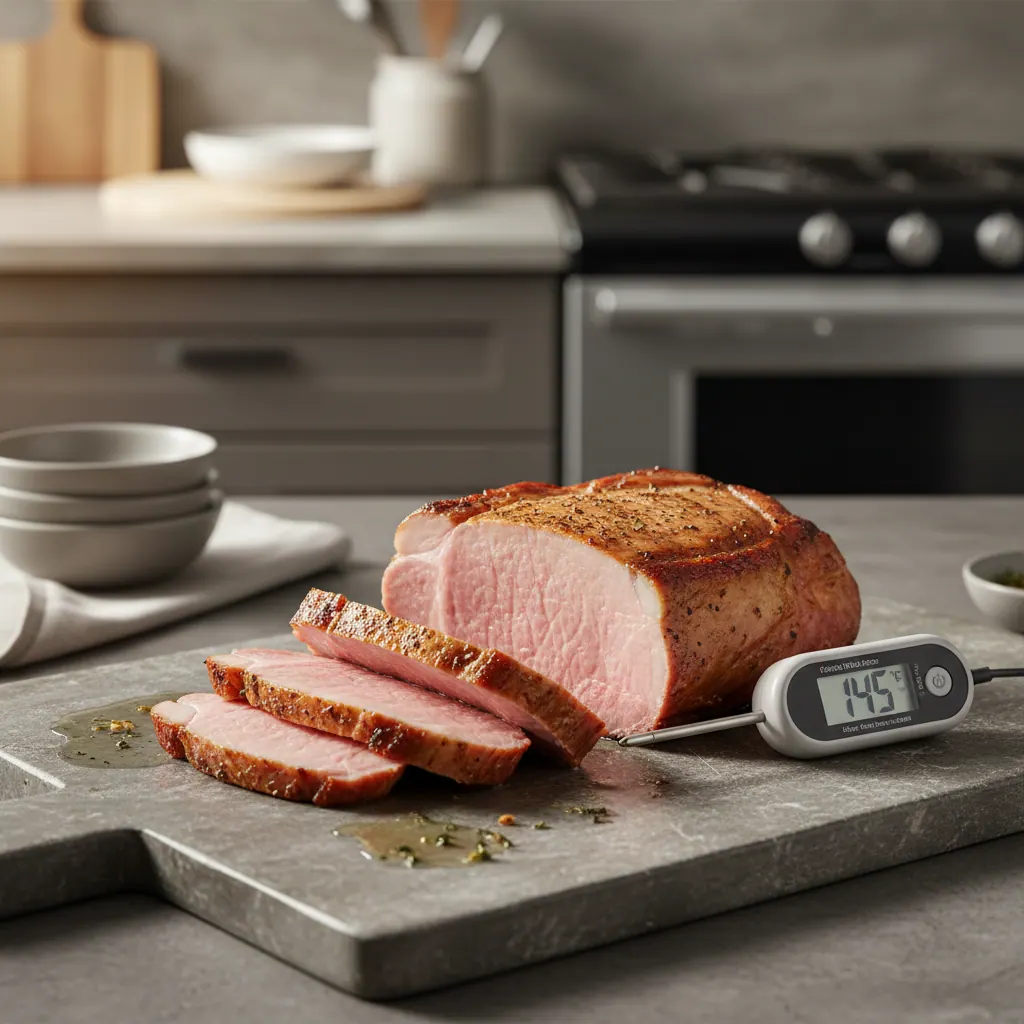
The temperature 145°F changed pork cooking forever. Before 2011, USDA recommended 160°F for pork — a standard set in the 1950s when trichinosis was a real concern in US pigs. Modern American pork is virtually trichinosis-free, and the 2011 update brought the safe temperature down to 145°F. The result: pork chops can now be served properly juicy and slightly pink, the way every chef in Europe has been cooking them for decades.
After 22 years cooking pork in restaurants and five years testing the technique on every cooktop technology, here is the complete chart — internal temperatures by cut, the exact cooktop method, and why the old 160°F number is still costing home cooks their best meals.
For pan-cooking technique fundamentals, our how to sear steak on induction covers the same searing principles. For deep-fried preparations like pork cutlets, see how to deep fry on induction.
The pork temperature chart
Pork cuts fall into two distinct categories with different cooking targets:
Whole-muscle cuts (chops, tenderloin, roasts) — cook to 140–145°F internal for optimal eating quality. USDA-safe at 145°F with 3-minute rest.
Tough cuts (shoulder, Boston butt, picnic) — cook to 195–203°F internal for collagen breakdown. These cuts need slow cooking to become tender.
| Cut | USDA safe temp | Chef pull temp | Final temp | Notes |
|---|---|---|---|---|
| Pork chop, boneless | 145°F | 138°F | 142°F | Lean — overcooks easily |
| Pork chop, bone-in | 145°F | 140°F | 145°F | Bone slows internal rise |
| Pork tenderloin | 145°F | 138°F | 143°F | Leanest cut — pull early |
| Pork loin roast | 145°F | 140°F | 145°F | Rest 10+ min for larger cuts |
| Pork shoulder/butt (fast) | 145°F | 145°F | 150°F | Quick sear; tough |
| Pork shoulder/butt (low + slow) | n/a | 195–203°F | 200°F | The right way — pulled-pork tender |
| Ribs (back/spare) | 145°F | 200–205°F | 205°F | Collagen breakdown, “fall-off” tender |
| Ground pork | 160°F | 160°F | 160°F | Higher temp due to surface area |
| Sausage (fresh) | 160°F | 160°F | 160°F | Same as ground pork |
| Pork belly (crispy) | 145°F | 195°F | 200°F | Fat needs full render |
The whole-muscle vs tough-cut distinction
Whole-muscle cuts (chop, tenderloin, loin) are best at 140–145°F because they’re already tender — additional cooking just dries them out. Tough cuts (shoulder, butt, ribs) contain abundant collagen — connective tissue that’s tough at low temperatures but breaks down into gelatin between 165–203°F. Pulling these cuts at 145°F produces tough, chewy meat; cooking them to 200°F produces fork-tender, gelatin-rich meat.
This is why pork shoulder takes 8+ hours and pork tenderloin takes 15 minutes — they’re cooked to fundamentally different endpoints.
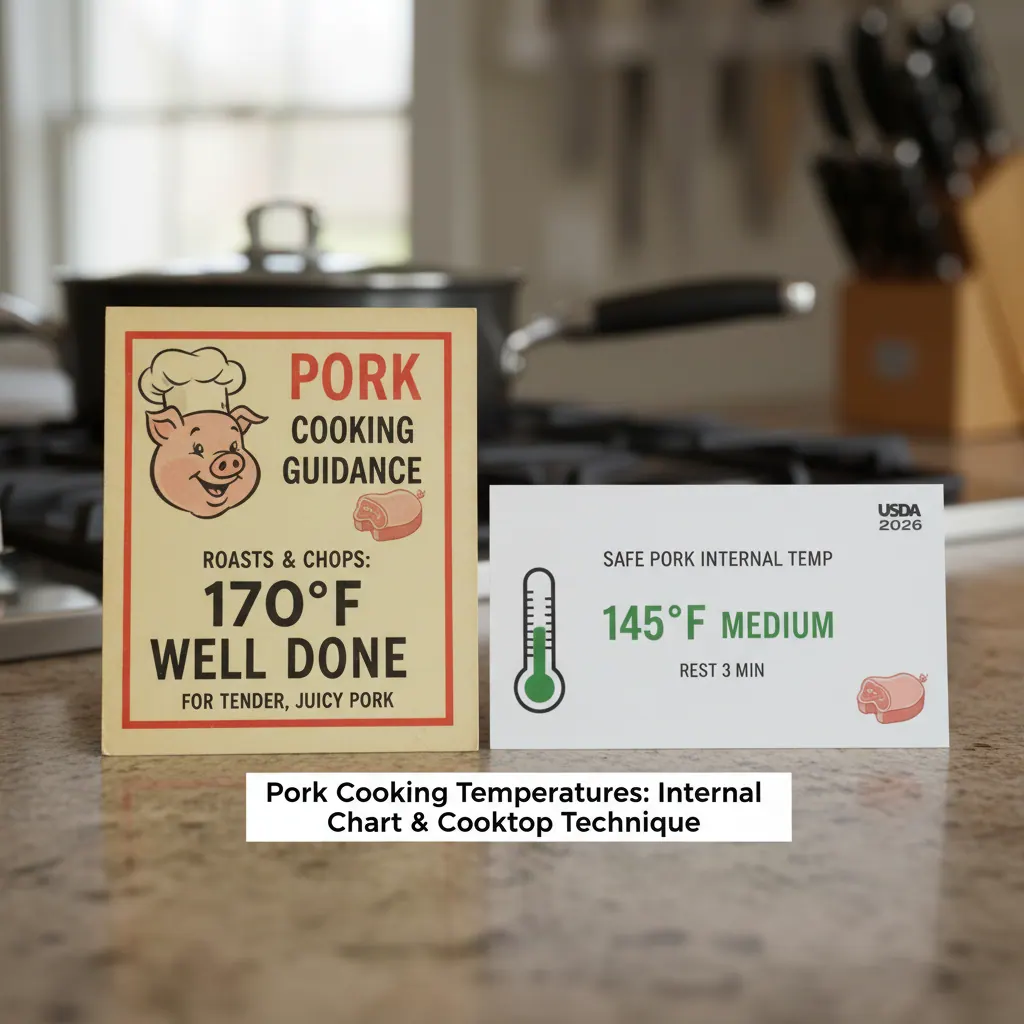
Why 145°F is now safe (and why your grandmother said 170°F)
The trichinosis story:
Pre-1950s: wild and feed-pen pigs in the US frequently carried Trichinella spiralis parasites in their muscle tissue, transmitted by the pigs eating uncooked food scraps containing infected meat. Cooking pork to 160°F+ was necessary to kill the parasite reliably.
1950s: Federal Swine Health Protection Act passed, mandating cooked-feed standards for commercial pigs.
1980s–2000s: trichinosis cases in US commercial pork dropped to fewer than 20 per year nationally. Trichinosis became virtually exclusive to wild game (boar, bear) — not commercial pork.
2011: USDA updated its safe internal temperature for whole-muscle pork from 160°F to 145°F — bringing it in line with the temperatures used for beef, lamb and game.
The 145°F standard kills any pathogens of concern in commercial US pork, including the residual trichinosis risk and the more common Salmonella concern. Pork at 145°F is as safe as beef at 145°F — which most people eat without thinking twice.
The pink color at 145°F: myoglobin (the muscle pigment) doesn’t fully denature until 155–160°F. Pork at 140–145°F is therefore slightly pink, especially near bones. This is normal, expected, and safe. The change in cooking culture is that pink pork is now correct, not undercooked.
If you grew up with the 160°F standard, this requires re-training. The first time you serve a properly-cooked pink-centered pork chop, it looks “wrong” — but it tastes correct.
Pork chop on the cooktop: the standard sear
The pork chop is the most common pork preparation. Get the chart numbers right and the result is consistently better than 80% of restaurant chops.
1. Choose the cut
| Cut | Thickness | Best technique | Notes |
|---|---|---|---|
| Boneless loin chop | 0.75–1” | Quick pan-sear | Common supermarket cut; lean |
| Bone-in loin chop | 1–1.5” | Pan-sear + rest | Best flavor; the “regular” pork chop |
| Bone-in rib chop | 1–1.5” | Pan-sear; reverse-sear for thicker | More marbling than loin chop |
| T-bone porterhouse pork | 1.5–2” | Reverse-sear | Two cuts on one bone — tenderloin + loin |
| Tomahawk pork chop | 1.75–2.5” | Reverse-sear (oven + sear) | Show piece; long bone |
Thicker chops (1.5”+) benefit from reverse-sear (oven first to internal temp, then quick sear) or pan-sear with a heat reduction in the middle to reach internal temperature without burning the exterior.
2. Bring to room temperature
30 minutes on the counter, uncovered. A refrigerator-cold chop (38°F) takes 1–2 minutes longer to reach internal target — and the exterior overcooks during that extra time.
3. Salt 40+ minutes ahead
Same rule as steak — salt at least 40 minutes ahead OR right before cooking. The 5-minute window is the worst (wet surface, no penetration).
4. Pat dry
Surface must be dry to brown properly. Pat with paper towels right before the pan.
5. Heat the pan
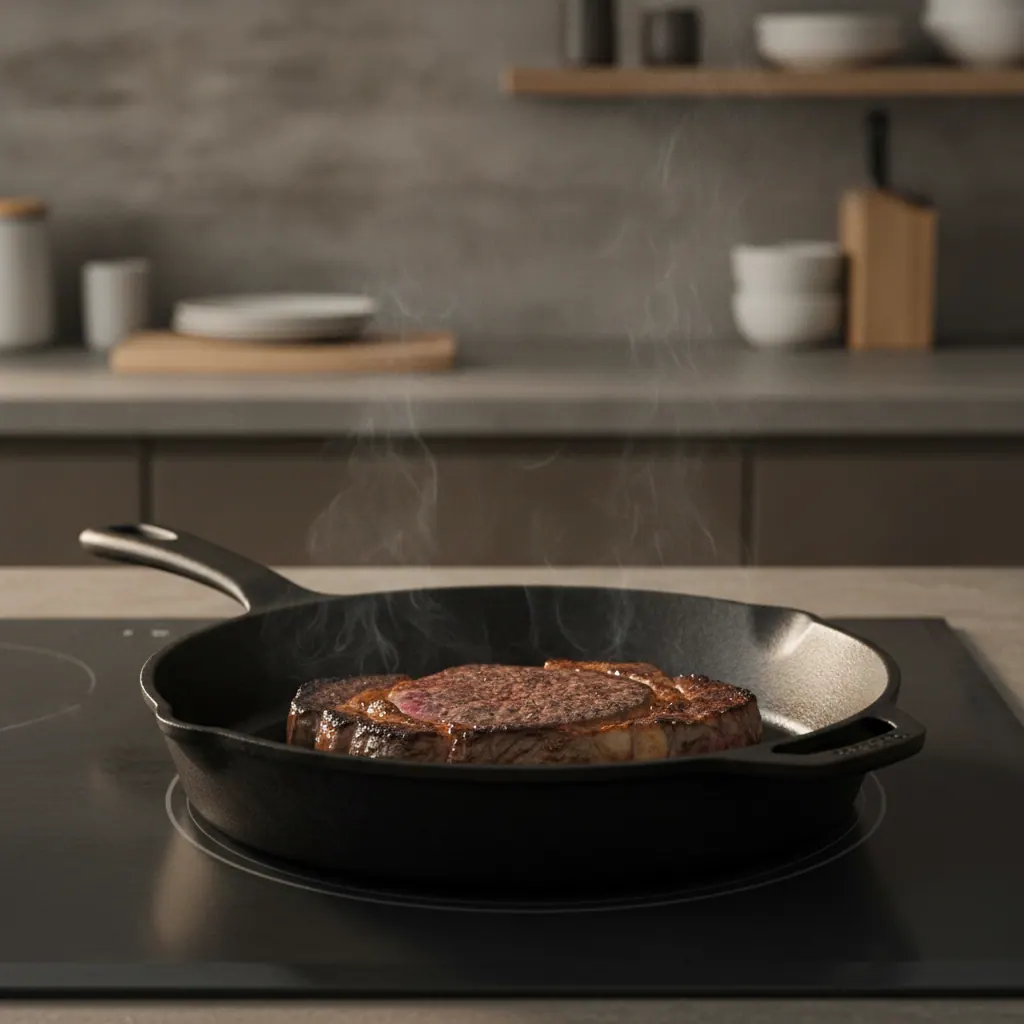
Cast iron, induction level 7 (~2,200W) or gas medium-high. Wait until the surface reads 450–470°F (IR thermometer or water-drop test). Add 1 tablespoon high-smoke oil.
6. Sear
Lay the chop in the pan. The first 30 seconds should produce a violent sizzle. Cook 3–4 minutes per side for a 1-inch chop, 4–5 minutes per side for 1.5-inch. Flip once.
7. Verify internal temperature
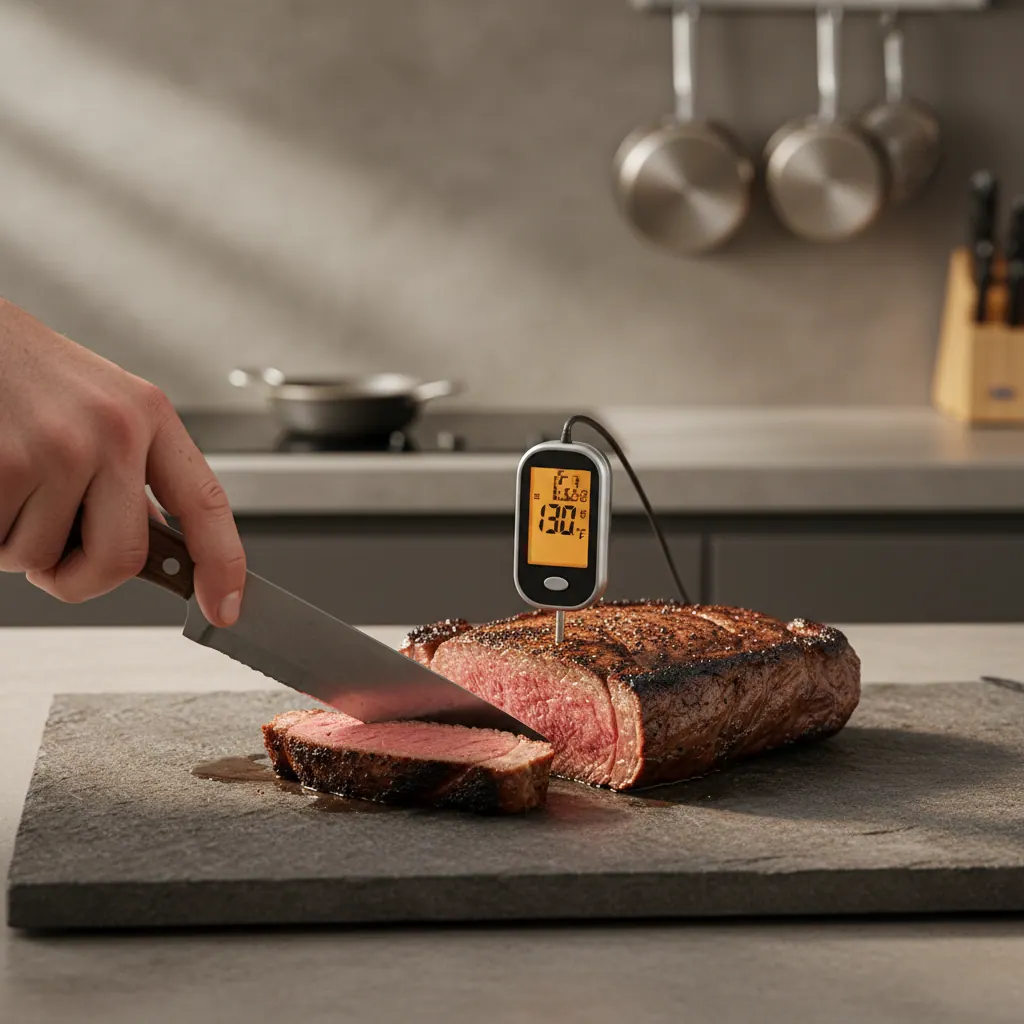
Pull at 138–140°F at the thickest point (avoid bone). For thick chops, you may need to lower the heat (induction level 5, gas medium) for the final minute or two to reach internal target without burning the exterior.
8. Rest 3–5 minutes
Wire rack, tented loosely with foil. Internal rises to 142–145°F. Cut on the bias against the grain.
Total time: 7–10 minutes active + 3–5 minute rest.
Pork tenderloin: the leanest cut
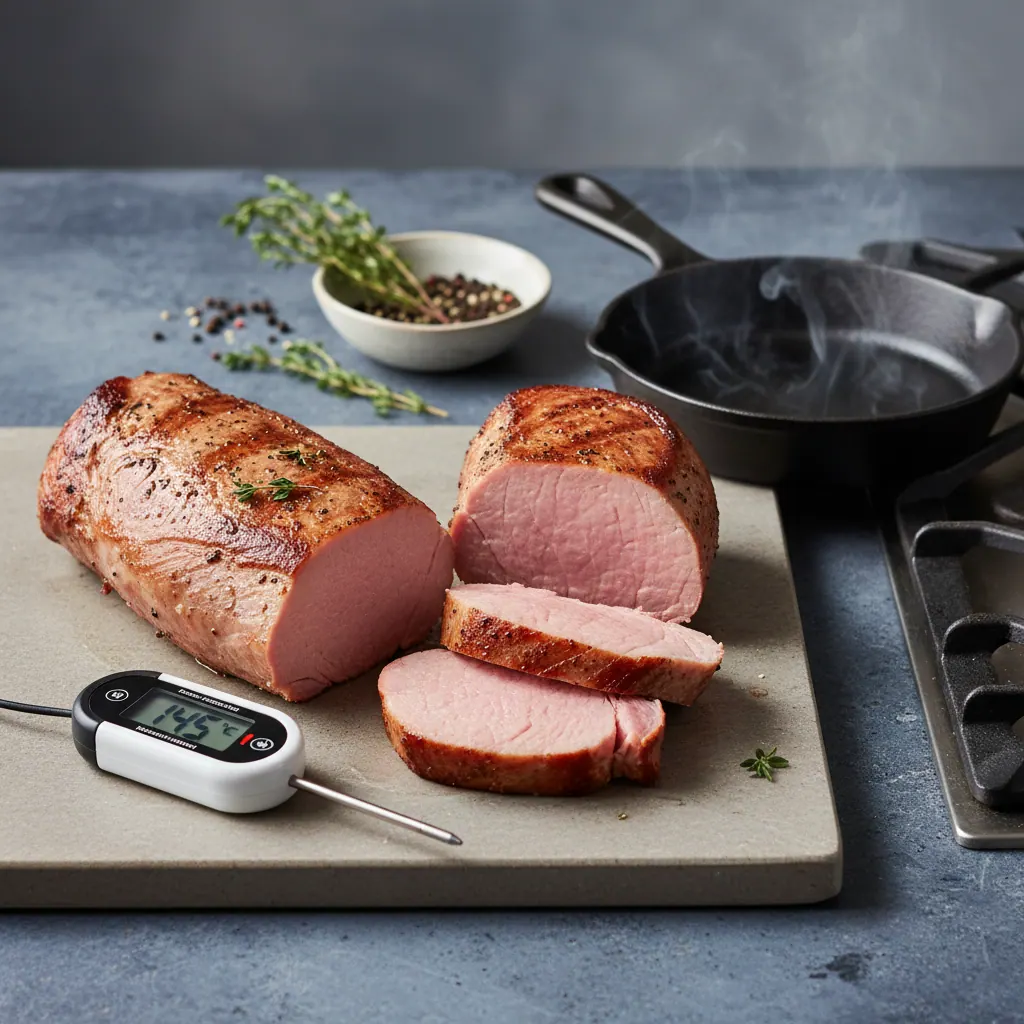
Pork tenderloin is the leanest pork cut — equivalent to chicken breast in fat content. It’s also the easiest cut to overcook. Done badly, it’s dry shoe-leather. Done correctly (140–145°F internal), it’s restaurant-quality.
Pan-sear and finish
For a 1–1.5 lb tenderloin (typical supermarket size):
- Pat dry thoroughly. Trim silverskin (the iridescent membrane).
- Salt and pepper generously, 30+ min ahead if possible.
- Heat pan medium-high (induction level 7, gas medium-high). 1 tablespoon high-smoke oil.
- Sear all sides — 90 seconds per side, all four (rotate as you go). Total searing time about 6 minutes.
- Reduce heat to induction level 4 or gas low-medium. Cover loosely (vented lid or tented foil).
- Continue 6–10 minutes until internal reads 138°F at the thickest point.
- Rest 5 minutes on a wire rack — internal rises to 143°F.
Total time: 12–16 minutes active + 5 minute rest.
For thinner tenderloins (under 1 inch diameter), reduce step 6 to 4–6 minutes. Always verify internal temperature.
Cast iron vs stainless
For tenderloin, cast iron is preferred for the heat retention during the covered finish. Stainless tri-ply works but the lower thermal mass means more active heat management.
For our cast iron picks, see best cast iron pans for induction and gas. For stainless options, best stainless steel pans for induction.
Pork shoulder: the slow-cook target
Pork shoulder (Boston butt, picnic) is the opposite of tenderloin — tough at any temperature below 165°F, transformative above 195°F. The connective tissue (collagen) requires sustained heat to dissolve into gelatin.
For traditional pulled pork, the target internal temperature is 200°F — held there for 30+ minutes for full collagen conversion. Below 195°F, the meat shreds with effort but isn’t truly tender. Above 205°F, the meat falls apart but loses moisture rapidly.
This is NOT a cooktop preparation — pork shoulder needs:
- Smoker or wood-fired BBQ at 225–250°F for 6–10 hours, OR
- Slow cooker (Instant Pot, Crock-Pot) at low for 8–12 hours, OR
- Dutch oven in oven at 250°F for 6–8 hours
A cooktop is the wrong tool for shoulder. If you have a Dutch oven, the technique is to sear all sides on the cooktop at high heat (3 minutes per side) THEN transfer the lidded Dutch oven to a 250°F oven for 6+ hours.
Ground pork and sausage
Ground pork must reach 160°F internal — not 145°F. The reason: grinding distributes any surface bacteria throughout the meat, so the entire mass must reach pasteurization temperature.
For a ground pork patty (1/2 to 3/4 inch thick):
- Pan-sear at induction level 7 or gas medium-high.
- 3–4 minutes per side until internal reads 158°F.
- Rest 2 minutes — internal reaches 160°F.
The same applies to fresh sausage links — internal target 160°F.
Common mistakes and the fixes
| Mistake | Result | Fix |
|---|---|---|
| Cooking to 160°F (old standard) | Dry, tough, white pork | Pull at 138–140°F; rest to 145°F |
| No thermometer | Inconsistent doneness | ThermoWorks ThermaPen — non-negotiable |
| Probing into bone | Reads 8–15°F lower than meat | Insert into thickest meat, not against bone |
| Cooking shoulder fast | Tough, chewy result | Slow-cook to 200°F internal — 6+ hours |
| Cooking tenderloin to 155°F+ | Dry, leathery | Pull at 138°F; tenderloin is the leanest pork cut |
| Cutting immediately | Juices everywhere | Rest 3 min for chops, 5 min for tenderloin, 10 min for roasts |
| Cold pan, refrigerator-cold pork | Pale, slow-cooked exterior | Preheat pan; rest pork at room temp 30 min |
| Crowding the pan | Steam, no sear | One chop per 7 inches of pan |
Cooktop technique notes
Induction
The best surface for pork chops and tenderloin. Precise power adjustment lets you go from sear (level 7) to finish (level 4) instantly — important for thick cuts. The boost feature on premium induction (Bosch Benchmark, GE Profile) reaches 3,700W on the front zone, which preheats cast iron in 4 minutes for the initial sear.
For our induction picks, best induction cooktops 2026 covers the units with the best power-control range for pork technique.
Gas
Gas works well for pork — the side-flame heating helps with the covered-finish technique on thick chops (the lid sits flat on a tilted pan, allowing flames to lap up the side).
For high-BTU gas cooktops, see best 30-inch gas cooktops and wolf vs thermador gas cooktop.
Electric smooth-top
Functional but slow heat response makes thick-chop technique more demanding. Pull-and-rest timing is the same; just expect more time waiting for the pan to come up to temperature.
Bottom line
The single biggest pork upgrade in home cooking: stop cooking to 160°F. Pull whole-muscle pork at 138–140°F internal, rest to 145°F. The result is pork that’s juicy, properly cooked, and slightly pink at the center — exactly how restaurants serve it.
Different cuts, different targets:
- Chop and tenderloin: pull at 138°F, rest to 143°F
- Loin roast: pull at 140°F, rest to 145°F
- Shoulder/butt: cook to 200°F (slow-cook only — wrong for cooktop)
- Ground pork and sausage: 160°F minimum
A thermometer is the entire game. Once you’ve made the switch from 160°F to 145°F pork, you won’t go back.
For pan and cooktop guidance, see best cast iron for induction and gas and best induction cooktops 2026.
Frequently asked questions
What is the safe internal temperature for pork?
145°F (63°C) for whole-muscle pork (chops, tenderloin, roasts) with a 3-minute rest — USDA standard since 2011. 160°F for ground pork and sausage. Tough cuts (shoulder, butt, ribs) cook to 195–203°F for collagen breakdown.
Is pork done at 145°F?
Yes — 145°F is the USDA-mandated safe temperature for whole-muscle pork as of 2011. The flesh is slightly pink, which is normal and safe. The old 160°F standard reflected pre-1980s trichinosis risk that’s been virtually eliminated from US commercial pork.
How long do you cook a pork chop on the stove?
Boneless chop (3/4-inch): 3–4 min per side, total 7–9 min on induction level 7 or gas medium-high. Bone-in (1-inch): 4–5 min per side, total 9–11 min. Thick-cut (1.5-inch+): sear 4 min per side, reduce heat, cover and finish 5–7 min — total 13–17 min. Always pull at 138–140°F internal.
What temperature should pork tenderloin be cooked to?
140–143°F final temperature — pull at 138°F and rest 5 minutes. Tenderloin is the leanest pork cut; above 150°F it dries out rapidly. The USDA 145°F standard produces juicy, slightly-pink, properly-cooked tenderloin.
Why is my pork tough?
Three causes: overcooked above 155°F (especially lean cuts); wrong technique for the cut (shoulder needs slow cooking, not searing); no rest after cooking. Use a thermometer, pull whole-muscle pork at 138–140°F, rest 3–5 minutes.
Cooking temperatures and timing data from the Cooktop Hunter test kitchen, May 2025–April 2026. Type-T thermocouples for pan surface measurement; ThermoWorks ThermaPen ONE for internal temperature. Food safety information per USDA FSIS Cook Like a Pro guidelines and USDA 2011 update on whole-muscle pork temperatures.