Yes — and the reasons are different from gas in a way that changes what you should buy.
Induction eliminates an entire category of indoor air pollution: combustion byproducts. No flame, no fuel, no exhaust. What it does not eliminate is everything the food produces, and that turns out to be most of what a range hood was capturing anyway.
The practical result: you need a hood, you need roughly half the airflow of an equivalent gas cooktop, and that difference has consequences that reach well beyond the hood itself.
What induction actually removes from the equation
A gas burner emits nitrogen dioxide, carbon monoxide, formaldehyde and ultrafine particulates in proportion to its run time. EPA guidance and a large body of peer-reviewed work connect unvented gas cooking to indoor NO₂ above WHO exposure guidance in a substantial share of homes. Our article on gas stoves and indoor air quality covers that evidence.
Induction produces none of it. The magnetic field induces a current in the pan’s ferromagnetic base and the pan heats itself. There is no combustion anywhere in the system.
It also dumps far less waste heat into the room. Induction transfers 85–90 % of its energy into the cookware; gas manages 32–40 %. The remainder is heat you paid for and then have to remove — which is why gas kitchens run hot in summer and induction kitchens do not. Our induction vs gas comparison works through the efficiency data.
Quotable takeaway: Induction eliminates combustion byproducts entirely and cuts waste heat by more than half. It eliminates none of the particulates, grease or moisture generated by the food itself.
What it does not remove
Here is where the “induction doesn’t need a hood” argument falls apart.
Cooking is itself a major source of fine particulate matter. Searing meat, frying, roasting, and heating oil toward its smoke point all generate PM2.5, grease aerosols and acrolein — from the food and the fat, not from the fuel. Indoor air studies consistently find cooking to be among the largest sources of residential particulate exposure, and those measurements do not care what heated the pan.
Moisture is unchanged. A pot of boiling pasta releases the same water vapor on induction as on gas. In a tight, well-insulated house that moisture condenses on the coldest available surfaces — windows, cabinet undersides, exterior wall cavities behind cabinetry — and becomes a mold problem.
Odor is unchanged. Fish is fish.
The counterintuitive part: induction can smoke more
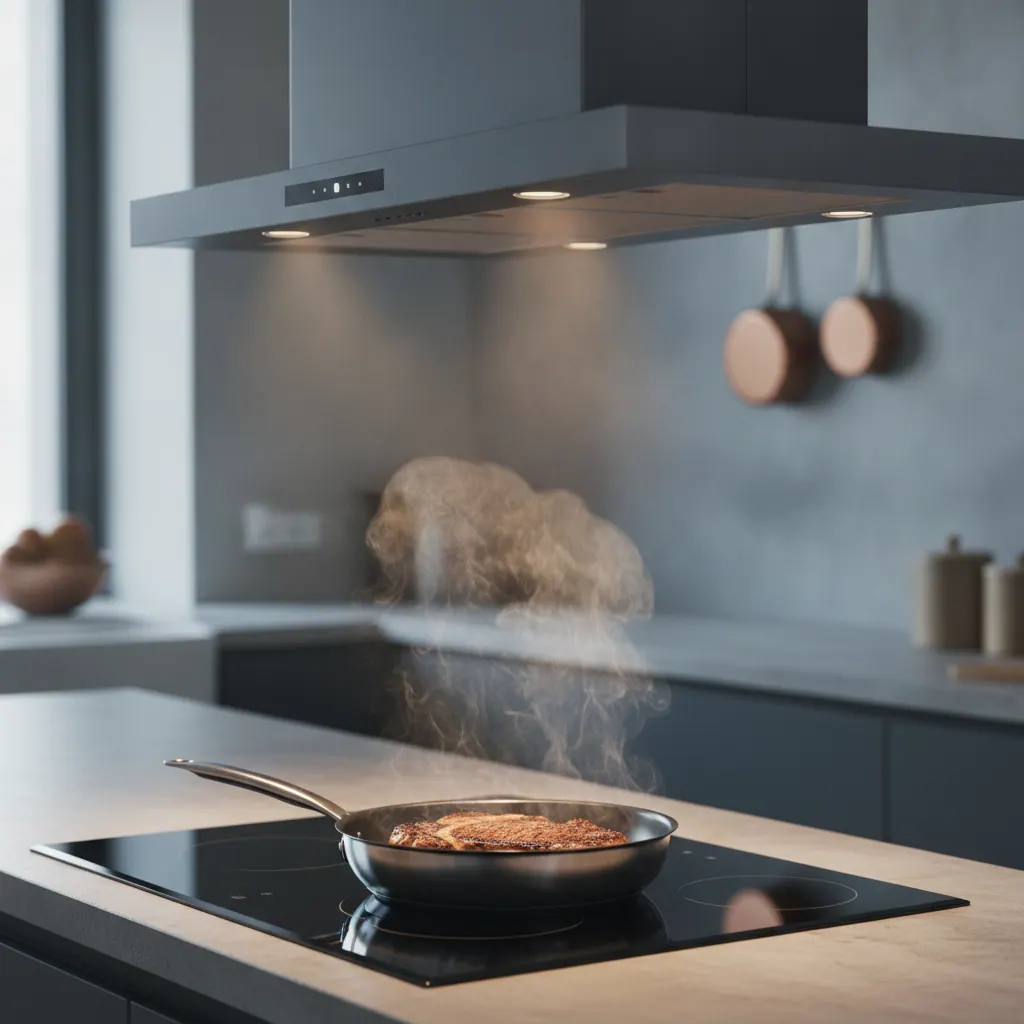
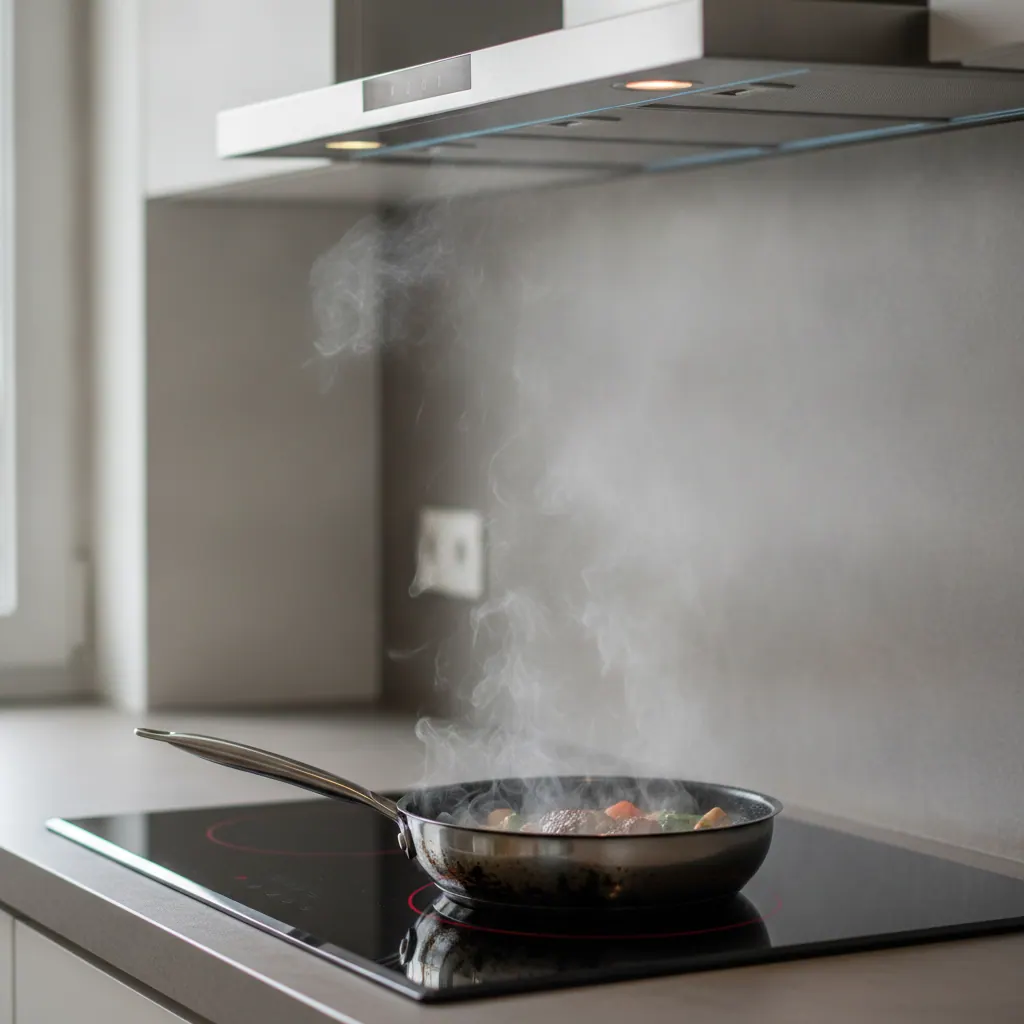
Cooks switching from gas to induction frequently set off the smoke alarm in their first week. Not because induction is dirtier — because it is faster.
A 3,700 W induction zone delivers energy into a pan far more efficiently than a 15,000 BTU gas burner, and a dry pan on boost reaches searing temperature in a fraction of the time. Cooks accustomed to gas timing preheat the way they always did, blow straight past their oil’s smoke point, and produce a room full of smoke in under two minutes.
This is a technique adjustment rather than a defect — our how to sear steak on an induction cooktop guide covers the timing changes. But it does mean that the “induction is cleaner so I need less ventilation” reasoning has a real limit. During high-heat work, an induction kitchen can be producing more visible smoke per minute than the gas kitchen it replaced.
How much CFM you actually need
Induction is sized by the linear-foot rule, not the BTU rule:
| Cooktop width | Wall-mounted | Island |
|---|---|---|
| 30” induction | 250 CFM | 350 CFM |
| 36” induction | 300 CFM | 450 CFM |
| 30” gas (~40,000 BTU) | 400 CFM | 550 CFM |
| 36” gas (~60,000 BTU) | 600 CFM | 800 CFM |
The gap is roughly a factor of two, and it exists because the gas figure has to account for combustion products and waste heat that induction never creates. Our range hood CFM guide covers the sizing math, including the duct losses that mean a rated 300 CFM hood may deliver considerably less.
The knock-on effect nobody mentions
Staying under 400 CFM is where induction quietly saves you real money.
In jurisdictions following the IRC, a kitchen exhaust system capable of exceeding 400 CFM triggers a makeup air requirement — an interlocked, damper-controlled duct bringing outdoor air in to replace what the hood removes. Passive systems run $500–$1,500 installed; tempered systems for cold climates run $2,000–$5,000 and up. See range hood makeup air requirements for the code detail.
A 36-inch induction cooktop sized at 300 CFM sits comfortably below that line. A 36-inch gas cooktop sized at 600 CFM does not. Choosing induction can remove an entire mechanical subsystem from the project — and that saving rarely appears in the fuel comparison spreadsheets.
Quotable takeaway: A 36-inch induction cooktop needs about 300 CFM and stays under the 400 CFM makeup air threshold. The equivalent gas cooktop needs about 600 and does not — so induction can eliminate a $500 to $5,000 makeup air system from the project entirely.
Ductless over induction: the defensible compromise
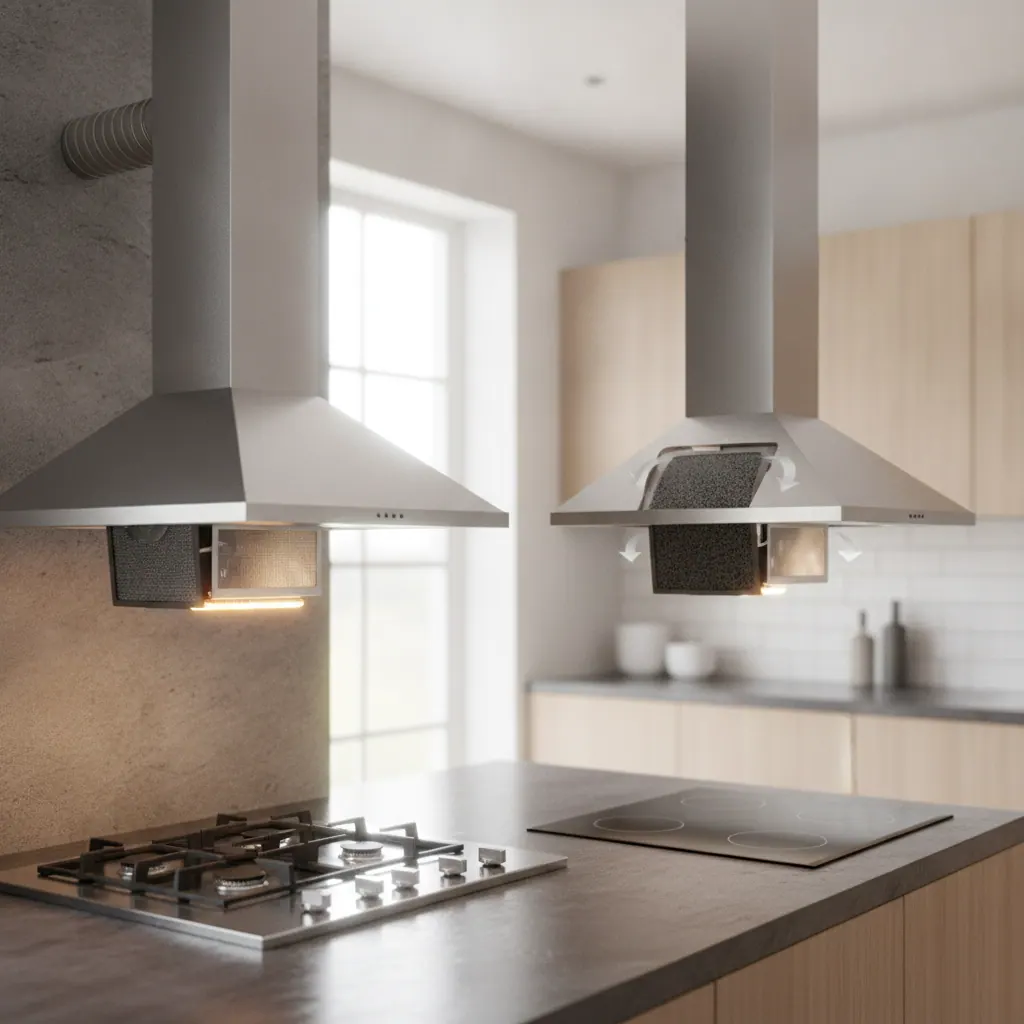
Recirculating hoods are a poor answer over gas because a charcoal filter cannot scrub NO₂ or CO. Over induction, there are no combustion gases to scrub, so the filter is being asked to do a job it can partly do: capture odor and some grease.
What remains unfixable is moisture, which no recirculating hood removes.
So for an apartment or condo induction kitchen with no duct path, a good ductless hood plus an openable window is a reasonable setup rather than a failure. Replace the charcoal filters every three to six months. Ducted vs ductless range hoods covers the full comparison, including the running cost most buyers underestimate.
Downdraft works better with induction
Downdraft ventilation — vents that pull sideways and down rather than up — has an inherent handicap: it fights the buoyancy of a rising plume.
Over gas, it fights something else too. A downdraft strong enough to capture a gas plume can disturb the flame itself. Induction has no flame to disturb, and its flat glass surface pairs neatly with a flush or telescoping downdraft. If your island cannot be ducted overhead, downdraft cooktops covers the tradeoffs — capture on tall stockpots remains the weak point regardless of fuel.
Practical recommendations
Building or remodeling: duct it. 300 CFM for a 36-inch induction cooktop, rigid metal, shortest run available. You will stay under the makeup air threshold and get proper moisture removal.
Apartment or condo, no duct path: a good ductless hood is acceptable over induction. Replace filters on schedule and open a window when frying.
Existing kitchen with an oversized gas-era hood: keep it. There is no penalty for having more capacity than you need, as long as a makeup air system is already in place or the hood stays under the threshold. Run it on a lower speed and enjoy the quiet.
Whatever you install, use it. The most common ventilation failure is not undersizing — it is a perfectly adequate hood that nobody switches on. Start it before you start cooking and leave it running a few minutes after, so it captures the plume from the beginning and clears residual particulates at the end.
Bottom line
- Yes, induction needs a hood — for cooking emissions and moisture, not for combustion products.
- Size at 100 CFM per linear foot: about 250 for a 30-inch, 300 for a 36-inch.
- That is roughly half the equivalent gas requirement, and usually keeps you under the 400 CFM makeup air threshold.
- Ductless is a defensible compromise over induction, unlike over gas — but it never removes moisture.
- Induction’s speed means more smoke, faster, during high-heat searing. Ventilate accordingly.
Still choosing the cooktop? Our best induction cooktops 2026 round-up covers the models we recommend, and how to choose a cooktop covers fuel, size and budget together.
Frequently asked questions
Do induction cooktops need a range hood?
Yes, but for different reasons than gas and at roughly half the airflow. Induction produces no combustion byproducts — no nitrogen dioxide, no carbon monoxide, no formaldehyde — because nothing burns. What it does not eliminate is everything the food itself generates: grease aerosols, fine particulates from searing and frying, acrolein from hot oil, steam and odor. Those are cooking emissions, not fuel emissions, and they are unaffected by how the pan got hot.
How many CFM does an induction cooktop need?
Size at roughly 100 CFM per linear foot of cooktop width, which puts a 30-inch unit at about 250 CFM and a 36-inch at about 300. That is substantially less than the equivalent gas cooktop, which is sized by burner output at roughly 1 CFM per 100 BTU and commonly lands between 400 and 700. The practical consequence is that most induction installations stay comfortably below the 400 CFM threshold that triggers a makeup air requirement in IRC jurisdictions.
Can you use an induction cooktop without any ventilation?
It is safer than doing the same over gas, because there are no combustion gases accumulating in the room, but it is still not a good idea. Searing, frying and any high-heat work generate significant fine particulate matter from the food and the cooking oil, and boiling generates moisture that has to condense somewhere. In a tight modern home without ventilation that moisture becomes a mold risk. At minimum, cook near an openable window and run some form of exhaust when you sear or fry.
Is a ductless hood acceptable over an induction cooktop?
It is a defensible compromise over induction in a way it is not over gas. Because there are no combustion byproducts to scrub, the charcoal filter is being asked to do a job it can actually partly do — capture odor and some grease. The unfixable gap is moisture, which no recirculating hood removes. If you have no duct path, a good ductless hood over induction plus an openable window is a reasonable setup. The same arrangement over gas leaves the real hazard untouched.
Does induction produce less smoke than gas?
Not necessarily, and this surprises people. Induction transfers heat to the pan far faster than gas, so a pan reaches searing temperature and blows past an oil’s smoke point more quickly. Cooks moving from gas to induction routinely report setting off the smoke alarm in their first week, not because induction is dirtier but because it is faster. The smoke comes from the food and the oil, and induction is unusually good at getting them hot.