If your range hood is capable of exceeding 400 CFM, building code in most of the United States requires a makeup air system. Not a recommendation — a requirement, enforced at inspection, and the reason more than one kitchen remodel has stalled a week before the final walkthrough.
This is the ventilation topic buyers discover last and should discover first. Makeup air is inexpensive to design in and expensive to retrofit, and the 400 CFM threshold sits well below the airflow that a serious gas cooktop actually needs.
What the code says
The relevant provision lives in the International Residential Code, in the mechanical chapters covering exhaust systems. In recent editions the language runs approximately as follows: where a kitchen exhaust system is capable of exceeding 400 CFM, makeup air must be supplied at a rate that offsets the exhaust, the makeup air system must have a means of closure, and it must be automatically controlled to operate simultaneously with the exhaust system.
Three details matter more than the exact wording.
“Capable of exceeding” refers to the equipment, not your habits. A 900 CFM hood is a 900 CFM system even if you only ever run it on speed one. Inspectors read the nameplate.
The interlock is mandatory. A hole in the wall with a damper is not a makeup air system. The damper has to open automatically when the hood runs and close when it stops, or the house has an uncontrolled air leak the rest of the year.
Editions and local amendments vary. The 2021 IRC conditions the requirement on the presence of atmospherically vented fuel-burning appliances inside the building envelope; earlier editions applied it more broadly. The International Mechanical Code carries parallel provisions, California works through its own mechanical code and Title 24, and plenty of jurisdictions amend all of the above. Your building department is the authority. Ask before you specify a blower, not after.
Quotable takeaway: The makeup air trigger is the exhaust system’s rated capability, not its typical use. A 900 CFM hood run permanently on low is still a 900 CFM system for code purposes.
The hazard the code is actually addressing
The rule exists because of backdrafting, and backdrafting is a carbon monoxide problem.
A range hood removes air from an enclosed volume. That air must be replaced. In a leaky older house it seeps in through the building envelope — around windows, through rim joists, past a hundred small gaps. In a tight modern build, those paths have been deliberately sealed, so the air finds whatever opening remains.
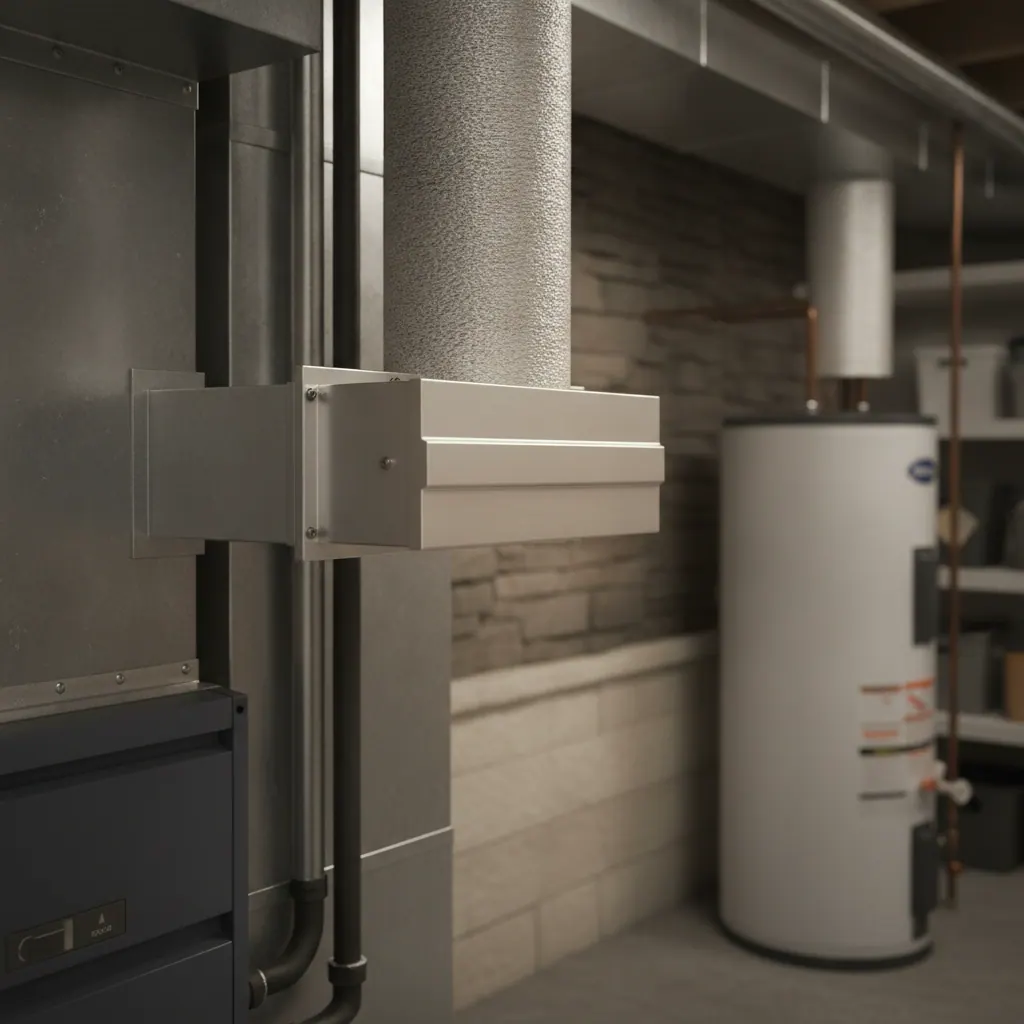
Frequently, that opening is a flue. An atmospherically vented water heater or furnace relies on natural buoyancy — hot gas rises up the chimney with no fan assisting it. That draft is weak, measured in a few pascals. A powerful exhaust fan can overcome it and reverse the flow, drawing combustion gases down the flue and into the house. Those gases include carbon monoxide.
The same physics applies to a wood fireplace, which is the version homeowners notice: smoke rolling out of the firebox when the hood is switched on. The water heater version produces no smoke and no smell, which is precisely why it is dangerous.
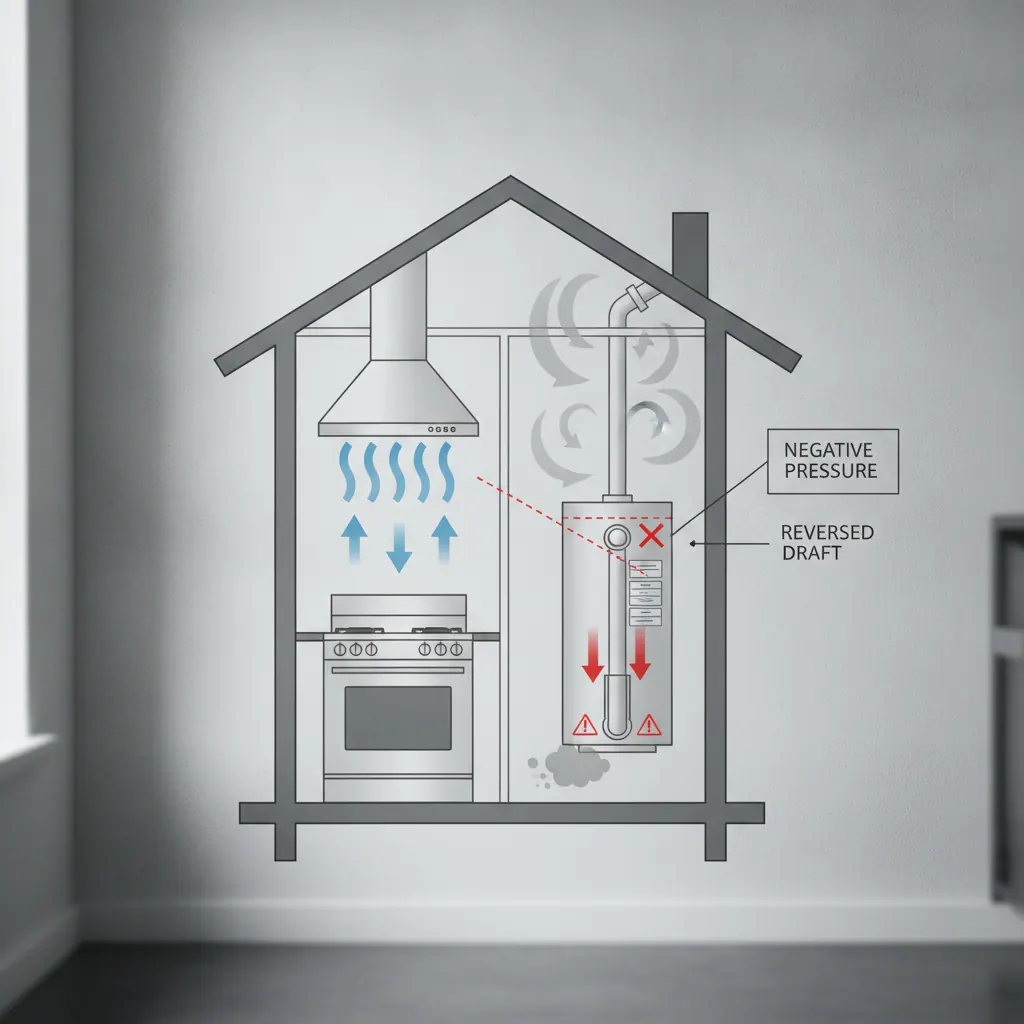
Homes at highest risk share a profile: tight envelope, atmospheric combustion appliances inside the conditioned space, and a powerful hood. If your water heater and furnace are both sealed-combustion direct-vent units, the risk drops sharply — and under the 2021 IRC language, the requirement itself may not be triggered. This is one of several reasons a mechanical contractor may recommend swapping an atmospheric water heater for a direct-vent model during a kitchen remodel.
The three types of makeup air system
Passive (damper-controlled). An insulated duct from outdoors to a supply point near the kitchen, fitted with a motorized damper wired to open with the hood. Simplest and cheapest. The tradeoff is that incoming air arrives at whatever temperature it is outside.
Powered. A dedicated fan pushes makeup air in rather than relying on the hood’s negative pressure to pull it. More reliable on long or complex duct runs, and easier to balance against a high-CFM hood.
Tempered. A powered system with a heater — electric resistance, hydronic coil, or routed through the HVAC system — so incoming winter air is conditioned before it reaches the room. Expensive, and in cold climates close to unavoidable.
| System | Typical installed cost | Best for |
|---|---|---|
| Passive damper | $500–$1,500 | Mild climates, hoods near the 400–600 CFM range |
| Powered | $1,200–$3,000 | Long duct runs, 600–900 CFM |
| Tempered | $2,000–$5,000+ | Cold climates, 900+ CFM, year-round comfort |
Those figures assume the system is designed in. Retrofitting makeup air into a finished kitchen — after cabinets, after drywall, after the countertop template — is where budgets break.
Sizing and placement
The general principle is that makeup air should approximately offset the exhaust, with the exact calculation depending on the code edition your jurisdiction enforces. Some editions require makeup equal to the full exhaust rate; the 2021 IRC language works from the amount by which the system exceeds 400 CFM.
Practical guidance that holds across editions:
- Do not undersize the duct. Makeup air ducting is subject to the same static pressure losses as exhaust ducting, and the same rules apply — rigid metal, minimal elbows, no reduction below the specified diameter. Our range hood installation guide covers equivalent-length math that applies equally here.
- Introduce the air near the kitchen but not into the capture zone. Air blowing across the cooktop disrupts the plume the hood is trying to capture, which degrades the hood’s performance and can push smoke into the room. A supply near the floor at the kitchen perimeter, or into an adjacent space, works better than a register beside the range.
- Insulate the duct and use a well-sealed damper. Uninsulated makeup air duct condenses in winter.
The 395 CFM phenomenon
Once you know the threshold, the market makes more sense. An implausible number of range hoods are rated at exactly 395 or 400 CFM. That is not a coincidence of engineering. It is a design target chosen so the installation avoids triggering a makeup air requirement.
Whether that serves you depends entirely on your cooktop.
For induction and electric, 400 CFM is genuinely sufficient at ordinary residential sizes — the sizing rule of 100 CFM per linear foot puts a 36-inch cooktop at 300 CFM, comfortably under the line. Staying below the threshold costs you nothing.
For gas, it frequently does not work. Sizing by burner output at roughly 1 CFM per 100 BTU puts a 60,000 BTU cooktop at 600 CFM before duct losses. Buying a 400 CFM hood to dodge a code requirement means accepting real under-ventilation over an appliance whose combustion products are the reason you wanted ventilation in the first place. Our range hood CFM guide works through the sizing math, and gas stoves and indoor air quality covers what under-ventilated gas cooking actually puts in the room.
Quotable takeaway: For induction, staying under 400 CFM costs nothing — the sizing rules rarely require more. For a 60,000 BTU gas cooktop, staying under 400 CFM means deliberately under-ventilating the appliance that most needs ventilation.
What this means for your project
Settle it at design. Before you fall in love with a 1,200 CFM pro-style hood, ask the building department what applies and price the makeup air system alongside it. The hood is rarely the expensive half.
Consider the fuel decision. Induction sidesteps most of this. No combustion means lower CFM requirements, which often means staying under the threshold entirely, which means no makeup air system at all. If you are already weighing fuel types, this belongs in the calculation — see our induction vs gas comparison and, if you are converting an existing kitchen, convert a gas cooktop to induction.
Audit your combustion appliances. Atmospheric water heaters and furnaces inside the building envelope are what make backdrafting possible. If a replacement is on the horizon anyway, a direct-vent unit removes the hazard and may remove the code trigger.
Do not treat a CO alarm as a substitute. Alarms are a last line of defense, not a ventilation strategy. They should be installed regardless.
Bottom line
- Exhaust systems capable of exceeding 400 CFM trigger makeup air in IRC jurisdictions.
- The rule exists to prevent backdrafting of atmospherically vented combustion appliances — a carbon monoxide hazard, not a comfort issue.
- Makeup air must have a means of closure and be interlocked to run with the hood.
- Budget $500–$1,500 passive, $2,000–$5,000+ tempered, and design it in from the start.
- Code editions and local amendments vary. Confirm with the authority having jurisdiction before specifying a blower.
Planning the rest of the installation? Our cooktop installation guide covers gas lines, electrical and cutouts, and ducted vs ductless range hoods covers the case where no duct path exists at all.
Frequently asked questions
When is makeup air required for a range hood?
In jurisdictions following the International Residential Code, a kitchen exhaust system capable of exceeding 400 CFM requires makeup air. The trigger is the system’s rated capability, not how you intend to use it — a 900 CFM hood that you plan to run on low still counts as a 900 CFM system. Code editions differ in the details, and many jurisdictions amend the provision locally, so the building department having jurisdiction is the authority on what applies to your project.
Why does a powerful range hood need makeup air?
Because a hood is an air pump, and air removed from a sealed house has to be replaced from somewhere. In a tight modern building, the path of least resistance can be backwards down the flue of an atmospherically vented water heater, furnace or fireplace — pulling combustion gases including carbon monoxide into the living space instead of sending them up the chimney. That reversal is called backdrafting, and preventing it is the entire purpose of the code provision.
How much does a makeup air system cost?
A passive system — an insulated duct, a motorized damper and an interlock to the hood — typically runs 500 to 1,500 dollars installed when it is planned into a project from the start. A tempered system that heats incoming winter air costs considerably more, commonly 2,000 to 5,000 dollars and up depending on the heater and the climate. Retrofitting either one after drywall and cabinets are in place is where costs escalate, which is why makeup air belongs in the design phase.
Can I avoid makeup air by buying a smaller range hood?
Yes, and this is exactly why so many hoods are rated at 395 or 400 CFM — they are engineered to sit just below the code threshold. Whether that serves you depends on the cooktop. For induction or electric, 400 CFM is genuinely adequate at most residential sizes. For a high-output gas cooktop, staying under the threshold means accepting real under-ventilation to avoid a code requirement, which is a poor trade if you cook seriously.
Does makeup air have to be heated?
Not by the model code, which requires makeup air to be provided but does not generally mandate tempering. In practice, climate decides. Introducing several hundred CFM of subzero outdoor air into a kitchen makes the room unusable and can create condensation problems, so cold-climate installations commonly add a heater or route makeup air through the HVAC return. In mild climates a passive untempered system is often perfectly livable.
This article summarizes model code provisions current to 2026 for general guidance. It is not a substitute for the code as adopted and amended in your jurisdiction, and it is not engineering advice. Confirm requirements with your building department and a licensed mechanical contractor. See our editorial policy.