
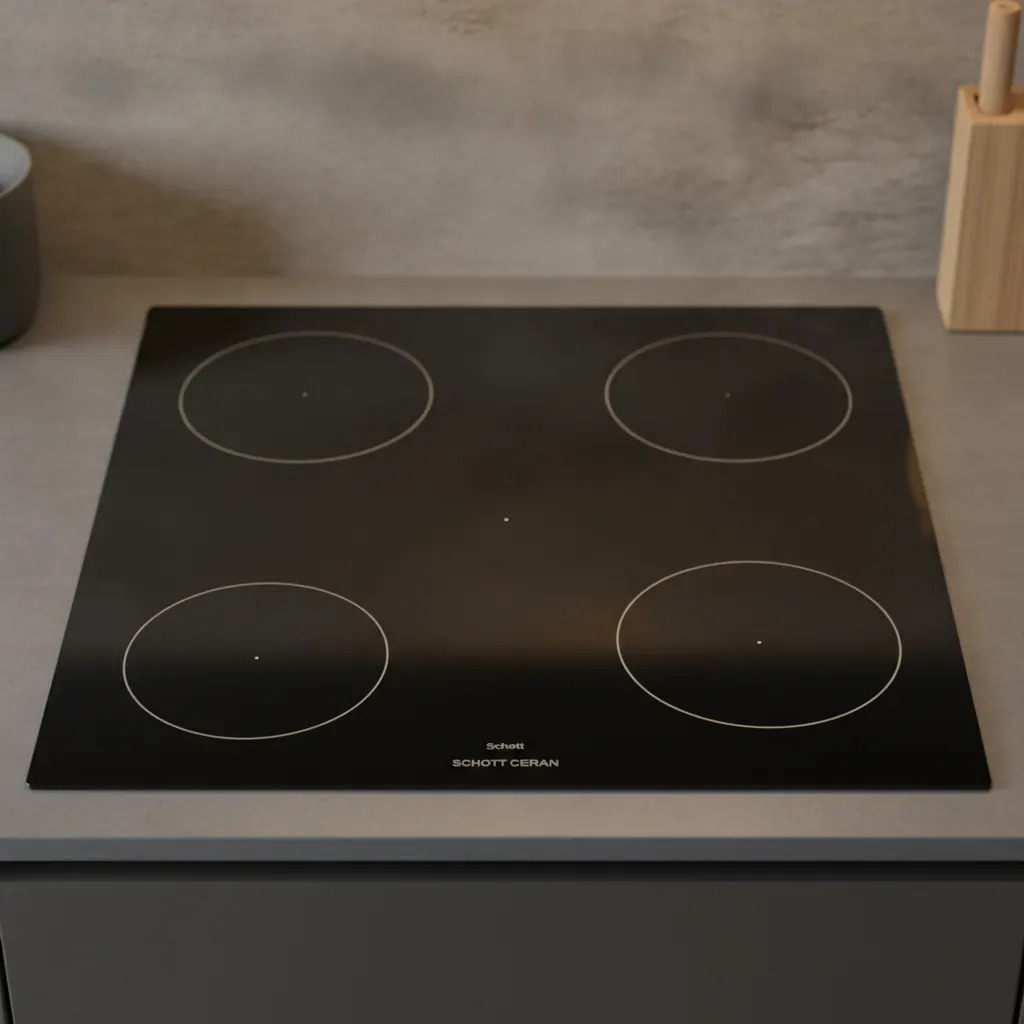
If you’ve shopped for an induction or radiant cooktop, you’ve probably seen “Schott Ceran” or “EuroKera” listed in the specs — and wondered whether it matters. These are the two leading brands of glass-ceramic cooktop surface: the smooth black panel that the heating elements sit beneath. This guide explains who makes each, which is better, and how much the glass brand should actually influence your buying decision.
Quick Answer
Schott Ceran and EuroKera are competing brands of glass-ceramic cooktop surface. Schott Ceran is made by the German company SCHOTT AG; EuroKera is made by a French joint venture of Corning and Saint-Gobain. Both are premium, highly heat- and shock-resistant glass-ceramic with near-identical real-world performance. Neither is meaningfully better — the cooktop’s coils, electronics and build quality matter far more than which glass brand it uses.
What Glass-Ceramic Actually Is
The flat surface of a modern induction or radiant cooktop isn’t ordinary glass — it’s glass-ceramic, a specially engineered material that is first formed as glass and then partially crystallized. This gives it two crucial properties: near-zero thermal expansion (so it survives rapid heating and cooling without cracking) and the ability to handle very high temperatures. On induction, the surface stays relatively cool and simply protects the coils; on radiant electric, it glows and transmits heat directly.
Both Schott Ceran and EuroKera produce exactly this kind of material. The differences are about brand and manufacturer, not category.
Schott Ceran: The German Standard
Schott Ceran is the flagship glass-ceramic product of SCHOTT AG, a German specialty-glass company that pioneered the material for cooktops in the early 1970s. Schott Ceran is the more recognized name among consumers and is frequently advertised as a premium feature on the spec sheet. It is known for:
- Excellent thermal-shock resistance and high-temperature tolerance.
- A consistent, deep-black finish.
- Decades of proven field history across European and North American brands.
When a cooktop maker wants the glass brand to be a selling point, Schott Ceran is usually the one they name.
EuroKera: The French Joint Venture
EuroKera is a glass-ceramic manufacturer formed as a joint venture between Corning (USA) and Saint-Gobain (France), with production in Europe and North America. Its product families include Kerablack and KeraLite. EuroKera supplies a very large share of the appliance industry, and its surfaces match Schott Ceran on the metrics that matter — thermal shock, temperature tolerance and durability. It is simply less of a consumer-facing “brand” because appliance makers don’t always advertise it by name.
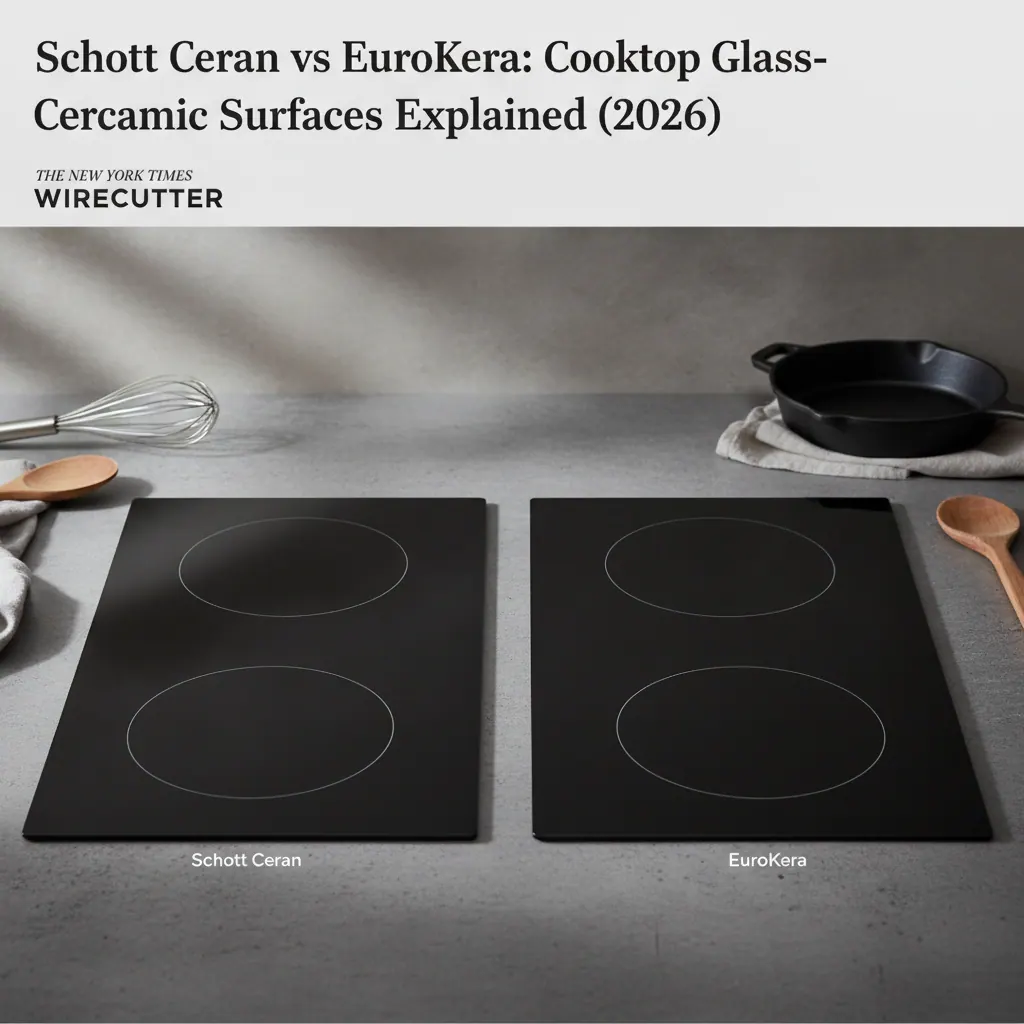
Schott Ceran vs EuroKera: Head to Head
| Factor | Schott Ceran | EuroKera |
|---|---|---|
| Maker | SCHOTT AG (Germany) | Corning + Saint-Gobain JV (France/USA) |
| Recognition | More marketed, better-known name | Less consumer-facing, equally widespread |
| Thermal-shock resistance | Excellent | Excellent |
| High-temperature tolerance | Excellent | Excellent |
| Durability vs impact | Strong (but can crack from drops) | Strong (but can crack from drops) |
| Effect on induction performance | None | None |
The honest takeaway: performance is essentially equivalent. If two cooktops are otherwise identical and one uses Schott Ceran while the other uses EuroKera, that single difference should not decide your purchase.
What Actually Matters More Than the Glass
For induction especially, the glass-ceramic is transparent to the magnetic field — it just protects the coils. So cooking performance is driven by what’s underneath: the coils, the inverter and the power electronics. When choosing a cooktop, prioritize:
- Boost wattage per zone (for fast boiling and searing).
- Simmer precision and pan-detection quality.
- Fan noise, build quality and brand reliability.
These are covered in our tested best induction cooktops of 2026 round-up and our best induction cooktop brands 2026 guide. If you’re specifically shopping radiant glass-top (non-induction) units, see our best ceramic cooktops 2026 guide.
Caring for a Glass-Ceramic Surface
Whichever brand of glass your cooktop uses, the care is the same. The number-one risk is impact — dropping a heavy pot or cast iron pan can crack the surface, even though it shrugs off heat. Lift heavy cookware rather than dropping or dragging it, wipe up sugary spills quickly (they can pit the surface if cooked on), and use a dedicated ceramic-cooktop cleaner. Our how to clean an induction cooktop guide covers safe products and technique, and our cast iron on induction guide explains how to use heavy pans without scratching the glass.
Bottom Line
Schott Ceran and EuroKera are both excellent glass-ceramic cooktop surfaces — one German (SCHOTT AG), one a French-American joint venture (Corning + Saint-Gobain). Schott Ceran is the better-known name, but EuroKera matches it on durability, thermal shock and heat tolerance, and neither affects induction performance. Don’t let the glass brand drive your decision; choose your cooktop on its coils, electronics, build quality and brand reliability instead. Start with our best induction cooktops of 2026 round-up.
Frequently Asked Questions
What is the difference between Schott Ceran and EuroKera?
Schott Ceran and EuroKera are two competing brands of glass-ceramic cooktop surface — the smooth black panel that the burners or induction coils sit beneath. Schott Ceran is made by the German company SCHOTT AG; EuroKera is made by EuroKera, a French joint venture between Corning and Saint-Gobain. Both are high-quality glass-ceramic with very similar performance; the main difference is the manufacturer, not a meaningful gap in durability or heat resistance.
Is Schott Ceran better than EuroKera?
Neither is clearly better — both are premium glass-ceramic surfaces that resist thermal shock, withstand high temperatures and last for years. Schott Ceran is the more recognized name and is often marketed as a premium feature, while EuroKera (including its Kerablack and KeraLite products) is equally capable and widely used by major appliance brands. The cooktop’s electronics, coils and build quality matter far more than which glass brand it uses.
Which cooktop brands use Schott Ceran?
Many premium and mid-range cooktop makers use Schott Ceran glass-ceramic, and brands frequently advertise it as a selling point. Because both Schott and EuroKera supply the industry broadly, the same appliance brand may use either surface depending on the model and production region. Always check the specific model’s documentation rather than assuming a brand uses one exclusively.
Can glass-ceramic cooktop surfaces crack?
Yes. Both Schott Ceran and EuroKera surfaces are highly resistant to heat and thermal shock, but they can crack from sharp impact — for example, dropping a heavy pot or cast iron pan onto the glass. Impact, not heat or normal cooking, is the most common cause of failure. Lifting heavy cookware instead of dropping or dragging it protects the surface.
Does the glass-ceramic brand affect induction performance?
No. The glass-ceramic surface is transparent to the magnetic field, so induction performance depends on the coils, inverter and power electronics underneath — not on whether the panel is Schott Ceran or EuroKera. Both surfaces transmit the magnetic field equally well. Choose a cooktop on its cooking performance and build, not on the glass brand.