A gas smell from your cooktop has a wide range of causes — from the completely normal (a 3-second whiff on ignition) to the genuinely dangerous (a supply line leak that requires evacuation). Knowing which you’re dealing with determines whether you should keep cooking, clean the burner, call a plumber, or leave the house.
After 22 years of professional cooking on gas and five years of cooktop testing, here is the complete diagnostic guide.
If your cooktop is clicking but not lighting — a related but distinct problem — see our gas cooktop clicking not lighting guide. For general gas cooktop performance, our gas cooktop BTU guide covers the full setup context.
First: how to assess the severity immediately
Before anything else, answer these three questions:
1. How strong is the smell?
- Faint, brief (under 10 seconds): likely normal ignition gas or a transient residual — continue reading.
- Noticeable but fades within 30 seconds of the burner lighting: likely a flow issue or dirty burner — correctable.
- Strong and persistent, or present when cooktop is off: potential leak — follow the emergency protocol below immediately.
2. When does it occur?
- Only during ignition: almost certainly normal or a burner flow issue.
- During cooking with the burner lit: a flame alignment or port problem.
- After cooking, burner off: gas valve not closing fully.
- With cooktop completely off: supply line or valve leak.
3. Is it natural gas or propane? Natural gas rises (lighter than air — ventilates relatively quickly); propane sinks and pools at floor level (heavier than air — more dangerous in an enclosed space). If you use propane and smell gas, treat it with more urgency than natural gas.
The emergency protocol: when to act fast
Evacuate and call immediately if:
- The smell is strong and not fading within 60 seconds
- The smell is present with the cooktop completely off
- You hear a hissing sound near the gas line or cooktop
- Anyone feels dizzy, nauseous or has a headache (early signs of gas exposure)
Emergency steps:
- Do not turn any electrical switches on or off — sparks can ignite a gas accumulation.
- Do not use your mobile phone inside the building.
- Do not light any flame.
- Leave the building immediately through the nearest exit. Leave doors open to ventilate.
- From outside: call your gas utility company’s 24/7 emergency line. In the US, this is printed on your gas bill. If you don’t have it, call 911.
- Do not re-enter until the utility company or fire department clears the building.
A gas leak is a potential explosion and asphyxiation hazard. These steps are not precautionary — they are the correct response.
The 7 causes of gas smell from a cooktop
1. Normal ignition flow (not a problem)
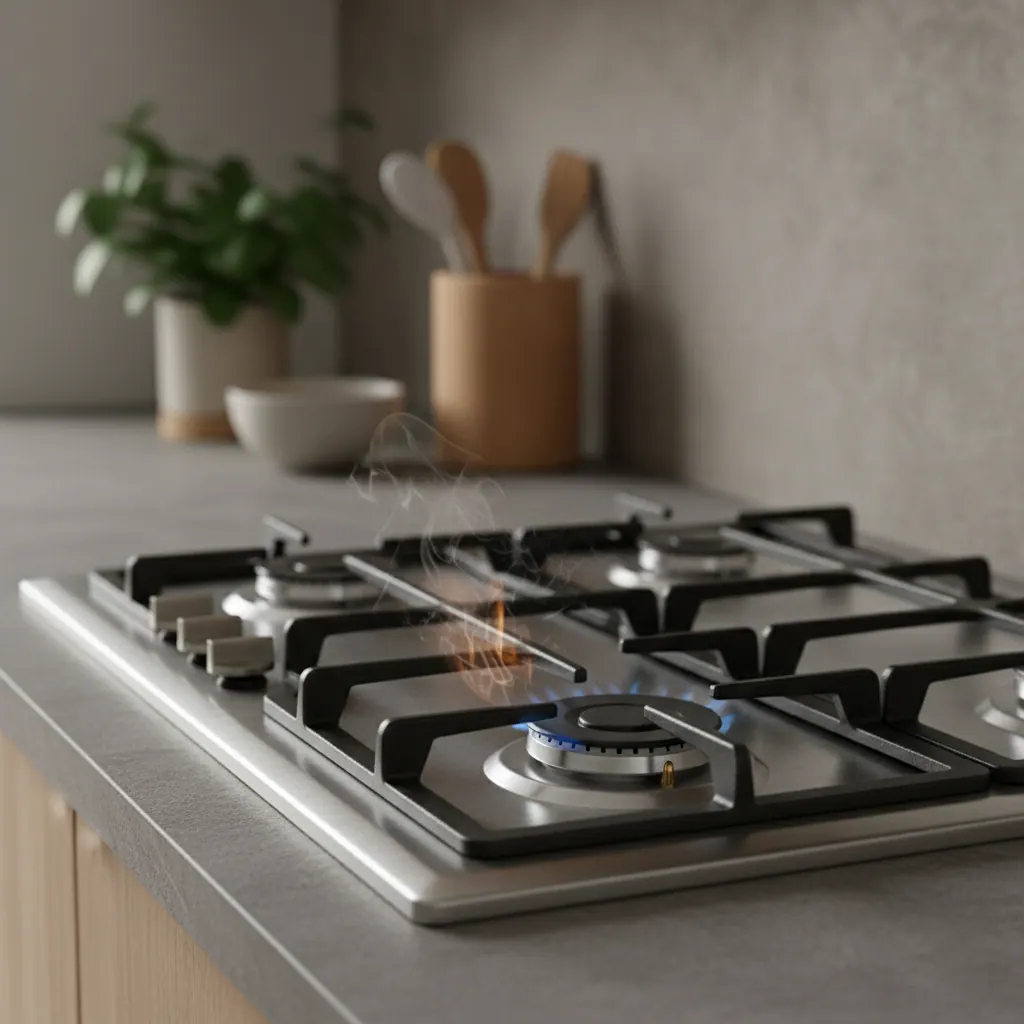
When you turn a gas burner knob to the ignite position, gas flows for a fraction of a second before the igniter sparks. That brief gas flow creates a faint smell that lasts 3–8 seconds, then disappears once the burner lights. This is normal on every gas cooktop ever made.
How to confirm this is the cause: the smell is very brief (under 10 seconds), appears only at the moment of turning the knob, and disappears entirely once the burner catches. No action needed.
2. Delayed or failed ignition
If you turn the knob and the burner doesn’t light immediately, gas continues flowing until you release the knob or the igniter sparks. A 5–15 second failed ignition attempt floods the burner area with gas, producing a noticeable smell. When the burner finally catches, there may be a small pop or brief larger flame as the accumulated gas ignites.
How to identify: smell is proportional to how long the ignition attempt took; burner either lights late or requires multiple attempts; no smell when burner is lit and burning steadily.
Fix: the igniter is likely wet, dirty, or partially clogged. See the full cleaning procedure in our gas cooktop clicking not lighting guide. The most common cause is boil-over liquid that has dried on the igniter tip. Clean with a stiff-bristled toothbrush and 90% isopropyl alcohol, then allow to dry completely (1–2 hours) before retesting.
3. Burner extinguished mid-cook
A sudden draft, a lid dropped onto the burner, or a boil-over can extinguish a lit gas burner. If you don’t notice immediately, gas continues flowing from the open valve into the kitchen. Modern cooktops with flame failure devices (FFDs) detect the extinguishment within 2–4 seconds and close the gas valve automatically. Older or budget cooktops without FFDs continue flowing until you manually turn the knob off.
How to identify: smell appears suddenly during cooking; burner is no longer lit; turning the knob off immediately stops the smell.
Fix: re-light immediately and check the knob is fully in the “on” position. If the burner keeps extinguishing, the issue is draft, vent positioning, or a clogged burner port (see cause 5).
Important: if you have an older cooktop without an FFD and the burner goes out unnoticed for several minutes, treat this as a level 2 event — ventilate immediately, don’t use electrical switches, wait 5 minutes before re-igniting.
4. Gas valve not fully closed after cooking
A gas valve that isn’t returned completely to the “off” position allows a small continuous gas flow. This is more common with knob-style controls that have a worn detent (the mechanical click that defines the off position).
How to identify: faint gas smell that appears after cooking and persists; smells coming from a specific burner area; disappears when that knob is pressed and turned firmly to off.
Fix: turn all knobs firmly to off. If one knob is noticeably looser or doesn’t click into the off position, the valve mechanism may be worn. This is a service call — a gas valve that doesn’t close reliably is a maintenance item that requires technician attention.
5. Clogged or dirty burner ports
Gas burner ports are small holes (0.5–2mm) drilled into the burner head. When food debris, grease or boil-over residue clogs these ports, gas pressure builds up behind the clog and exits through adjacent ports or around the burner rim rather than through the designed combustion points. This creates an irregular, larger-than-normal flame and a brief gas smell during the combustion phase.
How to identify: smell appears during cooking, not just at ignition; flame pattern is uneven (taller in some areas than others, or a section has no flame); burner ports show visible blockage.
Fix: turn off the burner and allow it to cool completely. Remove the burner cap and burner head. Use a straightened paper clip, a small wire brush or a burner cleaning tool to clear each port. Do not use a toothpick — wood fragments can lodge in ports. Rinse under warm water, dry completely, and reassemble. Never operate the cooktop with a wet burner.
6. Loose gas supply connection
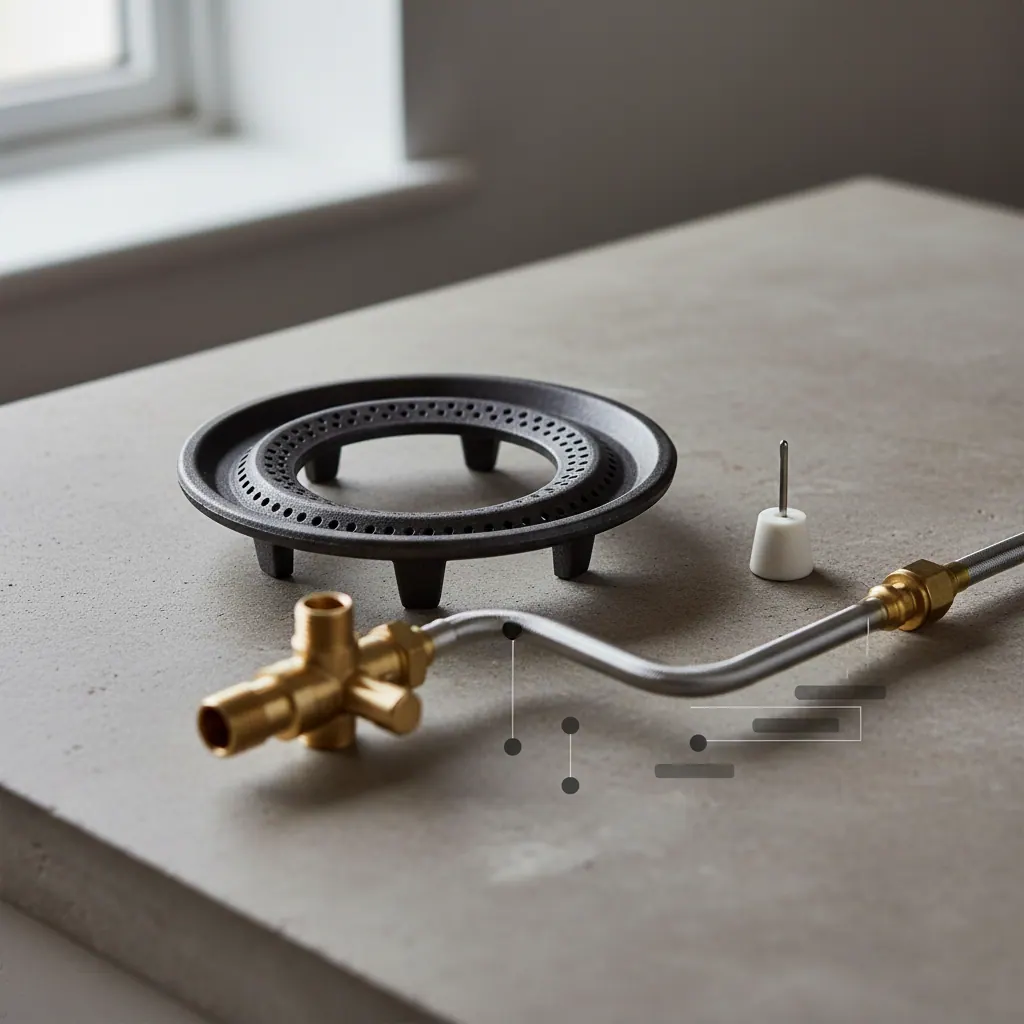
The flexible gas supply hose connecting the cooktop to the wall shutoff can develop a loose fitting over time — from vibration, from the cooktop being moved for cleaning, or from a fitting that was never fully tightened at installation. A loose fitting leaks gas continuously, even when the cooktop is off.
How to identify: gas smell present when cooktop is completely off; smell is coming from the rear or underside of the cooktop rather than the burner area; smell is consistent rather than appearing only at ignition.
Fix: this is a licensed plumber repair. Do not attempt to tighten gas fittings yourself without proper tools and training — an incorrect reconnection can make a loose fitting worse or create a new leak point. Turn off the gas at the wall shutoff (the lever handle behind or beside the cooktop; turn perpendicular to the pipe to close) and call a licensed plumber.
7. Failing gas valve or regulator
The gas valve inside the cooktop and the pressure regulator on the supply line are mechanical components that wear over time (typically 10–20 year service life on a well-maintained cooktop). A valve that doesn’t fully seal in the off position allows continuous micro-flow; a failing regulator can cause pressure fluctuations that produce irregular combustion and smell.
How to identify: persistent low-level gas smell that doesn’t correlate with cooking activity; no visible supply line issue; older cooktop (10+ years); smell is not resolved by cleaning burners or checking fittings.
Fix: service call. A failing gas valve requires replacement by a licensed appliance technician. On a cooktop over 15 years old, weigh the repair cost ($150–$350) against replacement. See our how to choose a cooktop guide for the full replacement decision framework.
Natural gas vs propane: different smell, different behavior
Both natural gas and propane are odourless in their natural state. Utility companies add mercaptan (a sulfur compound) as a safety odorant — the “rotten egg” or “sulfur” smell you detect. Propane suppliers add a similar compound with a slightly different chemical signature.
Key difference for safety:
- Natural gas (methane, CH₄): lighter than air — a leak disperses upward and toward ventilation openings. Still dangerous but ventilates relatively quickly.
- Propane (C₃H₈): heavier than air — a leak pools at floor level, concentrates in low areas (under cabinets, in floor voids, in basements). Remains dangerous much longer than natural gas in an unventilated space.
If you cook with propane and smell gas, treat it with higher urgency than natural gas — check at floor level and in lower cabinets, and ventilate from the bottom up (open low windows before high windows).
Gas smell during self-cleaning: a special case
Many dual-fuel and hybrid range cooktops have a self-cleaning oven below. During self-cleaning cycles, the oven reaches 900°F — high enough to vaporize any residual grease, food particles or cleaning product left in the oven cavity. This vapor can produce a smell that is sometimes confused with gas. It’s not gas — it’s carbonizing organic matter.
How to distinguish: self-cleaning smell is acrid, smoky or chemical rather than the distinctive sulfur/rotten-egg character of mercaptan. If you’re running a self-clean cycle and smell something: check that it smells like burning food, not sulfur. If it smells like sulfur, turn off the oven and follow the emergency protocol.
Preventing gas smells: the maintenance checklist
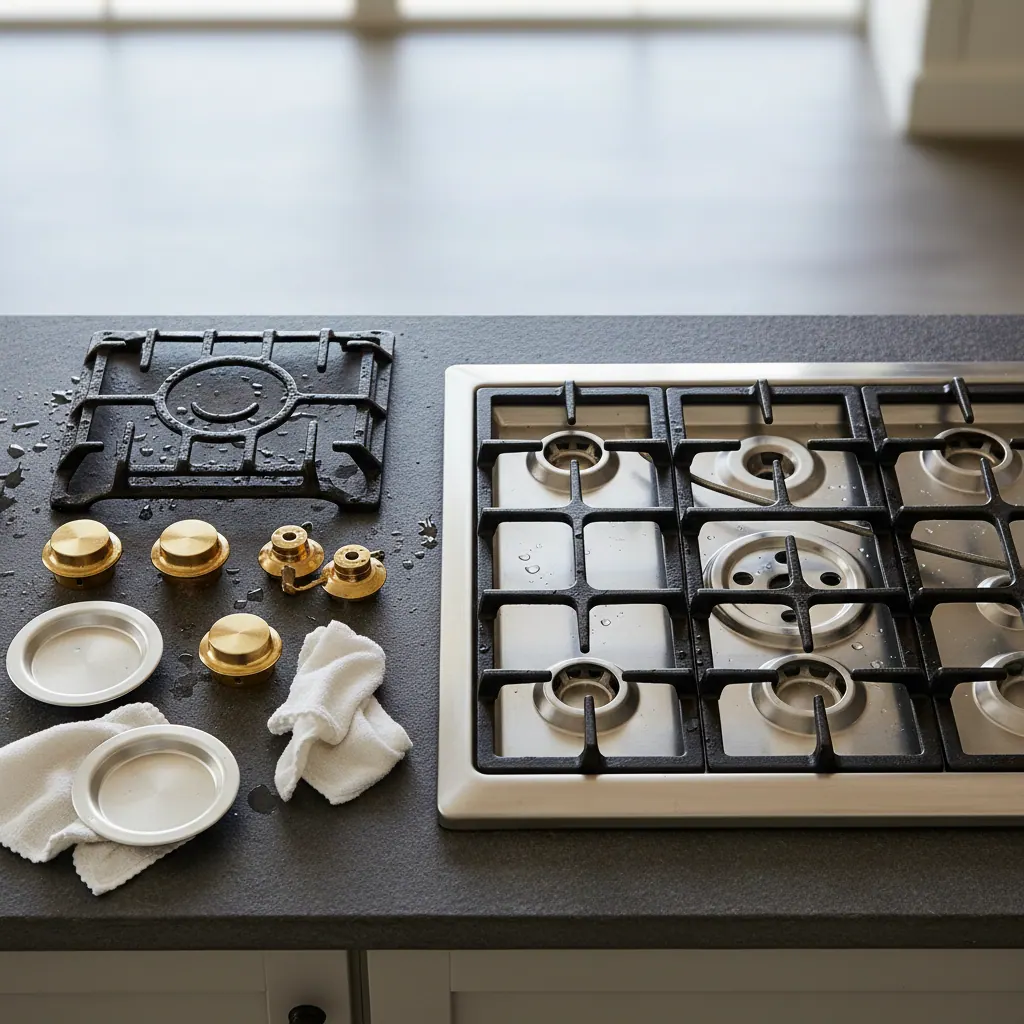
Preventing the correctable gas smell causes (causes 2–5) is a regular maintenance task:
Monthly:
- Wipe burner caps and burner heads with a damp cloth after each use to prevent food accumulation.
- Check that all knobs return firmly to the off position after each cooking session.
Every 3 months:
- Remove all burner caps and heads; clean ports with a paper clip or wire brush; rinse and dry before reassembly.
- Visually inspect the supply hose connection at the back of the cooktop for kinking, corrosion or loose fittings.
- Test the flame failure device: light a burner, then cup your hand over the flame to extinguish it (do not blow — that spreads gas). The burner should automatically shut off gas flow within 4 seconds. If it doesn’t, the FFD needs service.
Annually:
- Have a licensed plumber or gas technician check all fittings, connections and the regulator for integrity.
- Apply leak-check solution (soapy water) to all accessible gas fittings while the gas is on — bubbles indicate a slow leak.
For the specific burner port cleaning procedure, see our gas cooktop clicking not lighting guide which covers the same maintenance steps in step-by-step detail.
Bottom line
A gas smell from your cooktop is not automatically a crisis — but it does require an immediate, methodical diagnosis.
Brief smell at ignition, disappears in under 10 seconds: normal. No action. Smell during ignition attempts that persist: clean the burner ports and igniter. Smell during cooking: check for burner extinguishment; inspect flame pattern for port blockage. Smell after cooking: make sure all knobs are firmly off; check valve detent. Smell when cooktop is completely off: this is a leak. Turn off the gas at the wall shutoff, ventilate and call a plumber. Strong smell at any time: evacuate, don’t use electrical switches, call the gas utility from outside.
The difference between a dirty burner and a leaking supply line is significant. If any doubt remains after working through causes 1–5, treat it as a potential leak and call a professional. Gas appliances are maintained and serviced regularly for the same reason any pressure system is — a small problem found early is less expensive and less dangerous than a large one found late.
Frequently asked questions
Why does my gas cooktop smell like gas?
Seven causes: (1) normal ignition flow — brief, under 10 seconds; (2) delayed ignition; (3) extinguished burner; (4) valve not fully closed; (5) clogged burner ports; (6) loose supply connection; (7) failing valve or regulator. Causes 1–4 are user-correctable; 5–7 require cleaning or professional service.
Is a slight gas smell from a cooktop normal?
A brief smell during ignition (under 10 seconds) is normal. Anything persistent, strong, or present when the cooktop is off is not normal and requires diagnosis.
What should I do if my gas cooktop smells strongly of gas?
Don’t touch electrical switches. Don’t use your phone indoors. Leave immediately, leaving doors open. Call your gas utility’s emergency line from outside. Do not re-enter until cleared by a technician.
Why does my gas cooktop smell like gas when it’s turned off?
This is a leak — in the supply line, at a fitting, or at a valve that isn’t closing fully. Turn off the gas at the wall shutoff, ventilate the kitchen, and call a licensed plumber. Do not use the cooktop until the source is identified and repaired.
Can a dirty burner cause a gas smell?
Yes — clogged ports force gas through unintended paths. Clean burner ports with a straightened paper clip or small wire brush and allow to dry completely before relighting. See our gas cooktop clicking not lighting guide for the full cleaning procedure.
Safety information verified against AGA (American Gas Association) residential safety guidelines and NFPA 54 (National Fuel Gas Code). Updated May 2026. If in doubt, call a licensed technician — this guide is diagnostic, not a substitute for professional gas service.