Induction, gas, or electric — in 2026, choosing your cooktop is a genuine strategic decision, not just a matter of aesthetics or habit. With energy prices climbing steadily, increasing regulatory pressure around the energy transition, and a commercial landscape that keeps expanding, this choice directly impacts both your utility bills and your daily cooking experience. This induction vs gas vs electric comparison goes beyond theory: here you’ll find verifiable figures, efficiency measurements from credible sources, and a straight verdict for each type of user profile.
1. Energy Efficiency: What the Numbers Actually Mean
Induction wins hands-down on efficiency — and that’s not just marketing. Here’s why the data is unambiguous.
How is cooktop efficiency actually measured?
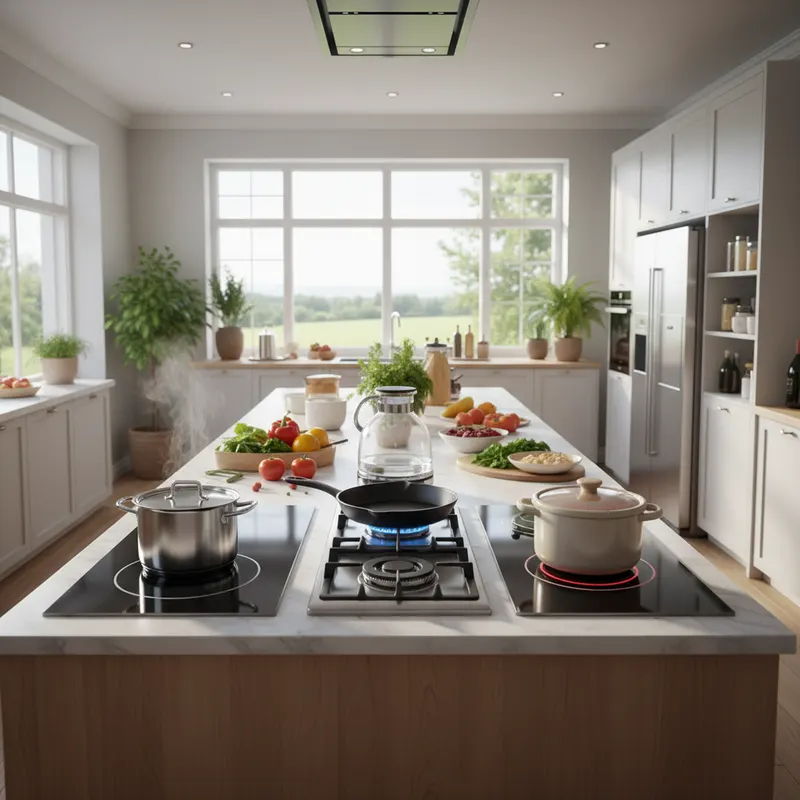
Efficiency is simply the ratio between the energy that ends up in your pot and the total energy you paid for — whether electricity or gas. To compare across technologies, the standard test is straightforward but highly revealing: start with 1 litre (about 1 quart) of water at 15°C (59°F), bring it to 100°C (212°F), and measure total energy consumed in kWh or kJ. Simple, repeatable, and hard to argue with.
| Cooktop type | Average efficiency | Useful energy / 1 L water | Average time (1 L) |
|---|---|---|---|
| Induction | 84–90% | ~0.10 kWh | 3 min 30 s |
| Electric ceramic/vitroceramic | 65–75% | ~0.13 kWh | 6 min 00 s |
| Natural gas | 40–55% | ~0.20 kWh | 8 min 15 s |
| Propane (bottled gas) | 35–50% | ~0.22 kWh | 9 min 00 s |
Sources: Lawrence Berkeley National Laboratory – Residential Appliance Study; European Commission – Energy Efficiency in Domestic Appliances, 2024
Why is gas so inefficient — and can you do anything about it?
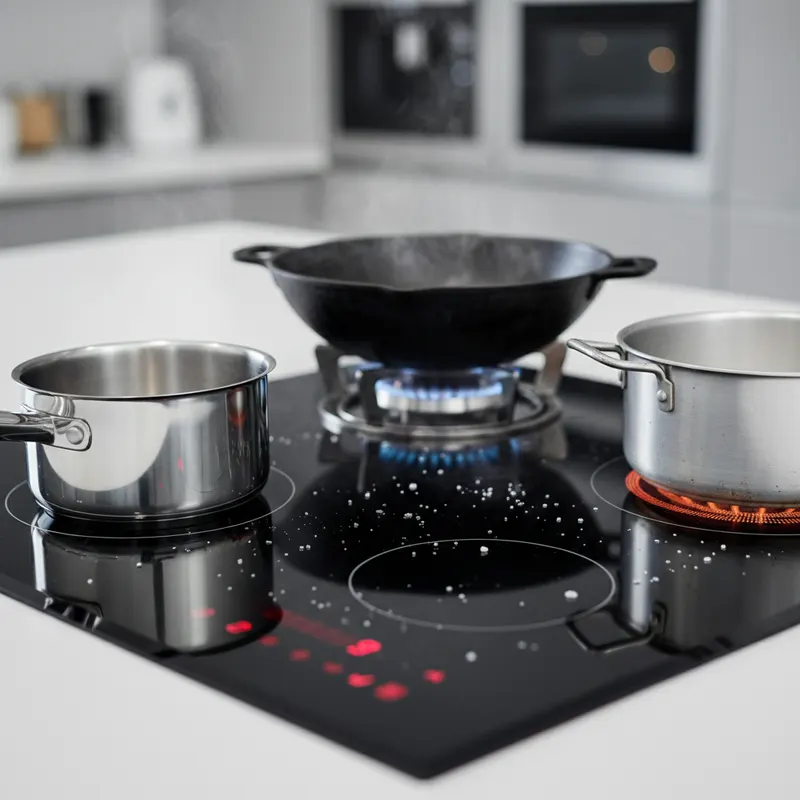
Not really. A gas burner’s flame doesn’t just heat your pot — it warms the surrounding air, radiates in all directions, heats the sides of the cookware, and sometimes the countertop too. In summer, this extra heat often forces your air conditioning to work harder — an irony every Mediterranean cook knows well. Between 45 and 60% of gas energy literally escapes into the atmosphere, and there’s nothing you can do about it: it’s a structural problem, not a calibration issue.
2. Real Running Costs: Realistic Annual Cost Simulation
On your annual utility bill, induction comes out ahead for the vast majority of households — even though natural gas retains a slight edge in some specific configurations. Here are the calculations, transparent and reproducible.
Reference prices used (2026 average, Western Europe/UK)
- Electricity : ~$0.16–$0.30 / kWh (US average ~$0.16; UK ~£0.25; EU average ~€0.26)
- Natural gas : ~$0.07–$0.12 / kWh equivalent (US ~$0.07; UK ~£0.07; EU ~€0.11)
- Propane (bottled) : ~$0.15–$0.20 / kWh thermal equivalent
What a year of cooking actually costs for a family of 4
For a family cooking every day — lunch and dinner, around 45 minutes of active heat per day — an estimated 300 kWh of useful energy is needed annually. Starting from there, we work back to gross consumption by accounting for each technology’s efficiency.
| Cooktop type | Gross energy needed | Estimated annual cost (EU avg.) | Difference vs induction |
|---|---|---|---|
| Induction (87% eff.) | 345 kWh electricity | ~€90 | — |
| Electric ceramic (70% eff.) | 429 kWh electricity | ~€112 | +€22/yr |
| Natural gas (48% eff.) | 625 kWh gas | ~€69 | −€21/yr |
| Bottled propane (43% eff.) | 698 kWh propane | ~€125 | +€35/yr |
Important note: Natural gas retains a small annual cost advantage as long as its tariff stays significantly below the electricity rate per kWh. However, with gas prices rising across Europe and North America (up 8–15% in 2025–2026 according to the IEA), this gap is narrowing fast — and in high-electricity-cost markets like California or Germany, induction is already clearly cheaper.
Over 10 years, including everything
Purchase price, installation, maintenance — these factors change the picture dramatically. An induction cooktop costs more upfront than a basic ceramic model, true — but a gas installation isn’t cheap either.
| Cooktop type | Average purchase price | Installation | Maintenance 10 yrs | Total 10 years |
|---|---|---|---|---|
| Entry-level induction | $300–$400 | $0–$80 | $50 | ~$1,050–$1,430 |
| High-end induction | $900–$1,200 | $0–$80 | $50 | ~$1,850–$2,230 |
| Electric ceramic | $200–$300 | $0 | $80 | ~$1,400–$1,500 |
| Natural gas | $350–$500 | $150–$400 | $200 | ~$1,390–$1,790 |
| Bottled propane | $350–$500 | $80–$200 | $200 | ~$1,880–$2,150 |
Annual running costs based on the 4-person household simulation above.
3. Cooking Performance: Which Is the Most Precise and Responsive?
For responsiveness and thermal precision, induction has no serious competition — and the measurements confirm it.
Responsiveness: no debate possible
A 3,500W induction zone reaches full power in under two seconds. In practice, it’s instantaneous. A standard ceramic hob takes 25 to 45 seconds to ramp up — which translates to overcooking and delayed adjustments. As for gas, even though the flame appears instant visually, remember that half the heat goes outside your pot before it even begins to warm the food.
Temperature precision: induction plays in a different league
The best induction cooktops on the market — Bosch FlexInduction, Siemens iQ700, Miele KM 7574 — offer up to 17 power levels with adjustments in 200W increments. Some models even feature an infrared sensor capable of maintaining oil at exactly 160°C (320°F) or caramel at 118°C (244°F). Try doing that with gas…
That said, gas retains real, undeniable advantages in specific situations:
- Traditional wok cooking (the flame wraps around the sides — a geometry induction replicates poorly)
- Direct flame work: charring peppers, flambéing
- Professional cooks trained on visual flame cues — changing reference points is not trivial
4. Air Quality and Environmental Impact: What the Science Actually Says
On this front, the scientific verdict is unambiguous: gas is the most thoroughly documented loser, and recent studies leave little room for doubt.
What your burners actually emit — even when off
A study published in Environmental Science & Technology in 2022 found NO₂ concentrations 2.4 times above WHO recommended thresholds in kitchens with gas cooktops — including when burners were off, due to micro-leaks of methane. The most vulnerable populations — children, asthmatics, the elderly — are logically the most exposed. This is an argument that, frankly, deserves to be taken seriously well beyond the economic debate.
Induction and electric cooktops emit strictly nothing inside the home. Emissions related to electricity generation are managed upstream, at the power plant level, with filtration and regulation systems.
Carbon footprint: a significant advantage for induction
In countries with a low-carbon electricity grid — nuclear and renewables — an induction cooktop emits between 35–80g CO₂eq per useful kWh. Natural gas runs around 250–310g CO₂eq per useful kWh. The gap is enormous, and it varies by country: in France (92% nuclear + renewables per RTE) or in Canada and Scandinavia, the advantage for induction is massive. In coal-heavy grids, the comparison is more nuanced — but as grids decarbonize globally, induction’s environmental edge only grows.
The regulatory landscape is shifting fast
The EU Energy Performance of Buildings Directive (EPBD, revised 2024) is pushing clearly toward electrification of thermal uses — cooking included. Several US states and cities (New York, California) have already introduced restrictions on gas in new construction. The UK’s Future Homes Standard points in the same direction. The trajectory is clear.
5. Installation, Practical Constraints and Safety: The Details That Make All the Difference
Induction is probably the easiest to install — but it’s not without requirements. A complete overview of the real constraints for each option.
What you need to plan before buying
| Criterion | Induction | Electric | Gas |
|---|---|---|---|
| Connection required | 32A circuit (240V / 3-phase for 4 zones) | 20A circuit (standard 240V) | Gas line + regulator |
| Average installation cost | $0–$80 | $0 | $150–$400 |
| Certified installer required | No | No | Yes |
| Time to set up | Immediate | Immediate | 1–3 days |
| Compatible with all-electric home | ✅ Yes | ✅ Yes | ❌ No |
Induction’s active safety features: a real advantage, not marketing
Modern induction cooktops include safety features that neither gas nor traditional electric can match:
- Automatic pan detection: no compatible pan on the zone = no heat activation
- Overflow detection: spilled liquid on the surface triggers automatic shutoff
- Child lock: hold a button to lock all controls
- Automatic timer: programmable shutoff from 15 minutes to 4 hours depending on model
Gas, on the other hand, carries two non-trivial risks: explosion from a leak (rare, but real) and carbon monoxide poisoning from incomplete combustion. These scenarios are statistically uncommon, but they require installation of a compliant gas/CO detector — an added cost and constraint.

6. Which Cooktop Is Right for Your Situation?
There’s no universal answer here — and be wary of anyone who offers one without knowing your situation. But some fairly clear profiles emerge.
Induction is right for you if…
- You live in an all-electric home or a modern construction
- You cook every day and want to reduce your energy bill long-term
- You have young children — or simply burn yourself easily (the surface stays cool!)
- You hate scrubbing encrusted grates and burners
- Indoor air quality matters to you
Natural gas still makes sense if…
- You already have a gas line and the cost of switching to electric is prohibitive
- You regularly cook with a wok or need direct flame for certain techniques
- You cook in a country where the electricity grid is still very carbon-heavy
- You run a semi-professional home kitchen with deeply ingrained flame-based habits
Electric ceramic makes sense if…
- Your purchase budget is tight (from around $150–$200)
- You cook occasionally — one or two meals a week, no more
- Your electrical installation doesn’t support the 32A circuit required for induction (older unrenovated home)
Our verdict at a glance
| Criterion | Induction | Gas | Electric |
|---|---|---|---|
| Energy efficiency | ⭐⭐⭐⭐⭐ | ⭐⭐ | ⭐⭐⭐ |
| Annual running cost | ⭐⭐⭐⭐ | ⭐⭐⭐⭐⭐ | ⭐⭐⭐ |
| Total 10-year cost | ⭐⭐⭐⭐ | ⭐⭐⭐ | ⭐⭐⭐⭐ |
| Cooking precision | ⭐⭐⭐⭐⭐ | ⭐⭐⭐⭐ | ⭐⭐⭐ |
| Safety | ⭐⭐⭐⭐⭐ | ⭐⭐⭐ | ⭐⭐⭐⭐ |
| Environmental impact | ⭐⭐⭐⭐⭐ | ⭐⭐ | ⭐⭐⭐ |
| Ease of installation | ⭐⭐⭐⭐ | ⭐⭐ | ⭐⭐⭐⭐⭐ |
| Culinary versatility | ⭐⭐⭐⭐ | ⭐⭐⭐⭐⭐ | ⭐⭐⭐ |
Conclusion: Why Induction Is the Smart Choice in 2026
At the end of this induction vs gas vs electric comparison, the result is clear for the majority of households: induction wins. An efficiency of 84–90%, zero indoor pollutant emissions, active safety features its competitors can’t match, and a total 10-year cost that is fully competitive — it’s hard to find a decisive argument against it in the context of a new build or kitchen renovation.
Natural gas? It retains a slight direct cost advantage in 2026 in some markets — perhaps $15–$20 per year for a family of four — but its price trajectory is upward, its installation is constraining, and its effects on indoor air quality are documented and concerning. For a new installation, the rational calculation rarely favors it.
Electric ceramic remains a valid option for tight budgets and light use — but it has no real edge against either of the other two technologies on the criteria that actually matter.
Still unsure which specific model to choose? Check our detailed comparisons by range and budget: see our cooktop buying guides → or get in touch with our team for personalized advice →.
Frequently asked questions
Which cooktop type uses the least energy?
Induction is the most efficient, with a heat-transfer efficiency of 84–90%, compared to 65–75% for electric resistance/ceramic and only 40–55% for gas burners.
Is induction actually cheaper to run than gas?
In most Western countries in 2026, thanks to its superior efficiency, induction delivers more heat per dollar spent than gas — even as gas prices remain nominally lower per kWh of raw energy.
Can I use any pan on an induction cooktop?
No. Induction requires ferromagnetic cookware (cast iron, 18/10 magnetic stainless steel). Look for the coil symbol on the base of your pots and pans.
Is gas cooking dangerous for indoor air quality?
Yes. A study published in Environmental Science & Technology (2022) found that gas burners emit NO₂ and methane even when turned off, significantly degrading indoor air quality.
Which cooktop is best for serious home cooking?
High-end induction (Bosch, Miele, Siemens) delivers the power and precision needed for serious cooking. Gas remains preferred for wok cooking or direct flame techniques.